
Consumer Goods Sector Risk and Recall Exposure: Lessons from the 2025 Shredded Cheese Recall Crisis


 Aime Summary
Operational Risk: Supply Chain Vulnerabilities and Quality Control
The recall, initiated by Great Lakes Cheese Co. and Ambriola Company, exposed weaknesses in supplier vetting and quality assurance protocols. Over 260,000 cases of shredded cheese-sold under private-label brands like Good & Gather (Target), Great Value (Walmart), and Happy Farms by Aldi-were pulled from shelves due to contamination risks. This underscores the sector's reliance on third-party suppliers, where lapses in raw material testing can cascade into large-scale product failures. For instance, the Listeria-tainted Pecorino Romano recall by Ambriola Company was classified as Class I (posing life-threatening risks), further emphasizing the spectrum of hazards in food production. 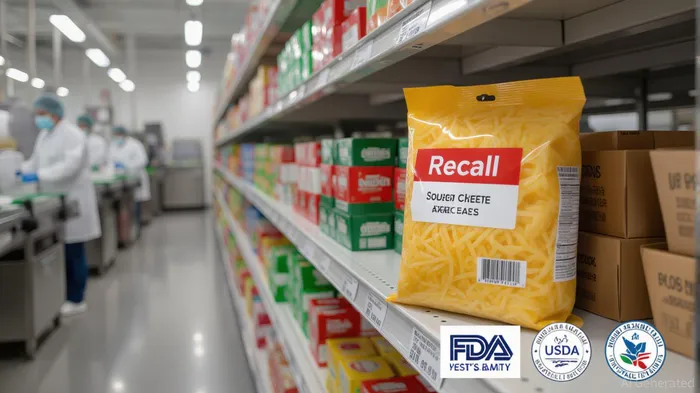
Investors must scrutinize companies' supplier audits and traceability systems. The 2025 crisis revealed that even major retailers with robust logistics networks are not immune to contamination risks originating from upstream suppliers. For example, the shredded cheese recall affected 31 U.S. states and Puerto Rico, necessitating costly product withdrawals and refund programs. Such disruptions strain operational margins, particularly for retailers with high private-label penetration, where brand reputation is directly tied to in-house quality standards.
Financial and Reputational Impacts: Quantifying the Hidden Costs
While specific financial losses for Walmart, Target, and Aldi remain undisclosed, the recall's magnitude suggests significant costs. For context, the 2025 incident dwarfs previous recalls, such as the 2023 salmonella-tainted cantaloupe recall, which cost affected producers an estimated $100 million in losses. The shredded cheese recall's scale-spanning multiple product lines and private-label brands-likely incurred expenses related to product retrieval, customer refunds, legal liabilities, and accelerated inventory turnover.
Reputational damage, though harder to quantify, poses long-term risks. A 2024 study by the Food Marketing Institute found that 62% of consumers reduce purchases from brands linked to food safety scandals according to the study. For retailers like Target, which reported a 1.5% decline in Q3 2025 net sales amid softer traffic, such incidents could exacerbate existing challenges. Aldi, meanwhile, faced scrutiny over its Happy Farms brand, with the recall prompting consumer warnings about metal contamination.
Investor Reactions: Earnings Volatility and Market Sentiment
Despite the recall's severity, Q4 2025 earnings reports for Walmart and Target revealed mixed signals. Walmart's Q4 FY25 performance was robust, with 5.2% constant currency revenue growth and a raised full-year sales guidance according to the report. However, premarket trading in Q2 2025 saw a 2.42% stock price dip following a minor EPS miss, illustrating how food safety concerns can amplify investor skepticism. Target, conversely, faced a sales decline and lowered earnings guidance, though analysts attributed this to broader retail trends rather than the recall according to market analysis.
The absence of direct stock price drops post-announcement does not negate long-term risks. Historical data shows that food recalls often trigger delayed market reactions. For example, the 2018 E. coli romaine lettuce crisis led to a 12% decline in Dole's stock price over six weeks according to market data. Investors should monitor quarterly earnings for indirect impacts, such as increased provisions for recalls or reduced consumer confidence metrics.
Long-Term Implications: Strengthening Supply Chain Resilience
The 2025 crisis highlights the need for enhanced supply chain oversight. Companies must invest in real-time monitoring technologies, such as blockchain-based traceability systems, to swiftly identify and isolate contaminated batches. For instance, Walmart's partnership with IBM's Food Trust platform has already reduced traceability times from days to seconds, offering a blueprint for sector-wide adoption.
Additionally, diversifying supplier bases and implementing stricter raw material testing protocols can mitigate future risks. The recall of Ambriola's Pecorino Romano cheese-linked to Listeria-demonstrates the importance of microbial testing for high-risk ingredients according to industry analysis. Retailers with vertically integrated supply chains, such as Costco's private-label Kirkland Signature, may gain a competitive edge by controlling quality at every production stage.
Conclusion: Balancing Risk and Resilience in the Consumer Goods Sector
The 2025 shredded cheese recall serves as a stark reminder of the operational and reputational risks facing the consumer goods sector. While immediate financial impacts remain opaque, the incident underscores the necessity of proactive risk management. For investors, the key differentiator will be companies that prioritize supply chain transparency, rapid recall response mechanisms, and brand trust-building initiatives. As the sector navigates an era of heightened regulatory scrutiny and consumer awareness, resilience-not just scale-will define long-term valuation success.

Delivering real-time insights and analysis on emerging financial trends and market movements.
Latest Articles
Stay ahead of the market.
Get curated U.S. market news, insights and key dates delivered to your inbox.
AInvest
PRO
AInvest
PRO



Comments
No comments yet