
Consumer Brand Loyalty and Seasonal Marketing Impact: How Limited-Time Campaigns Shape Fast-Casual Chains' Brand Equity and Investor Behavior


 Aime Summary
In an era where fast-casual dining faces mounting economic pressures-from inflation-driven price sensitivity to shifting consumer preferences-seasonal marketing campaigns have emerged as critical tools for sustaining brand relevance and equity. For chains like Chick-fil-A,
which has maintained the highest customer satisfaction scores in the quick-service restaurant (QSR) sector for 11 consecutive years, limited-time offers (LTOs) such as the 2025 Grinch Meal represent more than just holiday-themed gimmicks. They are strategic investments in brand identity, customer engagement, and long-term investor confidence.
Chick-fil-A's Brand Equity and the Grinch Meal Strategy
Chick-fil-A's dominance in the QSR space is underpinned by its
83 ACSI score in 2025, outpacing competitors like McDonald'sMCD-- (70) and KFC (77). This loyalty is further reinforced by its
98% drive-thru satisfaction rating, driven by factors like food quality and staff friendliness. The Grinch Meal, a seasonal offering featuring themed items like pickle salt fries and green socks, taps into the brand's ability to blend novelty with its core strengths.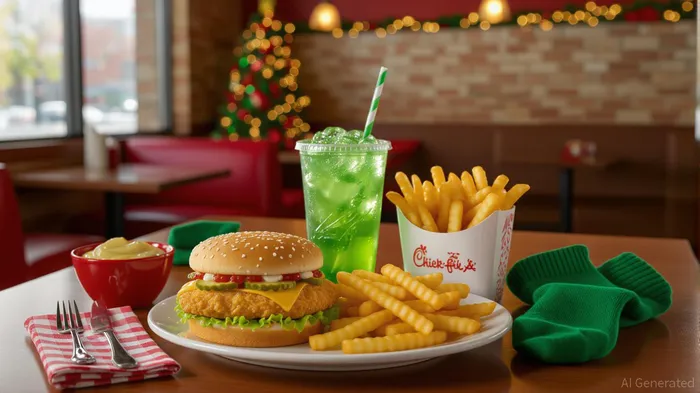 While some consumers criticized the meal as "not real food,"
others praised its creativity and quality. Such mixed reactions are not uncommon in a market where
rising food costs have heightened price sensitivity, yet the campaign's novelty aligns with Chick-fil-A's broader strategy to differentiate itself in a crowded chicken sandwich category.
According to industry analysis, such strategies are increasingly important in a competitive market.
The Grinch Meal also reflects a broader industry trend: leveraging pop-culture tie-ins to drive holiday engagement. For example,
McDonald's Grinch Meal-a similar campaign-was projected to boost short-term traffic and reinforce brand relevance. While
direct stock performance data for Chick-fil-A is unavailable, it remains a private company. The success of such campaigns by public peers like McDonald's offers indirect insights.
McDonald's stock, for instance, rose 3.1% in the month following its Grinch Meal launch in late 2025, with analysts attributing this to the campaign's role in maintaining brand visibility during a key retail period.
Media Sentiment and Consumer Behavior
Media sentiment around the Grinch Meal underscores the dual-edged nature of seasonal marketing.
Positive feedback highlighted the meal's "unique pickle salt seasoning", while critics questioned its value proposition in an inflationary climate. This duality mirrors broader industry challenges: balancing innovation with affordability.
Chick-fil-A's 3.2% traffic growth in September 2025-contrasting with Wendy's 10.2% decline-suggests that its loyal customer base remains resilient to economic headwinds. However, the brand's
5.4% sales growth in 2024, the slowest in over two decades, indicates that even high-performing chains must adapt to shifting consumer habits.
Investor Implications and Expert Insights
For publicly traded peers, the link between seasonal campaigns and stock performance is clearer.
McDonald's Grinch Meal, for example, contributed to a 7.8% total shareholder return for the year ending November 2025, with analysts projecting $30.6 billion in revenue by 2028. While Chick-fil-A's private ownership structure obscures direct financial metrics,
its strategic moves-such as international expansion into the U.K. and Singapore signal a focus on long-term growth. Industry experts emphasize that brand strength, defined by innovation and operational efficiency, is critical for investor confidence.
Chick-fil-A's investments in digital tools and store formats (e.g., drive-thru-only locations with automated systems) further underscore this focus.
Conclusion: Balancing Short-Term Gimmicks and Long-Term Equity
Seasonal campaigns like the Grinch Meal are not just about holiday sales-they are about reinforcing brand identity in a competitive landscape. For Chick-fil-A, the Grinch Meal's success lies in its ability to blend nostalgia with quality, maintaining its reputation as a premium yet accessible brand. While media sentiment remains mixed, the broader industry trend of using LTOs to drive engagement suggests that such campaigns will continue to play a pivotal role in shaping brand equity. For investors, the key takeaway is clear: brands that innovate without compromising core values-like Chick-fil-A's commitment to service and quality-are better positioned to navigate macroeconomic challenges and sustain long-term growth.

Stay ahead of the market.
Get curated U.S. market news, insights and key dates delivered to your inbox.
AInvest
PRO
AInvest
PRO



Comments
No comments yet