
Construction Sector Gains Momentum as Consumer Staples Face Headwinds: A Sector Rotation Play for 2026
 Aime Summary
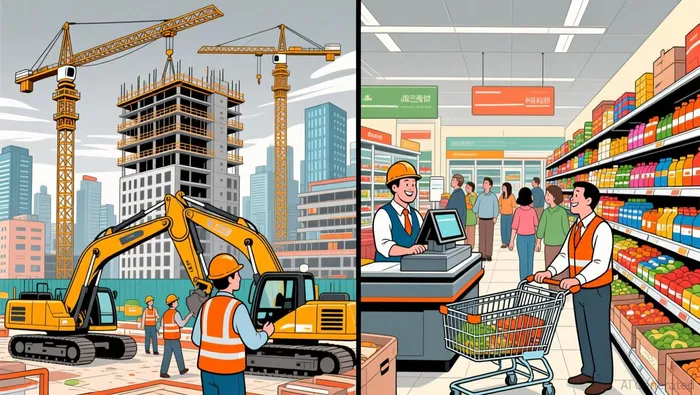
The U.S. housing market has long been a barometer of economic health, and the latest data—existing home sales rising 0.5% in December 2025—offers a nuanced signal for investors. While this modest gain defies broader market weakness, it underscores a critical shift in sector dynamics: the construction industry is gaining traction as a rotation destination, even as consumer staples face mounting challenges.
The Construction Sector: Policy-Driven Resilience and Innovation
The construction sector's recent performance reflects a confluence of policy tailwinds and technological adaptation. The One Big Beautiful Bill Act (OBBBA), enacted in July 2025, has been a game-changer. By retroactively allowing Research & Experimental (R&E) expense deductions for 2022–2024 and boosting the Advanced Manufacturing Investment Credit to 35%, the law has incentivized innovation in modular construction, AI-driven project management, and sustainable materials. These incentives are already spurring a surge in manufacturing-related construction projects, with U.S. data center spending hitting a seasonally adjusted annual rate of $40 billion in June 2025—a 30% year-over-year increase.
Moreover, executive orders streamlining AI/data center permitting and mandating classical architecture for federal buildings have created niche opportunities. Firms specializing in traditional craftsmanship or modular systems are seeing renewed demand, while automation adoption is mitigating labor shortages. Despite 88% of firms reporting open craft worker positions, digital recruitment tools and wage hikes are beginning to stabilize the workforce.
Consumer Staples: Resilience Amid Erosion
The consumer staples sector, long a defensive haven, has shown surprising resilience in 2025. Discount retailers like Walmart and Costco have thrived, with Costco reporting a 5.7% same-store sales (SSS) increase in Q3 2025 and Walmart up 3.8%. United Natural Foods, a key player in the sector, saw a staggering 156.3% earnings growth in Q3, driven by demand for organic and value-driven products.
However, cracks are emerging. The Household Durables subsector is projected to contract by 20% in Q3 2025, and rising tariffs and labor costs are squeezing margins. While the sector benefits from essential demand, its reliance on fixed-income investors and dividend yields makes it vulnerable to persistently high interest rates. The Federal Reserve's rate cuts in late 2025 may provide temporary relief, but the sector's long-term appeal is waning as investors pivot toward growth-driven industries.
Sector Rotation: Why Construction Outpaces Consumer Staples
The case for rotating into construction hinges on three pillars: policy tailwinds, technological adoption, and cyclical momentum.
- Policy Tailwinds: The OBBBA and executive orders are creating a virtuous cycle of investment. For example, the 35% Advanced Manufacturing Investment Credit is expected to drive a 20% surge in manufacturing construction starts in 2026, outpacing residential construction's projected 5% contraction.
- Technological Adoption: AI and modular construction are reducing labor bottlenecks. Firms like DPR Construction, which partnered with USG to develop Ready-Spray™ joint compound, are achieving 30% faster drywall finishing, illustrating how innovation can offset workforce challenges.
- Cyclical Momentum: With interest rate cuts spurring loan originations and data center demand surging, construction spending is poised to grow by 8–10% in 2026. In contrast, consumer staples face a “squeezed middle” as inflation erodes margins and tariffs disrupt supply chains.
Investment Implications
For investors, the construction sector offers a compelling rotation opportunity. While the sector is not without risks—labor shortages and material cost volatility persist—its structural advantages are hard to ignore. Firms with exposure to data centers (e.g., DXC Technology), modular construction (e.g., Katerra), or AI-driven project management (e.g., Procore Technologies) are well-positioned to capitalize on the OBBBA's incentives.
Conversely, consumer staples remain a defensive play but are increasingly at odds with the growth-oriented market. While companies like Walmart (WMT) and Costco (COST) will continue to outperform within the sector, their long-term growth potential is capped by demographic and macroeconomic headwinds.
Conclusion
The 0.5% rise in existing home sales in December 2025 is a microcosm of a broader trend: construction is emerging as a sector of innovation and policy-driven growth, while consumer staples face a crossroads. For investors seeking to align with the next phase of the economic cycle, construction offers a compelling case. However, careful stock selection and a focus on firms leveraging technology and policy incentives will be key to navigating the sector's challenges and reaping its rewards.

Stay ahead of the market.
Get curated U.S. market news, insights and key dates delivered to your inbox.
AInvest
PRO
AInvest
PRO



Comments
No comments yet