
Construction and Healthcare: The New Engines of U.S. Non-Manufacturing Growth—And Why Investors Should Rotate Now
 Aime Summary
The U.S. non-manufacturing labor market in Q4 2025 has delivered a jarring wake-up call for investors. While the broader economy stumbles under the weight of high tariffs, immigration headwinds, and a Fed still grappling with inflation, two sectors—construction and healthcare—are defying the odds. These industries are not just surviving; they're thriving, driven by demographic tailwinds, infrastructure demand, and a labor market that's both strained and surging. For investors, this divergence is a golden opportunity to rotate into sectors poised to outperform in 2026.
The Employment Data: A Tale of Two Sectors
The numbers tell a stark story. Nonfarm payrolls in construction added 28,000 jobs in November 2025, a modest figure but one that masks the sector's underlying strength. Labor shortages remain acute: 88% of construction firms report open craft worker positions, and 78% cite project delays due to workforce gaps. Yet, these challenges are fueling innovation. Firms are raising wages, investing in training, and adopting AI-driven recruitment tools. The result? A sector that's adapting to its pain points while maintaining a pipeline of demand from renewable energy projects, EV charging networks, and AI data centers.
Meanwhile, healthcare is a different beast altogether. Year-to-date through September 2025, the sector added over 450,000 jobs, with October's 52,300 gain marking the highest monthly increase since February 2025. Ambulatory care, hospitals, and nursing facilities are all hiring aggressively, driven by an aging population and a surge in mental health demand. The Healthcare Innovation Act's $20 billion rural broadband investment is set to create 25,000 telehealth roles by mid-2026, further turbocharging growth.
Why This Matters for Sector Rotation
The key takeaway? Construction and healthcare are not just resilient—they're structural growth stories. The broader non-manufacturing sector, by contrast, is faltering. Federal government employment has contracted by 271,000 jobs since January 2025, and transportation and warehousing lost 18,000 jobs in November. These sectors are shrinking, not just slowing.
For investors, the message is clear: rotate into the winners and away from the losers. Construction and healthcare are attracting capital due to their ability to absorb labor shortages through innovation and automation. For example, DPR Construction's partnership with manufacturers on AI-driven tools like USG's Ready-Spray™ compound is reducing labor intensity. In healthcare, AI is streamlining administrative tasks, displacing clerical roles but creating demand for data scientists and cybersecurity experts.
Investment Strategies: ETFs, Stocks, and the Road Ahead
The most direct way to capitalize on this rotation is through sector ETFs. The XLV (Health Care Select Sector SPDR Fund) and XHB (Construction & Engineering Select Sector SPDR Fund) are prime candidates. XLV has outperformed the S&P 500 by 4.2% year-to-date, while XHB's exposure to infrastructure and materials firms positions it to benefit from the green energy transition.
For individual stocks, focus on companies with clear tailwinds:
- UnitedHealth Group (UNH): The largest U.S. health insurer is leveraging AI to cut costs and expand telehealth, with a 3.8% year-over-year wage growth in its workforce.
- Caterpillar (CAT): A construction bellwether, CATCAT-- is seeing strong demand for machinery in infrastructure projects, with its stock up 12% in Q4 2025.
- Amgen (AMGN): Biotech's resilience in healthcare is underscored by its pipeline of high-margin therapies, which align with the sector's long-term growth.
Risks and the Path Forward
No strategy is without risk. Construction faces potential supply chain disruptions for materials, while healthcare must navigate Medicare reimbursement cuts and rising input costs. The Fed's 25-basis-point rate cut in December 2025 offers some relief, but investors should remain cautious about overexposure to rate-sensitive sectors.
However, the long-term fundamentals are compelling. The BLS projects healthcare to add 1.2 million jobs in 2026 alone, while construction's infrastructure-driven demand is expected to persist through 2030. For investors, the key is to balance these high-conviction plays with diversification—say, 15–20% of a portfolio in healthcare and construction ETFs, with the rest hedged in defensive sectors like utilities or consumer staples.
Conclusion: Rotate Now, Reap the Rewards Later
The U.S. non-manufacturing labor market is a mosaic of winners and losers. Construction and healthcare are the standout performers, driven by demographic inevitability and technological adaptation. As the Fed inches toward normalization and immigration trends stabilize, these sectors will likely outpace the broader economy.
For investors, the time to act is now. Load up on ETFs like XLV and XHB, and consider individual stocks with strong growth narratives. The market may be volatile, but the data is clear: construction and healthcare are the new engines of U.S. economic growth—and they're not slowing down.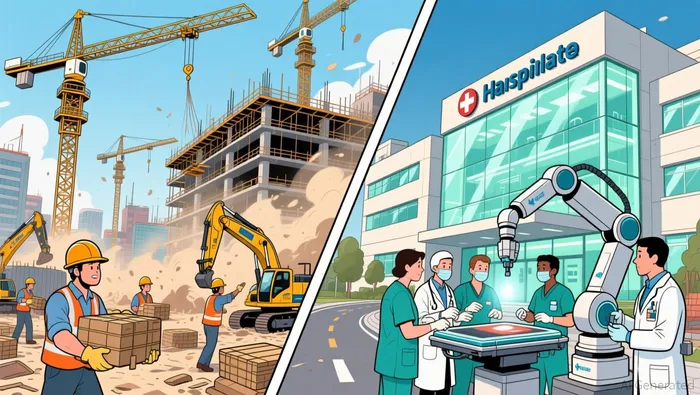

Stay ahead of the market.
Get curated U.S. market news, insights and key dates delivered to your inbox.
AInvest
PRO
AInvest
PRO



Comments
No comments yet