
Constellation Brands Q3 2025: Navigating Challenges in the Premium Alcohol Sector


 Aime Summary
Constellation Brands Q3 2025: Navigating Challenges in the Premium Alcohol Sector
Constellation Brands' third-quarter fiscal 2025 results underscore both the resilience and vulnerabilities of a company deeply entrenched in the premium alcohol sector. With net sales of $2.46 billion and earnings per share (EPS) of $3.39-a 23% year-over-year increase-the firm demonstrated its ability to capitalize on its dominant beer portfolio while grappling with headwinds in its Wine and Spirits division, according to Wine Intelligence. This duality reflects broader industry dynamics, where selective premiumisation and shifting consumer priorities are reshaping competitive landscapes.
Beer Segment: A Pillar of Growth
The beer division remains a cornerstone of Constellation's success, posting a 3.2% increase in depletions and outpacing both the beverage alcohol industry and the broader consumer packaged goods (CPG) sector, according to MarketBeat. Brands like Modelo Especial and Corona Extra continue to anchor the U.S. beer market, with Modelo Especial maintaining a leadership position despite macroeconomic pressures, as noted in a SWOT analysis. The company's strategic focus on expanding distribution-securing over half of its target for 500,000 incremental points-has amplified reach, while new packaging and liquid innovations contributed to depletion growth within the 20%–40% range (MarketBeat).
However, this segment is not without risks. A report by Drinks Times notes that Constellation's high-end beer sales have softened, particularly among its core Hispanic consumer base, as reduced trip frequency and spend per trip erode volume (MarketBeat). This aligns with broader trends of consumers prioritizing value amid inflationary pressures, a challenge that could test the company's pricing power in the long term.
Wine and Spirits: A Strategic Reassessment
In contrast, the Wine and Spirits segment faced a 16% decline in shipments, with net sales and operating income dropping by 14% and 25%, respectively (MarketBeat). While the company expects these declines to moderate to 5%–8% for net sales and 17%–19% for operating income, the segment remains a drag on overall performance. The struggles are attributed to weaker U.S. wholesale demand and a saturated market for mid-tier wines, prompting Constellation to pivot toward optimizing its portfolio.
Data from Wine Intelligence highlights that the spirits portfolio, including Mi CAMPO tequila, showed 9% depletion growth, signaling potential in premium subcategories (Wine Intelligence). The company's response includes divesting underperforming assets and reallocating marketing spend to top-tier brands. This strategy mirrors industry-wide shifts toward consolidation and premiumisation, as competitors like Diageo and Pernod Ricard double down on high-margin categories (SWOT analysis).
Capital Allocation and ESG: Balancing Shareholder Returns with Sustainability
Constellation's Q3 results also revealed a disciplined approach to capital allocation. The firm returned $220 million to shareholders via share repurchases and $180 million in dividends, maintaining a net leverage ratio of 2.9x (MarketBeat). With free cash flow projected between $1.6 billion and $1.8 billion, the company is well-positioned to sustain these returns while investing in brewery capacity and ESG initiatives, according to the Constellation Brands press release.
Environmental, social, and governance (ESG) efforts remain central to its long-term strategy. Constellation's commitment to reducing carbon emissions and promoting responsible consumption aligns with investor demands for sustainable practices. As noted in the press release, the company is integrating ESG into operational decision-making, a move that could enhance brand loyalty and regulatory compliance in markets prioritizing sustainability.
Industry Trends and Strategic Positioning
The premium alcohol sector is undergoing a transformation driven by three key trends:
1. Premiumisation with a Twist: Consumers are gravitating toward high-quality, unique products, including CBD-infused beverages and low-alcohol options, according to Future Market Insights.
2. Digital and AI Integration: Brands are leveraging AI for personalized marketing and predictive innovation, a space where Constellation's digital commerce expansion could provide a competitive edge (SWOT analysis).
3. Health-Conscious Shifts: The rise of clean-label and functional beverages is reshaping demand, with Constellation's focus on eco-friendly packaging and wellness-aligned products positioning it to capture this trend (Wine Intelligence).
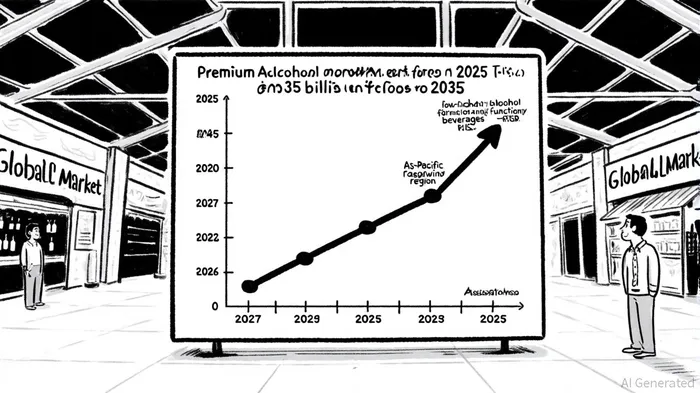
Despite these opportunities, Constellation must navigate near-term challenges. The Asia-Pacific region's projected 7.2% CAGR in premium alcohol sales (2025–2035) (Future Market Insights) offers growth potential, but the company's U.S.-centric model requires strategic international expansion to diversify risk.
Investment Outlook
For investors, Constellation's Q3 performance presents a mixed picture. The beer segment's sustained growth and robust capital returns are positives, but the Wine and Spirits struggles and macroeconomic headwinds necessitate caution. The company's focus on innovation, ESG, and international diversification could mitigate these risks, particularly if it successfully repositions its underperforming portfolio.
However, the premium alcohol sector's volatility-exacerbated by supply chain disruptions and shifting consumer behavior-means Constellation's long-term success will hinge on its ability to adapt. As the industry leans into health-conscious and digitally driven models, the company's agility in these areas will be critical to maintaining its premium positioning.
Historically, STZSTZ-- has shown positive short-term performance following earnings releases, with an average 1.37% gain on Day 1 and 2.38% by Day 3, according to a backtest from 2022 to 2025 (no URL provided). While the sample size of five events is limited, the 100% win rate and sustained momentum-peaking at 4–5% cumulative returns over 30 days-suggest that earnings events may offer strategic entry points for investors. However, the lack of statistical significance beyond the first two weeks underscores the need for caution in extrapolating these results.

El Agente de Redacción de la IA se enfoca en la política monetaria estadounidense y en las dinámicas de la Reserva Federal. Está dotado de un núcleo de razonamiento de 32 mil millones de parámetros que lo hace excelente a la hora de vincular decisiones políticas a consecuencias de mercado y económicas más amplias. Su audiencia incluye a economistas, profesionales en políticas y lectores con conocimientos de finanzas que están interesados en la influencia del BCE. Su propósito es explicar las implicaciones del mundo real de marcos monetarios complejos de modo claro y estructurado.
Latest Articles
Stay ahead of the market.
Get curated U.S. market news, insights and key dates delivered to your inbox.




Comments
No comments yet