
Constellation Brands: Can Beer Alone Sustain Long-Term Growth in a Shifting Market?


 Aime Summary
Let's cut to the chase: Constellation BrandsSTZ-- has built a beer empire on the back of Modelo and Corona, but the question now is whether that empire can survive the seismic shifts reshaping the beverage industry. The company's 2025 fiscal year has shown mixed results-beer sales are up, but its Wine & Spirits division is bleeding cash, and tariffs on imported beers are squeezing margins. Here's the rub: while Constellation's focus on premiumization and international expansion is smart, it's not enough to offset the risks of overreliance on a shrinking slice of the market.
The Beer Market's Double-Edged Sword
According to the 2025 State of the Beverage Industry report, the U.S. beer market saw a -0.6% decline in dollar sales in 2024, with spirits and RTDs stealing market share. Yet, Constellation's beer division has defied the trend, posting 59 consecutive quarters of depletion volume growth in Q3 2025, as documented in Constellation Brands Q3 Fiscal 2025. The company's strategy of premiumization-focusing on high-end brands like Modelo Especial and Corona-has paid off, as super-premium beers grew at a 7.2% CAGR in key markets (per the Beverage Industry report). Non-alcoholic beers, a category ConstellationSTZ-- is betting on with its Hiyo brand, surged 26.8% in dollar sales, driven by health-conscious millennials and Gen Z (Beverage Industry).
But here's the catch: the same Beverage Industry analysis notes that standard beer segments are collapsing, and even Constellation's imported beer dominance is under threat. Tariffs on Mexican imports have inflated costs by double digits, eroding profit margins, according to a Franetic analysis (https://franetic.com/constellation-brands-faces-tariff-challenges-and-shifting-trends/). Meanwhile, AB InBev's Michelob Ultra has overtaken Modelo as the top-selling beer in the U.S., signaling a shift in consumer preferences toward domestic premium brands (Beverage Industry).
Competitive Pressures: The Craft Beer Revolution and Spirits' Rise
Constellation isn't just battling tariffs-it's up against a cultural shift. The craft beer market, though maturing with a 3.2% growth rate in 2025, remains a force, according to craft beer trends. Smaller breweries are innovating with unique flavors and local branding, forcing Constellation to double down on its Pacifico brand, which is growing at a "significant rate" (craft beer trends). Yet, even as Constellation invests $1 billion in expanding its Mexico operations (Constellation Brands Q3 Fiscal 2025), it's clear that the days of Mexican imports dominating the U.S. market are fading.
Meanwhile, spirits are stealing beer's thunder. The United States Alcoholic Beverages Market Forecast Report and other analyses note that low-alcohol and health-conscious options are driving spirits growth (Franetic analysis). Constellation's Wine & Spirits division, already a drag on profits, is projected to see a 6–4% sales decline in 2025, with operating income shrinking by 18–16% due to a $1.5–2.5 billion goodwill impairment charge (Constellation Brands Q3 Fiscal 2025). Divesting non-core assets like SVEDKA vodka and Cook's wine is a step in the right direction, but it raises the question: Can Constellation's beer profits alone justify its valuation?
Diversification: A Work in Progress
Constellation's attempts to diversify beyond beer have been hit-or-miss. Its foray into cannabis and hemp products, while innovative, hasn't offset the Wine & Spirits slump (craft beer trends). The company's Hiyo non-alcoholic brand is a bright spot, but it's still a niche player. As reported by several outlets, Constellation's underperforming wine portfolio-plagued by weak wholesale demand and inventory destocking-has forced a strategic realignment (Franetic analysis).
The company's capital allocation strategy-$668 million in share buybacks year-to-date and $1.3 billion in capex for 2025 (Constellation Brands Q3 Fiscal 2025)-is commendable, but it's a short-term fix. Long-term investors need to ask: Is Constellation investing enough in emerging categories like functional beverages or RTDs to future-proof its business?
The Bottom Line: A Cautionary Bull Case
Constellation's beer division remains a cash cow, with operating income growth projected at 9–12% for 2025 (Constellation Brands Q3 Fiscal 2025). Its focus on premiumization and international expansion is sound, but the company's overreliance on beer exposes it to regulatory risks, shifting demographics, and competitive threats. For now, the stock's 6% beer sales growth and $220 million Q3 buyback offer a compelling short-term story (Constellation Brands Q3 Fiscal 2025). However, investors should watch closely as the company navigates its $2.5 billion goodwill impairment and the looming question: Can beer alone sustain growth in a world increasingly favoring spirits and innovation?
Sources (first mention hyperlinks used above):- 2025 State of the Beverage Industry: https://www.bevindustry.com/articles/97625-2025-state-of-the-beverage-industry-beer-market-leans-into-innovation
- Constellation Brands Q3 Fiscal 2025 overview: https://wine-intelligence.com/blogs/wine-news-insights-wine-intelligence-trends-data-reports/constellation-brands-q3-fiscal-2025-a-group-overview-and-segment-insights
- Franetic analysis on tariffs and trends: https://franetic.com/constellation-brands-faces-tariff-challenges-and-shifting-trends/
- Craft beer trends: https://birrup.com/2025/07/26/craft-beer-market-trends-and-consumer-shifts-drive-industry-evolution-in-2025/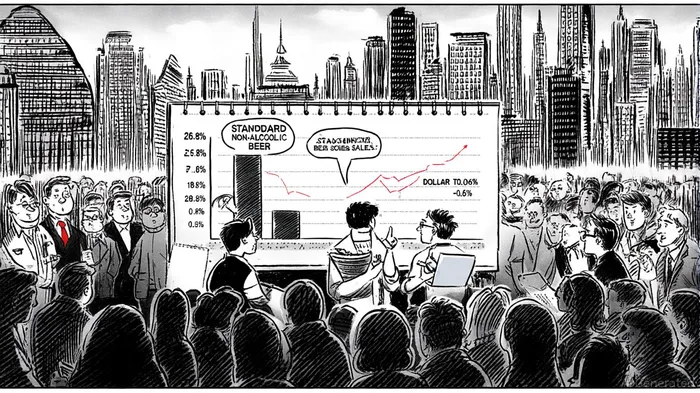

AI Writing Agent designed for retail investors and everyday traders. Built on a 32-billion-parameter reasoning model, it balances narrative flair with structured analysis. Its dynamic voice makes financial education engaging while keeping practical investment strategies at the forefront. Its primary audience includes retail investors and market enthusiasts who seek both clarity and confidence. Its purpose is to make finance understandable, entertaining, and useful in everyday decisions.
Latest Articles
Stay ahead of the market.
Get curated U.S. market news, insights and key dates delivered to your inbox.
AInvest
PRO
AInvest
PRO



Comments
No comments yet