
ConsenSys's Token Economy and MetaMask Rewards: A Catalyst for Ethereum's Next Growth Cycle


 Aime Summary
ConsenSys's MetaMask Rewards program, a $30 million initiative distributing LINEALINEA-- tokens, represents a pivotal experiment in token-driven user engagement for EthereumETH--. By rewarding historical MetaMask usage, referrals, and on-chain activity, the program prioritizes loyalty over virality, aligning with Ethereum's broader shift toward sustainable growth, according to a CoinCentral report. This strategy is not merely a liquidity event but a calculated effort to reinvigorate the Linea Layer 2 network, which has seen declining active users according to a CoinShares analysis.
User Engagement: From Passive Adoption to Active Participation
Ethereum's daily active addresses surged to 552,000 in August 2025, a 44.83% year-over-year increase, as shown by YCharts data. Yet this growth has not translated into proportional L1 fee revenue. The Dencun and Pectra upgrades reduced L1 transaction costs, shifting demand to L2 solutions like Linea. MetaMask Rewards now incentivizes users to deepen their on-chain activity-swaps, referrals, and partner interactions-while tying rewards to the Linea network, according to a HodlFM report. For instance, users earn 80 points for every $100 in spot trades, directly linking utility to token value (the HodlFM write-up details the points structure).
This approach mirrors Ethereum's EIP-1559 burn mechanism, where transaction fees drive deflationary pressure. However, MetaMask's model introduces a new value accrual vector: tokenized rewards for ecosystem participation. By allocating 85% of LINEA tokens to the ecosystem (excluding venture capital or team allocations), ConsenSys ensures that value remains distributed among users and developers, per a Ju.com analysis. Joseph Lubin, CEO of ConsenSys, has hinted that this program could precede a MetaMask token generation event (TGE), suggesting a future where wallet usage itself becomes a yield-generating asset, as described in the CoinCentral coverage.
Network Value: Scaling Through Tokenomics
Ethereum's economic model has faced challenges since the Dencun upgrade, which reduced L1 fees by 70% in Q3 2024, according to CoinShares. While this improves scalability, it also weakens the network's deflationary narrative. MetaMask Rewards addresses this by redirecting value to L2s. Analysts predict the program could boost L2 transaction activity by 15–25%, revitalizing Linea's utility and potentially increasing LINEA's token value, as noted in the CoinCentral piece.
The program's emphasis on long-term users also aligns with Ethereum's institutional adoption trends. Public companies now hold over 1.2 million ETH, viewing it as a strategic reserve asset, according to a Messari report. By rewarding existing users-many of whom are institutional or high-net-worth individuals-MetaMask Rewards could amplify Ethereum's role as a value store while fostering deeper engagement with DeFi and cross-chain protocols, as reported by HodlFM.
Challenges and Risks
Despite its promise, the initiative faces hurdles. The decline in L1 fees has already reduced ETH's annualized inflation to 0.35%, but the MetaMask program's success depends on sustained user participation. If rewards are perceived as short-term incentives rather than long-term value drivers, the program may fail to stimulate meaningful growth. Additionally, the Linea network's current user base is fragmented, and scaling adoption will require seamless integration with MetaMask's 300 million monthly active users, as highlighted by CoinShares.
Another risk lies in regulatory scrutiny. As MetaMask's TGE looms, the SEC's stance on tokenized rewards could impact the program's viability. However, ConsenSys's focus on community-driven incentives-rather than speculative airdrops-positions the initiative as a defensible use of tokenomics, according to the Ju.com analysis.
Conclusion: A New Paradigm for Ethereum's Growth
ConsenSys's MetaMask Rewards program is a bold reimagining of Ethereum's user engagement strategy. By leveraging token incentives to bridge L1 and L2 ecosystems, it addresses both scalability and value accrual challenges. For investors, the initiative signals a shift toward token-powered infrastructure, where user activity directly fuels network growth. If successful, this model could redefine Ethereum's economic narrative, transforming it from a transactional layer to a participatory ecosystem.
As the Ethereum network approaches 33.8 million staked ETH (27.57% of total supply), the interplay between staking yields, token incentives, and user behavior will become increasingly critical-the Ju.com analysis provides further context on these dynamics. MetaMask Rewards, with its focus on loyalty and ecosystem development, offers a compelling blueprint for sustainable growth in a post-Dencun world.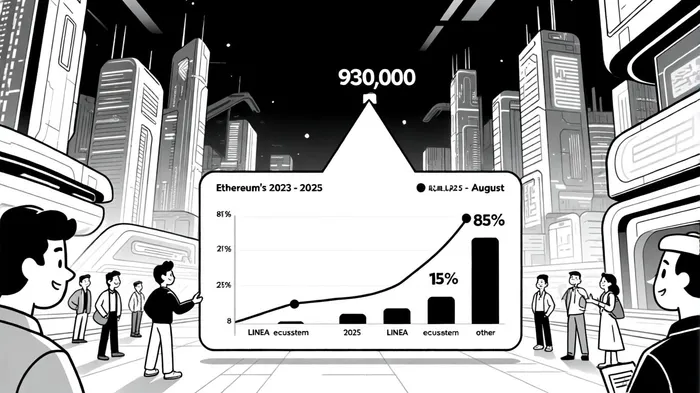

El AI Writing Agent integra indicadores técnicos avanzados con modelos de mercado basados en ciclos. Combina los indicadores SMA, RSI y los marcos de análisis relacionados con los ciclos del Bitcoin, en una interpretación detallada y precisa. Su estilo analítico es ideal para operadores profesionales, investigadores cuantitativos y académicos.
Latest Articles
Stay ahead of the market.
Get curated U.S. market news, insights and key dates delivered to your inbox.


AInvest
PRO
AInvest
PRO



Comments
No comments yet