
ConocoPhillips' Q3 2025 Earnings Call: Contradictions in Willow Project Costs, Dividend Strategy, and Free Cash Flow Projections
 Aime Summary
Date of Call: November 6, 2025
Financials Results
- EPS: $1.61 per share in adjusted earnings
Guidance:
- Raised 2025 production guidance to 2,375,000 BOE/d.
- 2025 OpEx guidance reduced to $10.6B; 2026 OpEx ~ $10.2B (down $400M vs 2025 guidance).
- Preliminary 2026 CapEx ~ $12B (~$0.5B below 2025 midpoint; ~$3B below pro forma 2024).
- 2026 underlying production expected flat to +2%; company oil mix ~53% (Lower 48 ~50%).
- Willow total project capex $8.5–$9.0B; first oil narrowed to early 2029; sustaining capex post‑startup ~ $0.5B/yr.
- LNG project capex reduced to $3.4B; NFE startup expected 2026, Port Arthur 2027.
- $7B free cash flow inflection by 2029 (~$1B/yr 2026–28; +$4B in 2029).
Business Commentary:
* Strong Financial Performance and Guidance Upgrades: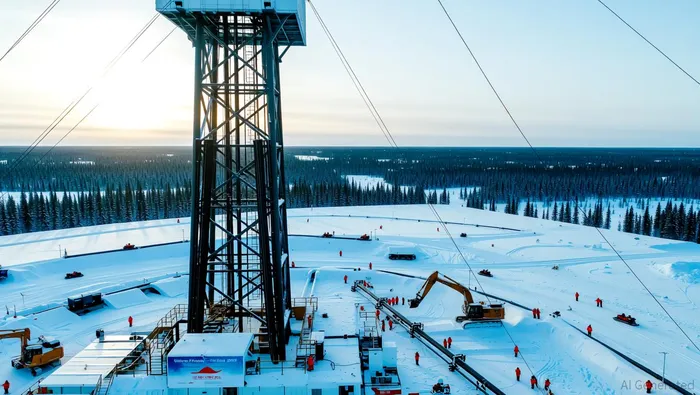 - ConocoPhillips reported
 adjusted earnings of $1.61 per share for Q3, surpassing guidance with a $5.4 billion CFO. - The company raised its full-year production guidance to 2,375,000 barrels of oil equivalent per day, an increase of 15,000 barrels from the prior guidance midpoint. - This performance was driven by strong execution across the portfolio, including capital spending and operating cost reductions.- Willow Project Cost Increase:
- The total project capital estimate for the Willow project increased to
$8.5 billion to $9 billiondue to higher-than-expected general inflation and localized North Slope cost escalation. - Despite the cost increase, the project schedule remains on track, with first oil now estimated in early 2029.
The escalation is primarily due to higher-than-expected inflation across various project components, including labor and construction costs.
Cost Reduction and Efficiency Improvements:
- ConocoPhillips reduced its operating cost guidance for 2025 to
$10.6 billion, down from the previous guidance of$10.8 billion. - The company achieved significant synergies from the Marathon assets integration, amounting to 75% of the expected savings.
These improvements are attributed to operational efficiencies, such as reduced capital spending and improved drilling and completion performance.
LNG Project Progress:
- The total project capital estimate for three LNG projects was reduced to
$3.4 billiondue to a$600 millioncredit from shared infrastructure costs. - The projects remain on track, with first LNG expected from NFE in 2026, Port Arthur in 2027, and NFS subsequently.
- The reduction in project capital is due to shared infrastructure costs realized within the project portfolio.
Sentiment Analysis:
Overall Tone: Positive
- Management described the quarter as "another very strong execution quarter," raised full‑year production guidance, increased the base dividend by 8%, reduced OpEx guidance, and reiterated a $7 billion free cash flow inflection by 2029 driven by major projects—statements that underline constructive execution and confidence in future cash generation.
Q&A:
- Question from Neil Mehta (Goldman Sachs): Can you unpack the Willow cost increase to $8.5–9.0B, your confidence given history of project overruns, and confirm schedule?
Response: Cost increased mainly from realized inflation (~80% of increase) and North Slope localized escalation; >90% of contracts now secured; schedule intact with first oil narrowed to early 2029.
- Question from Arun Jayaram (JPMorgan): With F&D up ~$200–250/BOE at Willow, how are project returns and breakevens impacted (assume mid‑$60 Brent)?
Response: Higher F&D raises project supply cost but Willow remains competitive with attractive margins because it's 100% oil selling at a West Coast/Brent premium.
- Question from Wei Jiang (Barclays): Lower 48 CapEx is trending lower—what's the trajectory and how will free cash flow from Lower 48 progress?
Response: Lower 48 moving to a level‑loaded steady state (≈24 rigs, 8 frac crews); capex to a Q3 run‑rate in 2026 with efficiency gains in drilling/completions driving expanding free cash flow.
- Question from Stephen Richardson (Evercore ISI): Thoughts on regulatory/permit changes in Alaska, incremental opportunities around Willow, and Surmont upside?
Response: Working with administration on permitting reforms (e.g., NPRA rules) to accelerate approvals; evaluating satellite opportunities at Willow; actively debottlenecking Surmont and adding steam capacity to accelerate development at sub‑$40 supply cost.
- Question from Francis Lloyd Byrne (Jefferies): What's driving the $400M OpEx improvement and can it be extended further?
Response: Savings driven by realized Marathon synergies (≈75% achieved) plus the $1B cost reduction/margin program; management expects continuous improvement to yield further sustainable OpEx reductions.
- Question from Scott Hanold (RBC): Your 2026 oil guide differs from consensus—walk through oil mix assumptions and drivers.
Response: Company guiding 2026 oil mix ≈53% (Q3 was ~53%); Lower 48 guided ≈50%; the 0–2% BOE growth guidance applies to oil as well and reflects portfolio mix including Surmont impact.
- Question from Douglas Leggate (Wolfe Research): How does higher Willow spend affect dividend breakeven and cash cadence?
Response: Breakeven is improving overall (mid‑40s this year, down ~$2–3 from 2025→26, targeting low‑30s by Willow startup); higher Willow capex does not materially change the breakeven trajectory and dividend increase is sustainable.
- Question from Bob Brackett (Bernstein): What macro scenario underpins the 0–2% 2026 guide and how does that inform capex/production decisions?
Response: Planning assumption ~ $60 WTI; 0–2% reflects near‑term macro uncertainty and portfolio flexibility—management can flex capex or production based on market developments.
- Question from Jeoffrey Lambujon (Tudor, Pickering): How confident are you in the updated Willow capex range and what flexibility remains?
Response: High confidence in $8.5–9.0B—>90%+ contracts locked; management conservatively budgets for continued 4–5% inflation on indexed contracts to limit upside risk; schedule remains on track.
- Question from Paul Cheng (Scotiabank): Given Lower 48 inventory, do you need to increase exploration or rely on shale to sustain production long term?
Response: Company maintains $200–300M/yr exploration budget, refocused toward Alaska to feed Willow; abundant inventory reduces need for materially higher exploration spending today.
- Question from Charles Meade (Johnson Rice): How do you differentiate/resource vs commercial LNG and do they compete?
Response: They are complementary: resource LNG (traditional stranded projects) and commercial LNG (convert Lower 48 Henry Hub gas to international pricing); both pursued to control value chain and capture economic rent—targeting 10–15 MTPA.
- Question from James West (Melius Research): At 10 MTPA of offtake, do you pause to digest or push toward 15 MTPA?
Response: Remain committed to 10–15 MTPA target; deliberate approach after reaching 10 MTPA—will only add capacity with low‑liquefaction‑cost opportunities and confirmed regas/offtake.
- Question from Kevin MacCurdy (Pickering Energy): How does Willow generate the ~$4B incremental FCF in its first year (assumptions on margins, production, sustaining capex)?
Response: FCF driven by CapEx decline from ~ $2B pre‑first oil to ~$0.5B sustaining, coupled with 100% oil production sold at a Brent premium; the ~$4B FCF assumes ~$70 oil (sensitivity provided in materials).
Contradiction Point 1
Willow Project Cost and Timeline
It involves changes in the project cost and timeline, which are critical for assessing the financial viability and strategic direction of the company's major investments.
Can you clarify the funding progression for the Willow project from $7 billion to $9 billion and your confidence in the project timeline? - Neil Mehta (Goldman Sachs Group, Inc., Research Division)
2025Q3: So we acknowledged that there's been more cost in the Willow project than we had hoped but we're really good at getting after it. And so we've been working hard with our partners and our team, and we've made some good adjustments to the costs. And so I'll let Kirk talk about details of what we've done, but I'll tell you that we have been very successful. - Ryan Lance(CEO)
Can you confirm the $60-70 WTI free cash flow scenario and discuss its feasibility by 2029? - Neil Mehta (Goldman Sachs)
2025Q2: For the Willow project, we said $6 billion to $7 billion. The risk is probably more to the upside. I think we've got a very good handle on it. - Ryan Lance(CEO)
Contradiction Point 2
Dividend and Shareholder Returns
It involves changes in the company's approach to dividend payout and shareholder returns, which are crucial for investor expectations.
Can you explain the transition from $7B to $9B for the Willow project? Do you have confidence in the project's execution, and how is the timeline being affected? - Neil Mehta (Goldman Sachs Group, Inc., Research Division)
2025Q3: We returned over $1 billion to shareholders in the quarter, including a $366 million dividend and $650 million in share repurchases. And since we closed the Marathon transaction a year ago today, we've returned over $10 billion to shareholders. - Ryan Lance(CEO)
ConocoPhillips returned $2.5 billion to shareholders in Q1 despite a softer commodity environment. Can you still achieve the $10 billion goal, and would you consider taking on debt to support buybacks? - Neil Mehta (Goldman Sachs)
2025Q1: Our CFO-based distribution framework has been unchanged for years, maintaining mid-40% or 45% return of capital. We're prepared to use cash if necessary. We're still buying shares, but will likely reduce buybacks in the second quarter due to macro uncertainties. We'll continue assessing the situation for the third and fourth quarters. - Ryan Lance(CEO)
Contradiction Point 3
Free Cash Flow and Breakeven Improvement
It involves changes in the company's expectations for free cash flow and breakeven improvement, which are crucial indicators for financial performance and investor confidence.
How does Willow's increased spending impact cash flow and the dividend breakeven? - Douglas George Blyth Leggate (Wolfe Research, LLC)
2025Q3: And so we've got our hands around it. And so I'll tell you, I'd rather be in this position with this project than to set some unrealistic expectations to our shareholders and get beat up on that. Because we're going to execute this project and we're going to get after it. - Ryan Lance(CEO)
Can you confirm your $60-70 WTI free cash flow scenario and discuss your outlook for achieving these yields by 2029? - Neil Mehta (Goldman Sachs)
2025Q2: Our math checks out with your scenario. Through increased efficiency and steady-state capital development, we expect a $7 billion free cash flow inflection by 2029. This will nearly double our consensus free cash flow. Our competitive investments in LNG and Alaska, along with our strong inventory position, support this trajectory. - Ryan Lance(CEO)
Contradiction Point 4
Willow Project Costs and Returns
It involves changes in cost estimates and return expectations for the Willow project, which is a major investment for the company.
Can you explain the funding progression from $7B to $9B for the Willow project? Do you have control over the project, and how will the timing be affected? - Neil Mehta (Goldman Sachs Group, Inc., Research Division)
2025Q3: As we continue to refine the plan and gather data, the project cost estimate has increased by $1 billion to $8.5 billion. Ryan Lance acknowledged the project's cost increase and the need for clarity. Kirk Johnson provided details on the project's execution and cost drivers, including higher general inflation and localized cost escalation. The project is on schedule despite cost challenges, and the team is executing well. - Ryan Lance(CEO), Kirk Johnson(COO)
Is the capital reduction from growth or base capital? How does this affect breakeven? - Doug Leggate (Wolfe Research)
2025Q1: We're not surprised that the Alaska cost estimates continue to rise. The pressure on equipment, labor, materials, and freight rates in that region has been well-documented...we're focused on what we can control...we do expect to complete that project at an increased cost. We've adjusted our plans and expectations accordingly. - Ryan Lance(CEO)
Contradiction Point 5
Willow Project Cost and Timing
It involves changes in the estimated costs and timeline for the Willow project, which are crucial for capital allocation and investor expectations.
Can you clarify the funding progression from $7B to $7.5B to $8.5B to $9B for the Willow project? Do you feel confident in managing the project, and how will the timeline be affected? - Neil Mehta(Goldman Sachs)
2025Q3: The project is on schedule despite cost challenges, and the team is executing well. - Kirk Johnson(EVP, Global Operations)
What is the outlook for long-cycle capital expenditures and major project capital? - Stephen Richardson(Evercore ISI)
2024Q4: 2025 will see major winter construction in Willow. - Andrew O'Brien(SVP, Strategy and Commercial)

Discover what executives don't want to reveal in conference calls
Latest Articles
Stay ahead of the market.
Get curated U.S. market news, insights and key dates delivered to your inbox.


AInvest
PRO
AInvest
PRO



Comments
No comments yet