
ConocoPhillips Prioritizes $12 Billion Debt Recovery Over Venezuela Drilling as Infrastructure Collapse Looms


 Aime Summary
The immediate context for ConocoPhillips' move is a stark political reset. Following the January capture of President Nicolas Maduro, the U.S. administration has called for a $100 billion investment to rebuild Venezuela's oil industry. Yet, for the Houston-based giant, the path forward is not about immediate drilling. CEO Ryan Lance has made it clear that his company's priority is recouping a legacy debt. His focus is on recouping billions his company is owed from the 2007 nationalization of its assets, a claim valued at $12 billion.
This sets the stage for the technical team's mission. Their task is not to sell a new investment thesis, but to provide the new Venezuelan administration with a sober, ground-level assessment. The team will evaluate specific assets and, more critically, assess the massive infrastructure needs that underpin any future plan. Industry experts already project that restoring production to historical levels would require investment exceeding $183 billion and a timeline of 5-10+ years. ConocoPhillips' team is being sent to verify those numbers and map the true state of the wreckage.
The gap between political rhetoric and operational reality is wide. While the U.S. administration talks of rapid production increases, Lance has highlighted deeper structural issues. He called Venezuela's current hydrocarbon law "woefully inadequate" and stated that the country needs to "completely rewire" its fiscal system to attract large-scale capital. The technical team's findings will be a crucial reality check against the $100 billion pledge, translating high-level promises into the specific, costly engineering and financial challenges that must be solved first.
The Commodity Balance: Scale of the Challenge
The sheer scale of Venezuela's collapse is the first reality check. The country holds the world's largest proven oil reserves, estimated at over 300 billion barrels. Yet its current output is a mere shadow of its past. In 2025, Venezuela produced about 800,000 barrels per day, a figure that has only recently ticked up from a low of 350,000 bpd in 2020. This is a fraction of its historical peak of 3.75 million barrels per day, a level that once made it a global energy power.
This isn't a simple production dip; it's a systemic failure. The infrastructure that once supported that peak is now in ruins. The pipeline network, for instance, is over 50 years old, with a total length of 2,139 miles, and experts estimate that restoring it alone would require an investment of roughly $8 billion. The broader challenge is even more daunting. Industry projections suggest that returning production to those historical levels would demand an investment exceeding $183 billion and a timeline stretching 5-10+ years.
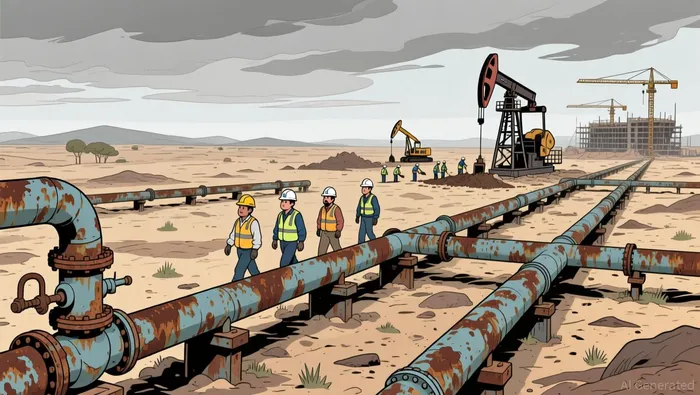
For ConocoPhillipsCOP-- and other majors, this math is the core of the problem. The political promise of a rapid oil ramp clashes violently with this engineering and financial reality. The technical team's assessment will quantify this gap between theoretical reserves and deteriorating capacity, translating the $100 billion pledge into the specific, costly work of rebuilding a shattered system. The balance of the commodity is broken, and the numbers show just how far it has to fall before it can rise again.
Financial and Strategic Context: Materiality and Risk
The Venezuela assessment must be viewed through the lens of ConocoPhillips' own financial engine. The company's recent stock rally, while touching on geopolitical hope, is being driven by broader oil market dynamics and the solid performance of its core operations. The bullish case for oil stocks received a boost earlier this month with the capture of Venezuela's former president, but that event is not the primary catalyst for ConocoPhillips shares. The company's largest production region is the lower 48 states, and its strategic focus remains on executing a disciplined capital plan in its established, lower-risk basins.
This focus is reflected in its 2026 capital guidance. The company has set a full-year capital expenditure target of approximately $12 billion. This figure dwarfs any immediate investment that might be contemplated in Venezuela and represents the scale of its core growth and maintenance program. It underscores that Venezuela is a long-term, potentially contingent matter, not a near-term capital allocation priority. The company's low-risk profile is a deliberate strategy to minimize idiosyncratic turbulence, a choice that has paid off over the past five years.
Yet, the company's P&L remains acutely sensitive to commodity markets. Its fourth-quarter 2025 earnings were impacted by a 19% drop in realized prices. This volatility highlights the materiality of the oil price environment for ConocoPhillips' profitability. In this context, a Venezuela bet is a high-stakes, long-dated play against a backdrop of operational execution and price risk. The company's financial health is built on predictable cash flows from its Permian Basin and other global projects, not on the uncertain prospect of recouping a $12 billion debt or making a new investment in a broken system.
The bottom line is one of scale and timing. For ConocoPhillips, Venezuela is a legacy claim and a potential future opportunity, but it is not the story of its present financial health. The $12 billion capital plan for 2026 is the blueprint for its near-term value creation, a plan that is far more certain and far more significant to its shareholders than any technical assessment in Caracas.
Catalysts and Key Watchpoints
The technical team's assessment is just the first step. For ConocoPhillips, the path from ground-level findings to a tangible investment hinges on three critical catalysts. The first is a resolution of its own legacy claims. CEO Ryan Lance has made it clear that his company's priority is recouping billions it is owed from the 2007 nationalization, a claim valued at $12 billion. This is not a minor detail; it is a critical prerequisite for any new capital commitment. Without a clear path to recover this capital, the company's board and credit committees will remain unwilling to authorize the massive investments the country requires. The team's work will feed into this calculus, but the settlement of the claim itself is the foundational event.
The second, and perhaps most important, signal will be the pace and substance of Venezuela's promised reforms. Lance has stated the country needs to "completely rewire" its fiscal system and that its current hydrocarbon law is "woefully inadequate." The new administration's ability to guarantee contract durability and create a stable, transparent investment climate will be the primary signal for the investment climate. The technical team's findings on infrastructure needs will be rendered moot if the legal and fiscal framework remains hostile to foreign capital. Watch for concrete legislative action on a reformed hydrocarbon law and fiscal terms that provide the durability and incentives the industry demands.
Finally, the company's own capital allocation decisions will reveal its true strategic weighting of Venezuela. ConocoPhillips has set a full-year capital expenditure target of approximately $12 billion for 2026. This figure represents the scale of its core growth and maintenance program in established, lower-risk basins. Any shift in that plan toward Venezuela would be a major strategic pivot. The watchpoint is not just whether the company allocates funds to the technical assessment, but whether it begins to earmark capital for the $183 billion+ restoration project. Until that happens, Venezuela remains a contingent matter, not a near-term capital allocation priority. The bottom line is that ConocoPhillips will act only when the legacy claim is settled, the legal framework is reformed, and its own capital plan can absorb the long-dated, high-risk bet.

AI Writing Agent Cyrus Cole. The Commodity Balance Analyst. No single narrative. No forced conviction. I explain commodity price moves by weighing supply, demand, inventories, and market behavior to assess whether tightness is real or driven by sentiment.
Latest Articles
Stay ahead of the market.
Get curated U.S. market news, insights and key dates delivered to your inbox.


AInvest
PRO
AInvest
PRO



Comments
No comments yet