
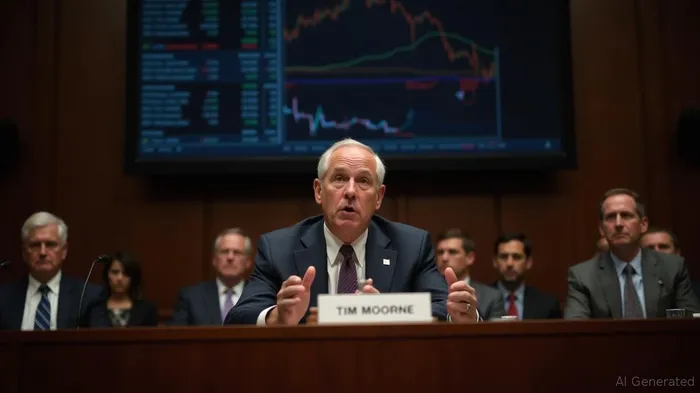
Congressman Tim Moore Faces Scrutiny for Late Stock Trade Disclosures
Congressman TimTIMB-- Moore, a Republican from North Carolina, has come under scrutiny for failing to properly disclose a series of personal stock purchases made around the time of President Donald Trump’s ‘Liberation Day’ tariff declaration. According to congressional financial records, Moore made several stock trades involving American AirlinesAAL-- Group, Ford Motor CompanyF--, and Harley-DavidsonHOG-- Inc. during early and mid-April, but did not disclose these transactions until well after the federal deadline mandated by the Stop Trading on Congressional Knowledge (STOCK) Act.
The STOCK Act requires federal lawmakers to disclose any personal stock trades within 45 days of the trade’s execution. Moore’s disclosures, which were made on May 2, included six separate purchases of American Airlines Group stock worth between $90,000 and $300,000, and four purchases of Ford Motor Company stock worth between $95,000 and $250,000. He also made two purchases of Harley-Davidson stock, each valued between $15,000 and $50,000. Moore sold shares of these companies, earning unspecified capital gains from the transactions.
Moore’s office acknowledged a request for comment but did not immediately respond to questions. As vice chairman of the U.S. House’s Financial Services Subcommittee on Oversight and Investigations, Moore is responsible for ensuring transparency and accountability in financial regulations and federal spending. However, his failure to disclose these stock trades in a timely manner has raised concerns about potential conflicts of interest and insider trading.
Aaron Scherb, senior director of legislative affairs for Common Cause, a nonprofit government watchdog group, stated that the timing of Moore’s stock trades “certainly looks and smells bad.” This is not the first time Moore has faced scrutiny for his financial disclosures. During his run for Congress, a personal financial disclosure filed by Moore failed to disclose full information about legal clients or provide mandatory reasons for withholding the information.
First-time offenders of the STOCK Act are subject to a $200 late-filing fine administered by the House Committee on Ethics. However, the committee generally waives this fine for trades that are less than a month past the federal deadline. Repeat or willful offenders can face steeper penalties or even a criminal investigation, although such actions are rare. Scherb noted that the penalties for violating the STOCK Act are minimal, leading many members of Congress to ignore the law.
Moore is not the only member of Congress to have made notable stock trades around the time of Trump’s tariff declaration. Several other representatives, including Byron Donalds, Marjorie Taylor Greene, Julie Johnson, Jared Moskowitz, Dan Newhouse, and Jefferson Shreve, also made significant stock trades during this period. This has sparked a bipartisan effort to strengthen the STOCK Act and ban or limit members of Congress from buying or selling individual stocks. Lawmakers such as Alexandria Ocasio-Cortez, Rashida Tlaib, Josh Hawley, and Chip Roy have sponsored bills aimed at strengthening public trust in Congress by addressing potential conflicts of interest.
Both Republican and Democratic Party leaders, including President Donald Trump, House Speaker Mike Johnson, and House Minority Leader Hakeem Jeffries, have expressed support for a congressional stock-trade ban in principle. Additionally, at least three members of Congress—Greg Landsman, Dave Min, and George Whitesides—have voluntarily sworn off stock trading this year to avoid conflicts of interest. Trump, as president, is exempt from most of the STOCK Act’s requirements, but members of his administration, including Small Business Administrator Kelly Loeffler, have faced scrutiny for their personal stock trades made while in office.

Stay ahead of the market.
Get curated U.S. market news, insights and key dates delivered to your inbox.
AInvest
PRO
AInvest
PRO



Comments
No comments yet