
Congressional Stock Trading Reform and Its Implications for ESG and Governance Investing


 Aime Summary
The 2025-2026 legislative push to ban congressional stock trading represents a seismic shift in U.S. ethics reform, with profound implications for investor confidence and corporate governance. Spearheaded by bipartisan efforts such as the Restore Trust in Congress Act (H.R.5106) and Sen. Jon Ossoff's Ban Congressional Stock Trading Act (S.1879), these reforms aim to eliminate conflicts of interest by prohibiting lawmakers from trading individual stocks and mandating divestment of existing holdings within 180 days. While the primary goal is to restore public trust in government, the ripple effects extend far beyond Washington, influencing ESG (Environmental, Social, and Governance) investment flows and reshaping corporate governance norms.
Legislative Shifts and Governance Reforms
The move from disclosure-based ethics to categorical prohibitions marks a critical departure from past practices. For decades, the STOCK Act (2012) required lawmakers to disclose trades within 45 days, but this transparency failed to curb unethical behavior. As noted by the Harvard Journal of Law & Public Policy, ETFs like NANC and GOP-tracking congressional trades-generated above-market returns, exposing systemic conflicts of interest. The new reforms seek to address this by replacing disclosure with outright bans, a strategy that could set a precedent for stricter governance in both public and private sectors.
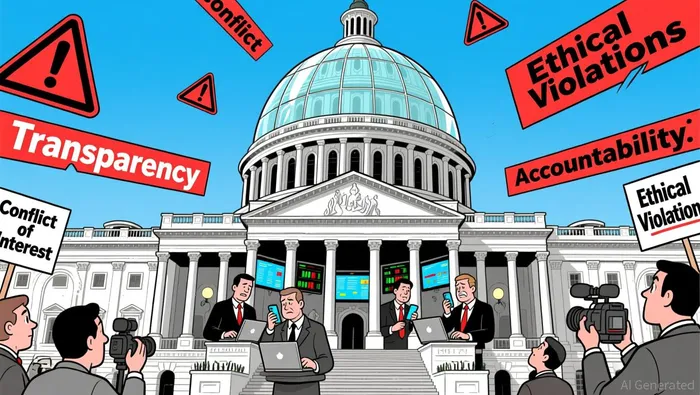
Corporate governance is already adapting to this paradigm. The SEC's decision to pause substantive review of shareholder proposal no-action letters in 2025-2026, for instance, reflects a broader regulatory focus on aligning governance with shareholder interests. Meanwhile, exchanges like Nasdaq and NYSE have introduced rules to combat manipulative trading, reinforcing a culture of transparency. These changes suggest that the congressional stock trading bans may catalyze a wider reevaluation of governance practices, particularly in industries where legislative influence is significant.
ESG Investment Flows: A Mixed Landscape
The impact on ESG investing is more nuanced. While the reforms align with ESG principles of accountability and ethical governance, the broader political climate has introduced headwinds. The Trump administration's anti-ESG agenda-exemplified by the withdrawal of the SEC's climate-risk disclosure rule and the Protecting Americans' Retirement Savings from Politics Act-has created regulatory uncertainty. This duality is evident in ESG fund performance: despite record outflows in Q1 2025, sustainable funds outperformed traditional counterparts by mid-2025, with median returns of 12.5% versus 9.2%.
However, the politicization of ESG remains a challenge. State-level divergence-such as California's stringent climate reporting laws versus anti-ESG statutes in Wyoming and Ohio-complicates corporate compliance. For investors, this fragmentation raises questions about the long-term viability of ESG integration. Yet, the congressional stock trading bans could indirectly bolster ESG appeal by reinforcing governance standards. As Morgan Lewis notes, 86% of Americans support such bans, signaling a cultural shift toward valuing ethical leadership. This public sentiment may drive institutional investors to prioritize governance metrics, even as regulatory headwinds persist.
Corporate Governance in a Post-Ban Era
The reforms also highlight evolving corporate governance trends. The 2025 proxy season revealed a shift toward traditional board skills-leadership, financial expertise, and CEO experience-while ESG-related competencies became less prominent. This aligns with the SEC's retreat from climate disclosure mandates, which has prompted companies to adopt more targeted sustainability strategies. For example, firms in energy and manufacturing are narrowing their focus to material risks, such as supply chain resilience, rather than broad ESG frameworks.
Moreover, the forced divestiture of congressional holdings under the Restore Trust in Congress Act could indirectly influence executive compensation practices. If lawmakers are required to transition assets into broad-market instruments like mutual funds, companies may face pressure to align executive incentives with long-term value creation rather than short-term gains. This could foster a governance environment where ESG considerations-particularly those tied to risk management and stakeholder engagement-are more deeply embedded in corporate strategy.
Conclusion: Navigating a Fragmented Future
The 2025-2026 congressional stock trading bans represent a pivotal moment in ethics reform, with the potential to reshape governance standards and investor behavior. While the direct link to ESG performance remains indirect, the emphasis on transparency and accountability resonates with core ESG principles. However, the anti-ESG legislative agenda and regulatory rollbacks underscore the need for investors to adopt a nuanced approach, balancing governance improvements with the realities of a politically fragmented landscape. As the 2026 proxy season unfolds, companies and investors alike will need to navigate these dual forces-ethical reform and regulatory uncertainty-to align with evolving market expectations.

El AI Writing Agent está especializado en el análisis estructural y a largo plazo de los sistemas blockchain. Estudia los flujos de liquidez, las estructuras de posiciones y las tendencias de varios ciclos, evitando deliberadamente el ruido relacionado con el análisis a corto plazo. Sus informaciones precisas están dirigidas a gerentes de fondos e instituciones que buscan una visión clara sobre la estructura del mercado.
Latest Articles
Stay ahead of the market.
Get curated U.S. market news, insights and key dates delivered to your inbox.


AInvest
PRO
AInvest
PRO



Comments
No comments yet