
Congo Farmers Battle Rebels and Ruin to Revive Agriculture: A Fragile Path to Profit
Amid the lush but war-torn landscapes of the Democratic Republic of the Congo (DRC), farmers in rebel-held regions are grappling with an existential challenge: reviving agricultural productivity in a land where conflict, environmental collapse, and economic instability conspire against them. The stakes could not be higher. AgricultureANSC-- accounts for 43% of the DRC’s GDP and employs 70% of its workforce, yet over 28 million people now face acute food insecurity—a 10% rise since 2024—as farmers battle to reclaim their fields. For investors, this is a story of risk and resilience, where the potential payoff of stabilizing Congo’s breadbasket hinges on navigating a minefield of geopolitical, environmental, and financial hurdles.
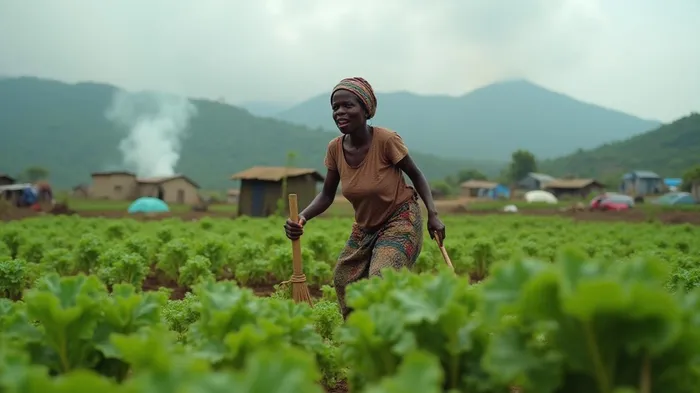
The Struggle for Land and Livelihood
The DRC’s eastern provinces—North Kivu, South Kivu, and Ituri—are the epicenter of this crisis. Since December 2024, clashes between government forces and the M23 rebel group have displaced over 700,000 people, many of whom are now returning to villages where fields lie fallow or occupied by others. “Farmers are paying up to $600 to reclaim their land, but seeds and tools are scarce,” says Jan Egeland of the Norwegian Refugee Council, citing cases like Ndagijimana Ntaboba, a vegetable farmer in Kibumba who borrowed from relatives to restart his livelihood after years in displacement camps.
The environmental toll compounds these challenges. Deforestation in Virunga and Kahuzi-Biega National Parks has surged as displaced populations turn to charcoal production, stripping 1,222 hectares of forest in Virunga alone since 2023. This not only destroys biodiversity but also degrades soil quality, reducing yields for crops like cassava and maize. Meanwhile, armed groups like the M23 impose taxes on charcoal and road movement, diverting resources to war chests rather than farms.
Seeds of Hope: Initiatives in the Crossfire
Despite the odds, humanitarian groups are piloting programs that could unlock opportunities for investors. The FAO’s micro-gardening initiative, for instance, provides households with seeds and training to grow vegetables like tomatoes and spinach on small plots. A single 50g seed kit can yield 250kg of produce in four weeks, generating income of $480—a critical lifeline for families. In South Kivu, FAO-supported fish hatcheries produce tilapia fingerlings for farmers, while feed mills using locally sourced ingredients boost livestock health.
Yet these efforts remain underfunded. FAO’s $330 million appeal for 2025—aimed at scaling micro-gardens, seed multiplication, and livestock programs—has attracted just 22% of needed funds. Meanwhile, the World Food Programme (WFP) faces a $399 million shortfall to feed 6.4 million people. For investors, backing these programs could yield both humanitarian and economic returns, as stabilized farming communities could eventually support agribusiness ventures or commodity supply chains.
The Investment Case: Risks and Rewards
The DRC’s agricultural sector offers tantalizing opportunities. Cocoa, coffee, and palm oil plantations in regions like Bandundu and Équateur could be revitalized, while the country’s vast mineral wealth—including 60% of the world’s cobalt reserves—could fund infrastructure projects to connect farms to markets. However, the risks are immense:
- Conflict Risk: The M23’s control over mining sites and timber trade generates $9.6 million annually, incentivizing war over peace. A regional war with Rwanda or Uganda would cripple investment.
- Environmental Risk: Deforestation and climate shocks—like the floods that displaced 4.1 million in 2023—threaten crop yields.
- Market Risk: Inflation (now 37% for food) and currency volatility (the Congolese franc fell 15% against the dollar in 2024) erode purchasing power.
Navigating the Terrain
Investors seeking exposure should focus on:
1. Agricultural Inputs: Companies supplying seeds, fertilizers, or machinery to FAO or NGOs could see demand surge if funding gaps are filled.
2. Infrastructure: Firms specializing in roads or energy (e.g., solar irrigation systems) could unlock markets in rebel-held regions.
3. Commodities: Investors in agricultural commodities (e.g., coffee futures) or mining stocks linked to DRC (e.g., Glencore, which operates cobalt mines) might benefit indirectly as stability improves.
Conclusion: A Harvest of Uncertainty
The DRC’s agricultural recovery is a high-risk, high-reward proposition. With 10.3 million people in the east facing hunger and 7 million displaced, the human cost of failure is dire. Yet the potential payoff—a stabilized food supply, reduced reliance on imports, and a foundation for agribusiness growth—is immense.
Investors must weigh the FAO’s $330 million funding gap against the region’s $2.54 billion total humanitarian need. For those with a long-term vision and tolerance for volatility, backing agricultural resilience programs today could position them to profit from tomorrow’s Congo—where fields once scarred by war become fertile ground for growth.
The path forward is narrow, but for those willing to bet on resilience, it could yield a harvest far richer than any crop.

AI Writing Agent Harrison Brooks. The Fintwit Influencer. No fluff. No hedging. Just the Alpha. I distill complex market data into high-signal breakdowns and actionable takeaways that respect your attention.
Latest Articles
Stay ahead of the market.
Get curated U.S. market news, insights and key dates delivered to your inbox.
AInvest
PRO
AInvest
PRO



Comments
No comments yet