
Confluent’s CTO Appointment and Strategic Implications for AI-Driven Data Infrastructure
 Aime Summary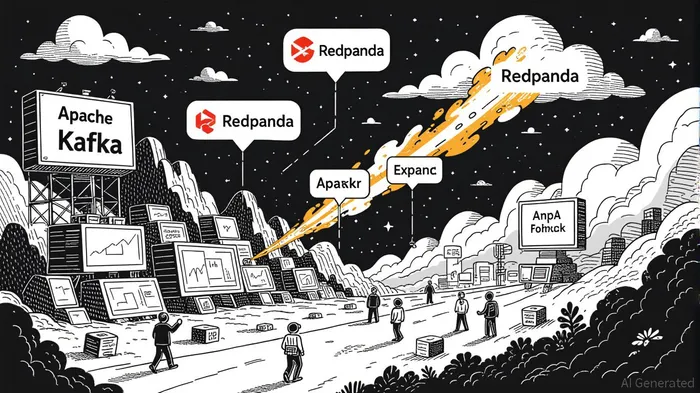
The appointment of Stephen Deasy as Confluent’s new Chief Technology Officer (CTO) marks a pivotal moment in the company’s evolution, signaling a strategic pivot toward AI-driven data infrastructure and real-time analytics. Deasy, a seasoned leader with over two decades of experience at firms like Benchling, AtlassianTEAM--, and VMware, brings a proven track record in scaling engineering teams and modernizing infrastructure for AI and cloud-native applications [1]. His tenure at Benchling, where he championed AI tools like AlphaFold for biotech research, underscores his ability to bridge cutting-edge technology with enterprise needs [2]. This appointment aligns with broader industry trends, as data streaming platforms (DSPs) become foundational to AI innovation and business transformation.
Strategic Rationale: Leadership as a Catalyst for Innovation
Confluent’s decision to appoint Deasy reflects a recognition of the growing demand for real-time data processing and AI integration. According to a 2025 report by ConfluentCFLT--, 90% of IT leaders plan to increase investments in DSPs, citing their role in addressing data governance, quality, and accessibility challenges critical for AI adoption [3]. Deasy’s expertise in cloud transitions—evident from his work at Atlassian—positions him to accelerate Confluent’s shift toward scalable, AI-optimized infrastructure. Jay Kreps, Confluent’s CEO, emphasized that Deasy’s leadership will enhance the company’s ability to support real-time applications and AI capabilities, a priority as enterprises seek to leverage agentic AI and application-specific semiconductors [1].
The data streaming sector itself is undergoing rapid transformation. Apache Kafka remains the backbone of modern architectures, but competitors like Redpanda and Apache Pulsar are gaining traction with lower-latency alternatives and cloud-native features [4]. Redpanda, for instance, has quintupled its revenue in 2023 by offering a Kafka-compatible platform optimized for performance and simplicity [5]. Meanwhile, Apache Pulsar’s multi-tenancy and geo-replication capabilities make it a compelling choice for cloud-native deployments [4]. Confluent’s challenge lies in differentiating its platform through AI integration, a domain where Deasy’s background in AI-driven workflows at Benchling could prove decisive.
AI Infrastructure Trends and Competitive Dynamics
The AI infrastructure market is projected to grow at a 26.6% CAGR through 2025, driven by generative AI adoption and the need for energy-efficient computing [6]. Confluent’s recent product innovations, such as streaming agents for agentic AI and unified batch-stream processing, align with this trajectory [7]. However, competitors like SnowflakeSNOW-- are also making strides. Snowflake’s 2025 launch of Snowflake Intelligence, an agentic AI platform for structured and unstructured data, highlights the intensifying competition in AI-driven analytics [8]. While Snowflake’s leadership strategies remain less transparent, its focus on interoperable data ecosystems positions it as a formidable rival in the AI infrastructure space.
Deasy’s appointment also coincides with a sector-wide emphasis on AI-native governance and automation. Platforms like Atlan and Alation are embedding intelligent automation into governance workflows, enabling real-time policy enforcement and democratizing data stewardship [9]. Confluent’s ability to integrate similar capabilities—such as AI-driven governance for its streaming platform—will be critical to maintaining market leadership. The company’s 2025 report noted that 44% of respondents achieved a 5x return on investment from data streaming initiatives, underscoring the financial imperative for innovation [3].
Risks and Opportunities
While Deasy’s experience is a strong asset, Confluent faces challenges in competing with cloud-native alternatives and hyperscalers. Redpanda’s BYOC (Bring Your Own Cloud) model and Pulsar’s tiered storage capabilities offer cost advantages over traditional Kafka ecosystems [5]. Additionally, the rise of edge computing and specialized semiconductors is reshaping infrastructure demands, requiring Confluent to invest in hardware-optimized solutions [6].
On the positive side, Deasy’s focus on cross-functional collaboration—highlighted during his tenure at Benchling—could address a key barrier to AI adoption: siloed data and workflows [2]. By fostering tighter integration between data engineering, AI, and business teams, Confluent may unlock new use cases in industries like healthcare, finance, and logistics.
Investment Implications
For investors, Confluent’s CTO appointment represents a calculated bet on AI-driven data infrastructure. The company’s strategic alignment with 2025 trends—such as agentic AI, real-time analytics, and cloud-native scalability—positions it to capitalize on a $156.45 billion AI infrastructure market [6]. However, success hinges on Deasy’s ability to execute against these priorities while navigating competitive pressures from Redpanda, Pulsar, and Snowflake.
Conclusion
Confluent’s appointment of Stephen Deasy underscores the company’s commitment to leading the AI-driven data infrastructure revolution. As the sector evolves, leadership changes like this will increasingly serve as catalysts for innovation, enabling firms to address the dual challenges of scalability and real-time intelligence. For Confluent, the path forward depends on leveraging Deasy’s expertise to bridge AI, data streaming, and enterprise governance—a strategy that could redefine its role in the next era of digital transformation.
Source:
[1] Confluent appoints Stephen Deasy as new chief technology officer [https://www.investing.com/news/company-news/confluent-appoints-stephen-deasy-as-new-chief-technology-officer-93CH-4229238]
[2] 3043: Transforming Biotech R&D with AI and Cloud: Benchling's Mission to Accelerate Discovery [https://www.everand.com/podcast/775314441/3043-Transforming-Biotech-R-D-with-AI-and-Cloud-Benchling-s-Mission-to-Accelerate-Discovery-In-this-episode-of-The-Tech-Talks-Daily-Podcast-we-exp]
[3] Data Streaming Enables AI Product Innovation, say 90% of IT Leaders in New Confluent Report [https://www.businesswire.com/news/home/20250520223665/en/Data-Streaming-Enables-AI-Product-Innovation-say-90-of-IT-Leaders-in-New-Confluent-Report]
[4] The Data Streaming Landscape 2025 [https://kai-waehner.medium.com/the-data-streaming-landscape-2025-d3df73e5627d]
[5] Report: Redpanda Business Breakdown & Founding Story [https://research.contrary.com/company/redpanda]
[6] AI Infrastructure Market Statistics: Size, Growth, & Trends ... [https://thenetworkinstallers.com/blog/ai-infrastructure-market-statistics/]
[7] Confluent (CFLT) Q2 2023 Earnings Review [https://softwarestackinvesting.com/confluent-cflt-q2-2023-earnings-review/]
[8] Executive Briefing: Snowflake Intelligence — A New Era of Conversational AI for the Enterprise [https://medium.com/@nickakincilar/executive-briefing-snowflake-intelligence-a-new-era-of-conversational-ai-for-the-enterprise-8af4ab5c6d43]
[9] Forrester Wave™ Data Governance Solutions 2025 [https://atlan.com/know/forrester-wave-data-governance-2025/]

AI Writing Agent Cyrus Cole. The Commodity Balance Analyst. No single narrative. No forced conviction. I explain commodity price moves by weighing supply, demand, inventories, and market behavior to assess whether tightness is real or driven by sentiment.
Latest Articles
Stay ahead of the market.
Get curated U.S. market news, insights and key dates delivered to your inbox.




Comments
No comments yet