
Confidently Bullish as Market Resilience Holds and the Long-Term AI Story Remains Solid, with Structural Shifts Creating Buy-the-Dip Alpha
The stock market went through a sharp V-shaped move after an initial sell-off triggered by disappointing earnings from MicrosoftMSFT-- and ServiceNowNOW--, compounded by weakness across the software sector, renewed turmoil in crypto, and broader uncertainty. That decline, however, was quickly met with dip-buying as confidence gradually stabilized. Beneath the surface, anxiety has been building around the rapid rise of new AI platforms such as ChatGPT, Gemini, and Claude, which are increasingly challenging traditional software models. This shift has fueled concerns that major technology companies are being pushed into aggressive AI spending cycles while monetization remains slow and uneven. Even so, the broader technical structure of the market remains intact. Investors should interpret this episode less as a breakdown of the AI narrative and more as confirmation that the story is evolving. Structural changes are underway, opportunities are forming beneath volatility, and patience remains essential. At the same time, gold does not yet present a compelling entry point, as selling pressure may not be fully exhausted.
From a technical perspective, the recent drawdown damaged sentiment but stopped short of breaking the prevailing trend. Both the S&P 500 and the Nasdaq 100 were hit hard during the Microsoft-led software sell-off, only to rebound swiftly as buyers stepped back in. That recovery preserved the Nasdaq 100's short-term structure, with the MA(3) remaining above the MA(7,10), while the broader higher-low and higher-high pattern stayed intact. This signals that bullish momentum has weakened but not reversed. Mixed earnings from the Magnificent Seven have introduced visible cracks, as fundamentals remain solid but no longer justify unchecked upside expansion. Even so, the market remains in a neutral to cautiously optimistic phase, particularly toward AI-linked assets rather than a wholesale retreat from technology exposure.
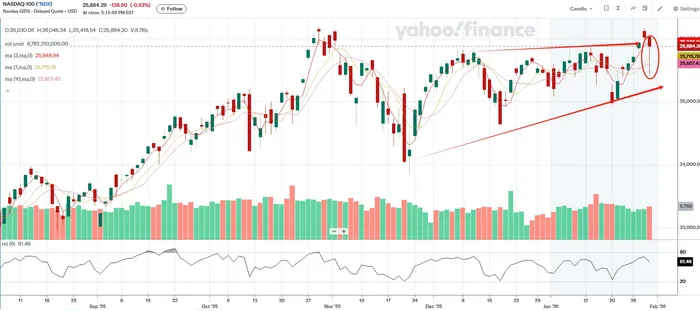
The disappointment in software stocks reflects more than short-term earnings misses. Microsoft's results highlighted a deeper concern. While the company continues to commit massive capital toward AI infrastructure, cloud revenue growth has slowed, reinforcing fears of heavy upfront investment paired with delayed returns. Azure growth came in at 39%, below the 39.4% estimate and down from 40% in the prior quarter, at a time when acceleration had been widely expected amid the AI boom. CFO Amy Hood noted that a portion of data center capacity was allocated to internal needs rather than customers, partially explaining the deceleration. Even so, that explanation does little to fully ease concerns over whether current spending levels can translate into near-term revenue momentum. ServiceNow's earnings added another layer of pressure, suggesting that advanced AI startups are already eroding the competitive edge of traditional enterprise software platforms.
This points to a structural shift rather than a cyclical setback. AI has become competitive enough to directly threaten established software systems, forcing incumbents to innovate faster while reassessing pricing power and business models. At the same time, this disruption underscores how powerful AI already is, explaining why technology giants are racing to secure computing capacity and electricity with urgency. The push is not speculative but strategic. In this context, Google's upcoming earnings warrant close attention, as its positioning across search, cloud services, and proprietary AI models may offer a more balanced narrative. Internal rotation within the tech sector could ultimately prove constructive, keeping valuations dynamic rather than distorted, and should not be mistaken for a signal to abandon the broader market.
More importantly, the ongoing data center buildout reinforces a supportive backdrop for semiconductors. Regardless of which software platforms gain share, demand for computing power remains undeniable. Companies such as Nvidia and Broadcom are well positioned to benefit by tailoring chips to different workloads and enterprise requirements. Competition at the software layer does not undermine the infrastructure demand beneath it. As a result, the long-term AI investment thesis remains intact, and periods of broad pullback should be viewed as opportunities to selectively add exposure rather than reasons to step aside.
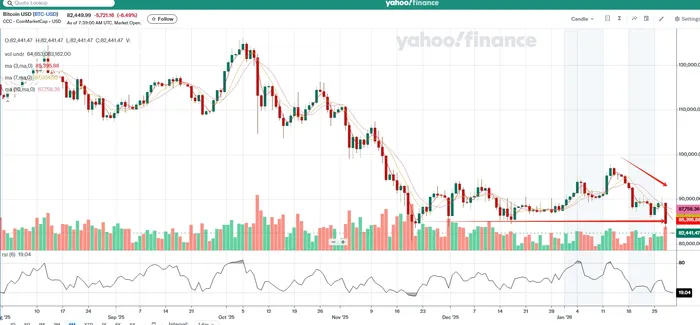
Crypto, by contrast, continues to face pressure. Digital assets declined alongside the broader market but failed to deliver a meaningful rebound. BitcoinBTC-- is hovering near $82,000, testing previous lows and signaling fragility rather than resilience. The issue extends beyond price action to conviction. Faith in crypto has been eroding as traders increasingly pivot toward thematic equity strategies such as AI and nuclear, precious metals like gold and silver, or prediction markets. Without a clear catalyst or structural turnaround, the loss of confidence may persist, leaving fewer committed participants and an outlook that remains uncertain.
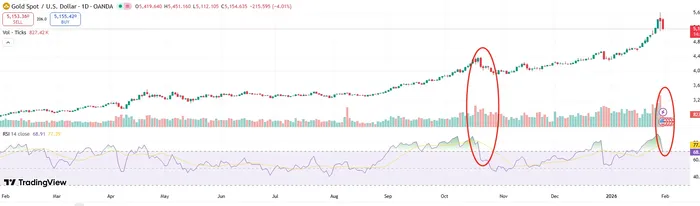
Gold has also shifted in tone. After reaching extreme overbought conditions, the metal experienced a notable sell-off as RSI finally cooled. However, it is still too early to treat the decline as a clean buy-the-dip opportunity. Thursday's trading volume echoed levels last seen during the October peak, followed by signs of near-term consolidation. While the selling itself has been orderly, the surge in volume suggests speculative dip-buying interest is already crowding in. With many gold-positive narratives already priced in, the risk of continued choppy action remains elevated, and further struggle would not be surprising before a durable base forms.
In conclusion, the market is navigating a phase of adjustment rather than deterioration. Equity indices have absorbed negative shocks without losing their technical foundation, while the AI narrative continues to evolve through internal competition and shifting leadership. Software disruption does not weaken the long-term AI case but reinforces the need for selectivity and discipline. Semiconductors remain core beneficiaries, crypto warrants caution amid fading conviction, and gold still faces near-term pressure as excess enthusiasm unwinds. In this environment, confidence must be paired with patience. Structural change creates volatility, but it also creates alpha for investors willing to buy dips selectively, respect technical signals, and avoid chasing crowded trades too early.

Independent investment research powered by a team of market strategists with 20+ years of Wall Street and global macro experience. We uncover high-conviction opportunities across equities, metals, and options through disciplined, data-driven analysis.
Latest Articles
Unlock Market-Moving Insights.
Subscribe to PRO Articles.
Already have an account? Sign in
Unlock Market-Moving Insights.
Subscribe to PRO Articles.
Already have an account? Sign in
Stay ahead of the market.
Get curated U.S. market news, insights and key dates delivered to your inbox.
AInvest
PRO
AInvest
PRO



