
Concentration Risk in Dividend ETFs: Evaluating SCHD's Sector Overexposure and Its Impact on Passive Income Strategies


 Aime Summary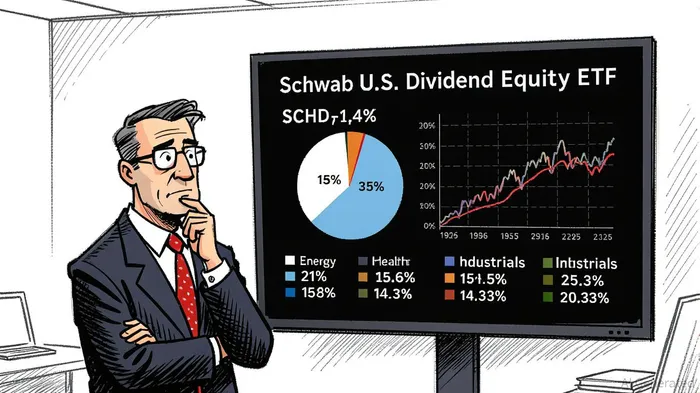
The Schwab U.S. Dividend Equity ETF (SCHD) has long been a favorite among income-focused investors for its focus on high-quality, dividend-paying stocks. However, , , . While these sectors have historically provided stability during market downturns, their outsized influence raises critical questions about concentration risk and the long-term sustainability of passive income strategies.
The Double-Edged Sword of Sector Concentration
SCHD's sector allocations reflect its mandate to prioritize companies with a history of consistent dividend growth. Energy giants like ChevronCVX-- (CVX) and industrials stalwarts such as 3MMMM-- (MMM) dominate the portfolio, while healthcare names like AbbVieABBV-- (ABBV) and MerckMRK-- (MRK) anchor the fund's defensive qualities. This focus has paid dividends during crises. For example, during the 2008–2010 financial crisis, , . Similarly, in 2020, , .
Yet, this concentration also creates a paradox. While these sectors have proven resilient in past downturns, their performance is not immune to macroeconomic shifts. Energy, for instance, is highly sensitive to oil prices and geopolitical events. A prolonged energy transition or a sudden drop in demand could erode both share prices and dividend consistency. Healthcare, though defensive, faces regulatory risks and margin pressures from drug pricing reforms. Industrials, meanwhile, are cyclical and vulnerable to supply chain disruptions or manufacturing slowdowns.
Historical Resilience vs. Future Uncertainty
SCHD's historical performance during crises underscores the value of its sector strategy. During the 2008–2010 crisis, , . In 2020, healthcare and industrials similarly held up, .
However, is not a guarantee of future results. , . , . Similarly, .
Implications for Passive Income Strategies
For investors relying on SCHD for , the fund's sector concentration presents a trade-off. On one hand, its focus on high-quality dividend payers ensures a steady income stream during . On the other, on energy, healthcare, and industrials could expose portfolios to sector-specific shocks. For example, a on healthcare pricing or a prolonged energy transition could disproportionately impact SCHD's yield.
Moreover, . , but for retirees or income-focused investors, .
Actionable Steps to Balance Yield and Risk
To mitigate while preserving yield, investors should consider the following strategies:
Diversify Across Sectors and ETFs: Pair SCHD with complementary ETFs that target underrepresented sectors. For example, .
Incorporate : Add ETFs with a tilt toward utilities or consumer staples, which historically exhibit lower volatility. .
Use : Adjust allocations based on macroeconomic cycles. For instance, .
Monitor : Regularly review the payout ratios and balance sheets of SCHD's top holdings. A high payout ratio (e.g., .
Leverage : Take advantage of SCHD's annual reconstitution to adjust sector weights. For example, .
Conclusion
SCHD's has historically enhanced its resilience during market downturns, making it a compelling choice for passive income strategies. However, the overrepresentation of energy, healthcare, and industrials introduces concentration risk that could undermine long-term stability. By diversifying across sectors, incorporating defensive ETFs, and actively monitoring , investors can strike a balance between yield and risk. In an era of economic uncertainty and shifting market dynamics, a diversified approach is essential to preserving both capital and income.

Delivering real-time insights and analysis on emerging financial trends and market movements.
Latest Articles
Stay ahead of the market.
Get curated U.S. market news, insights and key dates delivered to your inbox.
AInvest
PRO
AInvest
PRO



Comments
No comments yet