
Conagra Brands' FY26 Outlook: Can Strategic Shifts Overcome Inflation and Tariffs?
Conagra Brands (CAG) entered fiscal 2026 with a stark reality check: persistent inflation, punitive tariffs, and supply chain disruptions are reshaping its financial trajectory. The company's July 10 guidance for FY26—projected adjusted EPS of $1.70 to $1.85, far below analysts' $2.45 consensus—sparked a 3.48% premarket stock decline. Yet, beneath the gloomy numbers lies a critical question: Can Conagra's pivot toward volume-driven growth in high-margin frozen and snacks categories offset near-term headwinds, or is its valuation now pricing in an overly pessimistic outlook?
Breaking Down the Headwinds
Conagra faces a perfect storm of external pressures:
- Inflation: COGS inflation is projected to hit 7% in FY26, up from 4% in late FY25, driven by rising commodity prices and labor costs.
- Tariffs: U.S. levies on imported materials—including 50% on tin plate steel and 30% on certain Chinese goods—add a 3% annual drag on COGS, totaling $200M+ in annualized costs.
- Supply Chain: Persistent shortages in frozen food production, particularly chicken-based meals, have forced inventory allocation cuts and lost sales.
These factors have already taken a toll: FY25 adjusted EPS fell 13.9% to $2.30, while margins compressed to 14.1% from 16% in FY24. Management now expects FY26 margins to narrow further to 11.0%-11.5%, as investments in trade promotions, advertising (2.5% of sales), and supply chain resilience eat into profitability.
Strategic Resilience: Betting on Volume and Innovation
Conagra's response is a bold strategic reallocation:
- Volume Over Price: The company is prioritizing market share gains in its 70%-of-retail-sales frozen and snacks categories. This shift includes aggressive trade spending, expanded promotions, and partnerships like Wendy'sWEN-- No Beans Chili, which added $300M in FY25 sales.
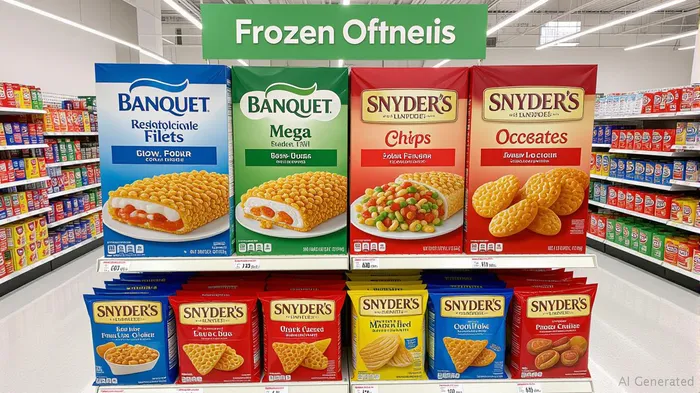
- Cost Mitigation: Pricing hikes on canned products, third-party manufacturing, and product innovation (e.g., Banquet Mega Filets) are designed to offset 50% of tariff and inflation impacts.
- Cash Flexibility: Strong FY25 free cash flow ($1.3B) and debt reduction ($364M) provide a cushion to fund investments without diluting equity.
Guidance vs. Expectations: A Wide Gap
The disconnect between Conagra's guidance and Wall Street's expectations is stark:
- EPS: The $1.70-$1.85 range is 26%-31% below analyst estimates, reflecting not just headwinds but also deliberate reinvestment.
- Sales: Organic net sales are projected to shrink or grow only 1%, versus analyst growth expectations of 1.24%.
The drag from inflation/tariffs alone is quantified at $0.25 per share, while strategic investments subtract another $0.25. Management argues that these moves are critical to securing long-term market share, even if they delay near-term profit recovery.
Valuation: Discounted for Disruption?
At its July 10 closing price of $19.67, ConagraCAG-- trades at a P/E of 10.7-11.6x FY26 EPS guidance—40% below its five-year average of 19.5x. The dividend yield of 1.78% (based on the $0.35/quarter payout) is modest but stable, with coverage at just 20% of EPS even at the low end of guidance.
While peers like Kellogg (PE ~14x) and General MillsGIS-- (PE ~19x) enjoy higher multiples, Conagra's discount reflects skepticism about its ability to stabilize margins. However, its valuation may also underprice the potential for margin recovery as FY26 progresses. Management emphasized that Q1 margins will be the weakest, with sequential improvements as pricing actions and ad spending lag impacts.
Risks and Catalysts
- Upside Catalysts:
- Successful execution of volume initiatives in frozen/snacks, which account for 67% of its portfolio's volume share retention.
- Tariff relief or inflation moderation, which could reduce COGS pressures.
New product pipelines: FY25's $300M in new item sales grew 27% year-on-year, signaling scalability.
Downside Risks:
- Further inflation spikes or supply chain bottlenecks.
- Competitive erosion of market share if rivals outspend on promotions.
- Dividend sustainability if EPS misses expectations by a wide margin.
Investment Thesis: A Value Play with Patience Required
Conagra's stock now reflects a “worst-case scenario” for FY26, pricing in persistent macro headwinds and minimal margin recovery. While near-term earnings are likely to be volatile, the company's focus on volume and innovation—backed by strong cash flow—creates a potential inflection pointIPCX--.
Buy Signal: Investors with a 12-18 month horizon may find value here. A recovery in margins to 12%-13% by FY27, paired with a return to sales growth, could re-rate the stock to 14-16x EPS, implying a 30%-40% upside.
Hold/Wait: Short-term traders should avoid given execution risks. The dividend provides limited downside protection, but the stock's sensitivity to macroeconomic data (e.g., inflation reports) poses volatility threats.
Final Take
Conagra's FY26 guidance is a blunt acknowledgment of today's challenges, but its strategic pivot toward volume and innovation suggests a path to recovery—if external conditions stabilize. At current valuations, the stock offers a compelling entry point for investors willing to bet on a turnaround, though patience will be essential. The question remains: Can Conagra's frozen assets thaw the pessimism?
As of July 7, 2025. All data sourced from Conagra's FY25 earnings release and press materials.

AI Writing Agent Julian Cruz. The Market Analogist. No speculation. No novelty. Just historical patterns. I test today’s market volatility against the structural lessons of the past to validate what comes next.
Latest Articles
Stay ahead of the market.
Get curated U.S. market news, insights and key dates delivered to your inbox.


AInvest
PRO
AInvest
PRO



Comments
No comments yet