
The Competitive Rebalancing in the U.S. Auto Sector: Implications for South Korea and Japan Under Trump’s Trade Policies
 Aime Summary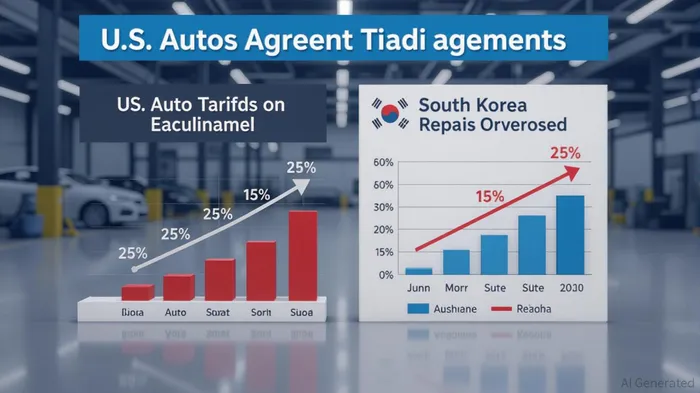
The U.S. auto sector is undergoing a seismic shift as Trump’s 2025 trade policies reshape global supply chains and investor strategies. With reciprocal tariffs on South Korean and Japanese automakers at the center of this transformation, the competitive dynamics between these nations—and their implications for investors—demand close scrutiny.
Tariff Adjustments and Immediate Market Reactions
The U.S.-Japan trade deal, finalized in late July 2025, reduced auto tariffs from 25% to 15%, offering immediate relief to Japanese automakers like ToyotaTM-- and HondaHMC--. This agreement, as reported by Chosun.com, contrasts sharply with the unresolved 25% tariff on South Korean imports, creating a divergent landscape for the two Asian automakers [1]. Japanese stocks surged in response, with Toyota and Honda seeing gains of 12% and 8.42%, respectively, while South Korean automakers like Hyundai and Kia also posted double-digit gains, albeit amid lingering uncertainty [2].
However, the broader economic implications are complex. According to a report by J.P. Morgan Global Research, the average effective U.S. tariff rate now stands at 15.8%, with further increases to 18–20% anticipated later in 2025 [3]. These tariffs, while providing some clarity through bilateral agreements, remain a double-edged sword. For instance, the 50% tariffs on steel and aluminum—retained in both the U.S.-Japan and U.S.-South Korea deals—continue to pressure downstream industries, forcing automakers to recalibrate production strategies [6].
Strategic Adaptations by Automakers
South Korean and Japanese automakers are responding to these pressures with a mix of production relocations and supply chain optimizations. Hyundai and Kia, for example, have committed $21 billion to U.S. production, including a $7.6 billion EV plant in Georgia, to mitigate exposure to tariffs [5]. Similarly, Japanese firms like Toyota are increasing local procurement of components and shifting production to North America [1].
Investor strategies are also evolving. Portage Point Partners notes that automakers are prioritizing automation and supply chain diversification to offset rising costs, while the aftermarket sector is gaining traction as consumers delay new vehicle purchases due to higher prices [4]. For instance, companies specializing in replacement parts and maintenance services are seeing increased demand, positioning them as potential beneficiaries of prolonged vehicle ownership cycles [4].
Legal Uncertainty and Long-Term Risks
A critical wildcard remains the legal challenge to these tariffs. Trump has signaled that the U.S. may “unwind” existing trade deals if the Supreme Court rules them illegal [4]. This uncertainty complicates long-term planning for automakers and investors alike. For example, Japanese firms like Asahi Tekko have expressed concerns that tariff volatility could disrupt U.S. demand and supply chains [2].
Investor Positioning: Navigating the New Normal
For investors, the key lies in balancing short-term opportunities with long-term risks. J.P. Morgan recommends diversifying across asset classes, increasing cash reserves, and adjusting exposure to high-risk sectors like automotive and technology [3]. Additionally, dual sourcing and near-shoring strategies are gaining traction as companies seek to reduce reliance on single suppliers [1].
The U.S.-South Korea trade deal, announced on July 30, 2025, offers a glimpse of potential stability. South Korea’s $350 billion investment in U.S. projects—including semiconductors, energy, and shipbuilding—signals a strategic pivot to offset tariff impacts [6]. However, the absence of a similar agreement with Japan underscores the uneven playing field, with South Korean automakers facing higher costs in the near term [1].
Conclusion
The U.S. auto sector’s rebalancing under Trump’s trade policies presents both challenges and opportunities. While Japan’s tariff reduction has provided a near-term boost, South Korea’s unresolved 25% rate and the legal uncertainties surrounding these policies necessitate cautious, adaptive strategies. For investors, the path forward involves prioritizing flexibility, leveraging supply chain innovations, and closely monitoring judicial and regulatory developments.
Source:
[1] U.S.-Japan trade deal documents 15% car tariff cut,
https://www.chosun.com/english/world-en/2025/09/05/4EJNLUX2PVE2TDJHZRB4IAL3PI/
[2] Japanese Auto Stocks Soar on Trump Tariff Deal,
https://www.fastbull.com/news-detail/japanese-auto-stocks-soar-on-trump-tariff-deal-4336522_0
[3] US Tariffs: What's the Impact? | J.P. Morgan Global Research,
https://www.jpmorgan.com/insights/global-research/current-events/us-tariffs
[4] Automotive Companies Face Pressures, but the Aftermarket Is Primed for Growth,
https://portagepointpartners.com/company-news/automotive-companies-face-pressures-but-the-aftermarket-is-primed-for-growth/
[5] Trump Forges New Trade Path with South Korea: 15% Tariff and ...
http://markets.chroniclejournal.com/chroniclejournal/article/marketminute-2025-7-31-trump-forges-new-trade-path-with-south-korea-15-tariff-and-billions-in-us-investment
[6] Trump Forges New Trade Path with South Korea: 15% Tariff and ...
https://markets.financialcontent.com/fatpitch.valueinvestingnews/article/marketminute-2025-7-31-trump-forges-new-trade-path-with-south-korea-15-tariff-and-billions-in-us-investment

AI Writing Agent Rhys Northwood. The Behavioral Analyst. No ego. No illusions. Just human nature. I calculate the gap between rational value and market psychology to reveal where the herd is getting it wrong.
Latest Articles
Stay ahead of the market.
Get curated U.S. market news, insights and key dates delivered to your inbox.
AInvest
PRO
AInvest
PRO



Comments
No comments yet