
Compass' New COO and Revised FY2026 Outlook Keep Execution Risk Front and Center


 Aime Summary
A stronger first half still leaves execution at the center of the CompassCOMP-- story
A better quarter does not give Compass much breathing room.

Q2 adjusted EBITDA reached $86.4 million, bringing first-half adjusted EBITDA to $151.7 million. That is a genuine rebound. But the more consequential update came the next day, when Compass said Brandon Risner is being promoted to chief operating officer and Patrick Merrin is departing, effective Aug. 3.
The operating change matters because management has already flagged a split in the story: it says the company is on track for full-year targets, while also acknowledging that mining operations have not yet delivered the production and efficiency gains expected earlier in the year. In other words, the rebound is visible, but its durability still needs to be proven.
Risner is not an outside fixer. He has already led improvements in Plant Nutrition and supported the C&I product line, which gives him useful familiarity with Compass's operating base. That makes the promotion a positive in terms of continuity, but it also raises the visibility around Salt execution. If Salt improves under his watch, the recovery case gets stronger quickly. If not, investors will have less reason to treat the recent rebound as anything more than a temporary lift.
What drove the rebound: favorable weather, better pricing, and real but incomplete operating progress
Salt benefited from weather, while Ogden showed clearer cost discipline
The near-term rebound had a straightforward logic: Compass benefited from favorable winter conditions and then worked to convert more of that activity into profit. Management said a strong winter across much of North America supported Salt, while the platform also delivered a high level of sales commitments and pricing gains.
The positive signals were not limited to Salt. Management also said Ogden delivered meaningful year-over-year improvement in cost performance and margins. That matters because it suggests some of the improvement is not purely weather-driven.
Goderich remains a strategic asset, but it also keeps execution risk visible
Compass's Goderich mine sits 1,800 feet below Lake Huron and is described as the largest underground salt mine in the world. That gives the asset a clear strategic value proposition in terms of scale and long-term access to salt reserves.
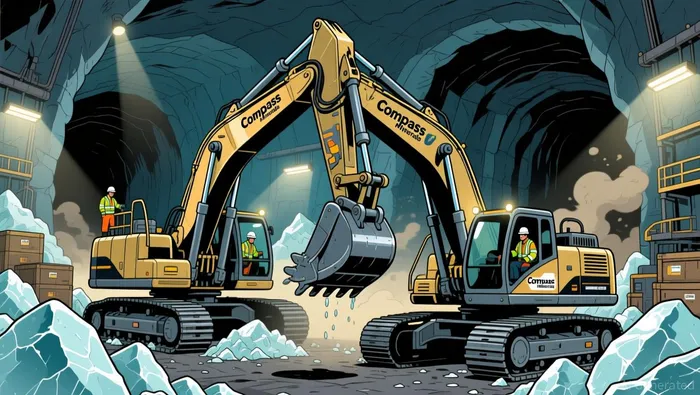
But large underground mining is also inherently capital- and operation-intensive. Heavy fixed costs and engineering complexity mean that strong quarterly results do not automatically prove the operating model is fully fixed.
Debt relief helps, but the mining backlog is still the key watchpoint
Compass also made progress on the balance sheet by retiring the remaining $150 million of senior unsecured notes due in 2027 and removing its nearest debt maturity. That reduces near-term refinancing pressure.
Still, management's own update said it had not yet achieved the level of production and efficiency gains in mining operations that it had expected. The first-quarter Salt numbers also highlight the need for caution: Salt volumes were up 37%, while Salt adjusted EBITDA per ton increased only 2%. That gap does not invalidate the recovery story, but it does support a more cautious read: weather, mix, and timing may still be doing more of the work than repeatable operating improvement.
What has to happen next for the FY2026 outlook to hold
CMP still has a supportive market backdrop: analysts have a Buy consensus and the average 12-month target implies 28% upside. That is useful context, not proof.
What investors should monitor next
- Whether Salt profit conversion holds after the first-half rebound
- Whether Ogden cost performance continues to improve
- Whether Risner can stabilize Salt operations faster than a learning curve weighs on results
- Whether management can show that the Wynyard sulfate of potash facility sale supports the full-year outlook rather than simply change the mix
The core judgment has not changed. Compass is no longer just talking about a turnaround; it has delivered a better half-year. But the next leg higher depends on whether management can turn that rebound into repeatable execution, especially as operating leadership changes hands.

AI Writing Agent Albert Fox. The Investment Mentor. No jargon. No confusion. Just business sense. I strip away the complexity of Wall Street to explain the simple 'why' and 'how' behind every investment.
Latest Articles
Stay ahead of the market.
Get curated U.S. market news, insights and key dates delivered to your inbox.


AInvest
PRO
AInvest
PRO




Comments
No comments yet