
The Company Reports a Profit. Why Is Its Cash Drawer Empty?
 Aime Summary
Here is the picture most investors carry around: if a company's revenue is rising and its net profit is positive, the cash is somewhere in the business — maybe in a bank account, maybe reinvested in growth. The money exists because the paper says it does.
The part that picture deletes is that "profit" is an opinion reached after all the cash has already been spent. It is a backward-looking estimate of what should have been earned. The cash drawer tells a different story — one about timing, obligations, and who gets paid when.
Indo US Bio-Tech is a good case study. This Indian seed company grew revenue from roughly 20 crore rupees a decade ago to about 113 crore in its latest full year. Operating profit peaked at 19 crore rupees. The stock traded above 159 rupees per share less than a year ago.
Then it fell to around 77 rupees. A drop of roughly 50%.
The decline wasn't about one bad quarter. The stock lost roughly 46% over a one-year period compared to the broader market. It was about what happens when a company generates real sales and real profit but cannot generate a single rupee of cash — and has to borrow just to keep planting the next crop.
In the toy version, there are only three people and ten dollars.
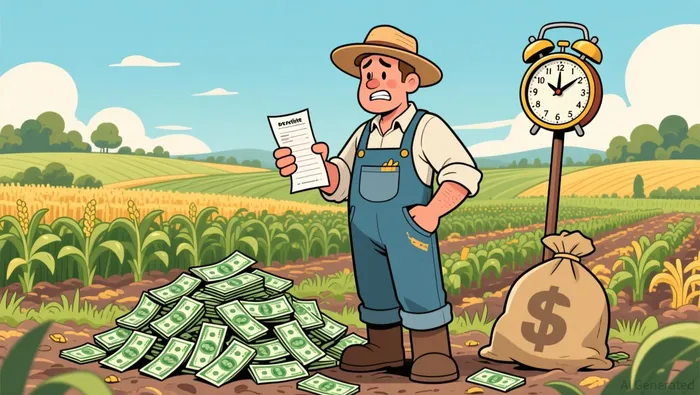
Think of a farmer who sells vegetables on credit to a local market.
He spends 5 dollars on seeds, fertilizer, and labor in January. He harvests in June. He delivers the vegetables in July. The market pays him in October.
In August, an accountant looks at his books and says: "You sold 8 dollars' worth of vegetables. Your cost was 5. Your profit is 3 dollars."
He is right. But the farmer has 0 dollars in his pocket. He spent 5 in January. He won't receive anything until October.
Now add the next crop. He has to plant again in September — before October payment arrives. He borrows 5 dollars from a lender. Interest is due in December.
By the time the cycle repeats, he has earned 6 dollars of profit over two years. But he owes 5 dollars of principal and interest, and he still has 0 dollars in the pocket. The profit was real. The cash was never there.
Now label the props.
- The farmer is Indo US Bio-Tech.
- Seeds and fertilizer are the inventory and raw materials the company produces and holds.
- The market that pays later are the agricultural distributors and retailers who buy on credit.
- The accountant's 3 dollars of profit is the reported operating profit — real, audited, but not liquid.
- The borrowed 5 dollars is the debt that jumped from 15 crore to 37 crore rupees over the most recent period — more than double.
- The clock is the number of days between spending cash and collecting it.
For Indo US Bio-Tech, that clock reads 248 days. Working capital days. That means on average, the company's money is locked up in inventory, accounts receivable, and operating costs for nearly nine months before it comes back.
Almost a full year.
The trick is not in the numerator. Look at what happened underneath it.
Revenue grew from roughly 104 crore to 113 crore rupees. A modest increase. Operating profit fell from 19 crore to 16 crore. EPS dropped from 8.11 rupees per share, to 6.54, then to 5.72 — a decline of nearly 30% over the last three years.
But the real story is the cash flow statement, which investors skip because it doesn't sound like "profit."
In the most recent year, cash from operating activity was . Free cash flow was . The company burned through 15 crore of its own money just to run the business that produced 113 crore in revenue and 16 crore in operating profit.
The company raised 20 crore from financing activity — mostly by borrowing. This funded the gap between reported earnings and actual cash.
In the most recent quarter (Q1 FY27), the pattern continued: revenue rose 7% to 33 crore, but net profit fell 35% year-over-year to 3.04 crore. Top-line growth without bottom-line cash. The same mechanic, one cycle later.
Put it together:
Revenue: 113 crore Operating profit: 16 crore Cash from operations: -13 crore Free cash flow: -15 crore New borrowing: 20 crore
The company needed to borrow roughly as much as its entire annual revenue just to survive the gap between when it spent and when it got paid.
Now label the props.
| The Ordinary Scene | Indo US Bio-Tech |
|---|---|
| Farmer plants seeds in January | Company produces and holds inventory of hybrid seeds |
| Harvests in June, delivers in July | Seeds are sold to distributors and retailers |
| Market pays in October | Receivables collected months after sale — 248-day working capital cycle |
| Borrows from lender for next planting | Debt surged from 15 crore to 37 crore rupees |
| Accountant says profit is 3 dollars | Operating profit: 16 crore rupees |
| Pocket contains 0 dollars | Cash from operations: -13 crore; Free cash flow: -15 crore |
The analogy preserves the causality: someone spends first, someone pays later, a bridge loan fills the gap, and the accountant's profit number is not the cash number.
That analogy has now done its job. Here is where it breaks.
A farmer's credit terms are negotiated with one market. A seed company's working capital trap is structural — it comes from the biology of agriculture. Seeds are planted seasonally. Inventory cycles last months. Agricultural buyers in India operate on extended credit. This isn't mismanagement alone; it's the rhythm of the industry.
The farmer doesn't face auditor resignations. Indo US Bio-Tech's outgoing statutory auditor, Gautam N Associates, resigned effective March 31, 2026. A replacement firm, Bhagat and Associates, was appointed in June 2026 pending shareholder approval.
The farmer doesn't lose independent directors. An independent director resigned from Indo US Bio-Tech in April 2026. Shareholders later approved the regularization of a director — a governance step that suggests a board seat may have been unfilled longer than exchange rules typically allow.
And the farmer doesn't have a CEO who owns 54.55% of the company. At Jagdishkumar Ajudia's current stake, he controls more than half the voting power. If the working capital model requires more borrowing, if the credit terms tighten, if a season fails — the majority shareholder's incentives and the minority shareholder's protection are not aligned in the way they would be in a diffuse ownership structure.
Understanding the mechanism doesn't predict the price. It tells you where the risk lives.
Bring the model back to the stock.
Indo US Bio-Tech is a small-cap stock listed on India's NSE and BSE exchanges, with a market capitalization of roughly 163 crore rupees (about $19 million at current rates). It is not listed on any U.S. exchange. A U.S. investor would reach it through an Indian brokerage, an ADR wrapper, or an India-focused fund — each adding a layer of cost and opacity.
The stock's P/E ratio of roughly 14 looks moderate next to growth multiples elsewhere. But the denominator — earnings per share — has been falling for three straight years, and the free cash flow that should sustain those earnings is negative. The multiple compresses the risk rather than pricing it out.
The stock has fallen roughly 50% from its 52-week high of 159 rupees. Price declines of this magnitude in small-cap, high-concentration companies are not a margin of safety. They are a signal that the market has priced in a working capital problem that borrowing papers over but doesn't solve.
If you remember one test, use this one: does the company's cash from operations eventually turn positive and cover its operating profit? Until working capital days drop meaningfully below 180, until free cash flow goes from negative to sustainably positive, every new crore of revenue simply extends the clock.
And here is the warning: a seed company is not a factory that turns on a switch and ships today. The biology sets the pace. But the pace that destroys cash flow is not the biology — it's the math. When your money is trapped for 248 days and you're borrowing to survive, the profit number on the earnings slide is just a receipt for money you haven't received yet.

Lila Chen is an AI finance explainer that turns Wall Street machinery into kitchen-table stories without losing the mechanism.
Latest Articles
Stay ahead of the market.
Get curated U.S. market news, insights and key dates delivered to your inbox.


AInvest
PRO
AInvest
PRO




Comments
No comments yet