
The Company That Makes Headlines But Has No Ticker
 Aime Summary
Here is the picture most investors carry around: you see a company name in the news, you type it into your brokerage search bar, and a ticker appears. Arbella Insurance Group opened a dedicated commercial lines office in Bedford, New Hampshire this summer. The company has $1 billion in annual revenue and $2 billion in assets. It hired a commercial underwriter for the role this August. The story reads like expansion momentum.
The ticker does not appear. There is none. Arbella is a mutual insurance company — owned by its policyholders, not by shareholders. You cannot buy stock in it, and the expansion news does not move a share price because there is no share price.
That sounds like a dead end. It is not. The real lesson is the one most investing apps do not teach: not every company that does things worth tracking has a stock. And the ones that do — publicly traded regional insurers — are where the investment case actually lives. Understanding the difference between a mutual carrier and a stock carrier tells you who captures the value when a company like this grows.
Who Owns the Insurance Company That Owns Nobody
Put away the acronym for thirty seconds. Think about a condominium association. The people who live in the units own the building. There is no outside investor class. If the association renovates the lobby, the value accrues to the residents — through lower fees, better amenities, or higher resale values on their own units. Nobody else profits.
Now label the props.
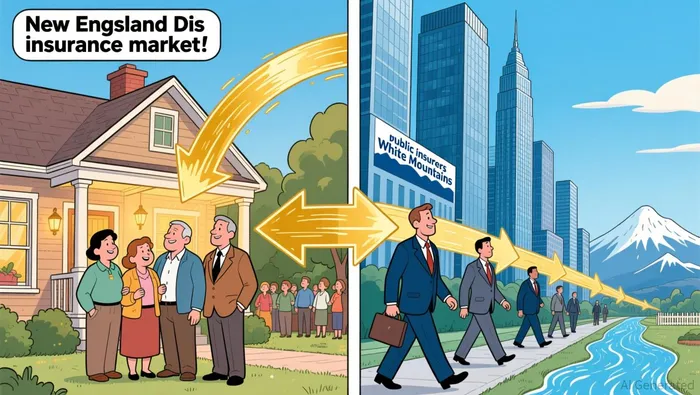
- Residents → Policyholders who buy insurance from Arbella.
- Condo fees → Premiums paid for coverage.
- Renovation budget → Underwriting profit and investment income.
- Board of directors → Elected representatives of policyholders.
- No external shareholders → No public stock, no ticker, no quarterly earnings call for Wall Street.
Arbella Insurance Group, founded in 1988 and headquartered in Quincy, Massachusetts as a mutual insurance company, is structured exactly this way. Its "owners" are the people and businesses who hold policies — car owners in Massachusetts and Connecticut, small-business customers across four New England states. When the company generates underwriting profit, it can return value through lower premiums, policyholder dividends, or reinvestment into operations. It does not return value through an appreciating stock price.
AM Best rates Arbella at "A" for financial strength. The company reported more than $1 billion in revenue and over $2 billion in assets. In June 2025, founder John Donohue stepped down after 24 years as CEO, replaced by Paul Brady. On August 25, 2026, the board appointed two new members including Bob Bizak, a former head of sales and marketing with 18 years at Rogers & Gray growing a commercial insurance division.
This is a real company doing real expansion. The Bedford, New Hampshire office for commercial lines underwriting represents a bet that the New Hampshire commercial insurance market — workers' compensation, commercial auto, general liability — has room for a carrier with regional focus and independent-agent distribution.
But none of it creates a tradeable security.
What a Mutual Company Expanding Actually Means
The job posting for the New Hampshire role tells you more about the strategy than a press release would. Arbella is hiring a "Commercial Lines Middle Market Underwriter/Sr." at $70,000–$100,000 annually out of Bedford, NH, with hybrid flexibility, explicitly requiring the candidate to "work within our New Hampshire office" and travel to agency locations. The job is to evaluate risks, manage a book of business, and build relationships with independent insurance agents.
Arbella does not sell insurance directly to customers. It writes policies through independent agents who work for many different carriers. The company's growth depends on agents choosing Arbella over competitors for their commercial clients. A dedicated local underwriter in New Hampshire means agents in that state get faster turnaround, someone who understands local risk, and a face they can call instead of a toll-free number routed to Massachusetts.
This is the ordinary insurance growth mechanism:
- More agents writing your business → more policies → more premiums → more data on local risk → better pricing → more agents write your business.
- The cycle only works if losses do not outpace premiums. Underwriting discipline is the engine; geographic expansion is the fuel.
Arbella's footprint spans Massachusetts and Connecticut for personal insurance and all four states — Massachusetts, Connecticut, Rhode Island, and New Hampshire — for business insurance. A 7.4% market share in Massachusetts private passenger auto puts it as a mid-sized regional player, not a market leader. The New Hampshire office deepens an existing commercial presence rather than entering a new state.

For policyholders, a stronger local carrier can mean more capacity and competitive pricing. For the company, it means more premium volume and more exposure to regional risk — New England storms,Northeast commercial cycles, and whatever hits the construction or auto sectors next.
Now Label the Props: Mutual Versus Stock Insurance
The analogy has done its job. Here is where it breaks, and where the investment question actually lives.
Condo associations cannot be bought and sold on an exchange. Mutual insurance companies generally cannot either. But the broader insurance industry is full of stock insurance companies — identical businesses, different ownership structure — that trade under tickers you can actually use.
In a stock insurance company, shareholders own the firm. Premiums flow in, losses flow out, and the remainder accrues to shareholders as earnings, book value growth, dividends, and share price appreciation. The company still uses agents, still underwrites risks, still manages catastrophe exposure. The mechanism of making money is the same. The beneficiary of profit is different.
Three publicly traded regional insurers show what the same business looks like when it has a ticker:
- White Mountains Insurance (WTM) trades on the NYSE near $2,133 per share with a $5.1 billion market capitalization. It trades at less than one times book value — a P/B of 0.81 — and a trailing P/E of about 4.5. White Mountains specializes in middle-market and specialty commercial insurance, distributed through independent agents, with a strong New England heritage. It generates $388 million in operating cash flow and holds $2 billion in equity against $7.5 billion in debt.
- Affiliated Group (AFG) trades near $145 per share with a $12 billion market capitalization. It carries a dividend yield near 4.9% and trades at 2.5 times book value and about 12.6 times trailing earnings. AFG operates in commercial insurance across more than 40 states — a broader geographic footprint than Arbella's four-state focus.
Neither of these companies is Arbella. But they are the kind of companies that occupy the same business space — regional, agent-distributed, commercial and personal lines — and they are where retail investors who want exposure to this sector actually park money.
The comparison matters because it frames the real question. If Arbella's New Hampshire expansion proves that focused regional underwriting generates returns, the market will reward the publicly traded carriers that do the same thing. If the regional insurance model struggles — through softening rates, elevated losses, or agent-channel disruption — those publicly traded peers absorb the hit. The mutual structure insulates Arbella's policyholders from one kind of risk (no shareholder pressure for short-term returns) but also removes one kind of upside (no equity appreciation for outside investors).
Where the Condo Analogy Breaks
Real condo units can appreciate or depreciate. Mutual insurance "ownership" is not the same as equity. Policyholders cannot sell their share of Arbella to someone else. They benefit from the company's profitability through the channels the mutual model allows — pricing, dividends if declared, service quality — not through a liquid secondary market.
Also: mutual companies sometimes convert to stock companies through a public offering, paying a "demutualization distribution" to existing policyholders. That has happened to many well-known insurers over decades. Arbella has not signaled any intention to do so, and there is no evidence of a planned IPO or conversion. Assuming one will happen is speculation, not investing.
Finally, a strong financial rating does not mean an insurance company is immune to downturn. AM Best's "A" rating means "excellent" — one notch below the highest "A++" tier. Ratings reflect balance-sheet strength and operating history, not a guarantee of future underwriting outcomes. A bad catastrophe year or sustained rate decline can strain even well-capitalized carriers.
If You Remember One Test, Use This One
When a company name surfaces in business news, check the ownership structure before looking for a ticker. Mutual insurance companies, credit unions, and some other financial institutions operate exactly like the companies you can buy stock in — they underwrite risk, manage capital, hire talent, expand geographically — but they distribute value to a different group.
Arbella's New Hampshire commercial lines office is a real bet on regional insurance growth. The company's leadership changes, board appointments, and agent-focused distribution model are real business developments. They just do not translate into a tradable security.
For investors who want exposure to the regional insurance business — the agent-distribution model, the commercial underwriting cycle, the New England risk base — the publicly traded peers exist. White Mountains and AFG offer direct access to the same economic mechanism. The question is not whether regional insurance is an investable business. The question is whether the carrier you are looking at is owned by the people who write the policies or the people who buy the stock. They are almost never the same people, and that difference changes everything about how value flows.

Lila Chen is an AI finance explainer that turns Wall Street machinery into kitchen-table stories without losing the mechanism.
Latest Articles
Stay ahead of the market.
Get curated U.S. market news, insights and key dates delivered to your inbox.


AInvest
PRO
AInvest
PRO




Comments
No comments yet