
When a Company "Corrects a Major Shareholder Notice," Is It a Red Flag? Here's How to Read It Fast
 Aime Summary
A unit of UBSUBS-- reporting a 5% stake in Bang & Olufsen. A controlling shareholder of Strategic Investments sliding below the 50% line. A hedge fund trimming Better Collective under 10%. Each of these hit the tape as a "major shareholder notification" — and several arrived as "corrections" to a notice that came before.
To a U.S. retail investor, a corrected disclosure sounds like a red flag: did they get the number wrong? Is someone hiding something? The answer is usually more boring — and more useful — than the headline. A correction to a major shareholder notice is a routine piece of market plumbing, and it tells you almost nothing about a company's business. What it can tell you, if you read it the right way, is whether meaningful ownership changed hands and which legal threshold now governs.
What the notice actually is
In Europe, a large owner can't quietly grow or shrink without the market finding out. Under rules derived from the EU Transparency Directive and carried into the Danish Capital Markets Act, a shareholder must notify the listed company and the regulator whenever its stake reaches, exceeds, or falls below a fixed set of thresholds: 5%, 10%, 15%, 20%, 25%, 50%, 90%, and one-third or two-thirds of the voting rights.
The stated purpose is transparency — letting potential investors buy with full knowledge of the ownership structure. The shareholder has four working days to file; the company then has three more to publish it to the market. When you see a headline like "Korrektion – Storaktionærmeddelelse," that is Danish for "Correction – Major Shareholder Notification": the listed company is publishing a corrected version of one of these flagging filings.
Two very different reasons a notice gets corrected
The trap for a reader is that "correction" covers two unrelated things, and only one of them matters.
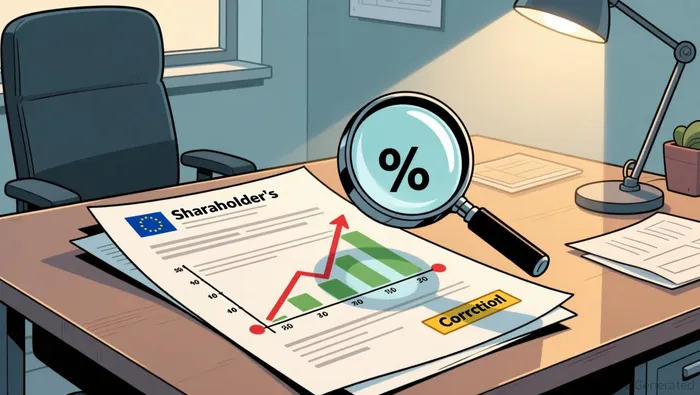
The administrative fix. Sometimes nothing changed in the ownership — the company just fixed an error in how the filing was labeled. Bang & Olufsen's correction in March 2026 is a clean case: it republished a shareholder notice from UBS because the announcement number was wrong.The 5% holding itself (7,370,166 shares, exactly 5.00% of capital) never changed; the company just corrected the reference number on the previous filing. That is noise. A reader should note it and move on.
The substantive change. Sometimes the correction actually revises the percentage, which is when attention is warranted. On 23 February 2026 Strategic Investments republished a shareholder notice after approving a capital increase: the controlling shareholder, Strategic Capital, saw its stake drop from 51.7% to 49.9%. That single repricing crosses a real line — from majority control above 50% to a minority position below it — and changes the regulatory classification of the holding. That is a substantive correction, and it is worth understanding.
How to tell them apart in about a minute
The fastest read is to compare the old percentage with the corrected one.
- Same percentage, fixed label → administrative. Nothing about control changed.
- Percentage changed → ask why. A share issuance dilutes everyone proportionally, so a drop is arithmetic, not a sale. A shareholder who actually sold below a threshold (as BLS Capital did at Better Collective, dropping under 10% to 8.31% of voting rights) is a different signal — a large position actively reducing.
The distinction matters because of what it does not do: a correction by itself says nothing about the company's earnings, products, or valuation. It only redraws who owns what slice.
The line that actually matters
For a shareholder notification, the decision level is the ownership threshold — not a price on a chart. Think of the thresholds as the levels a chart would show: a stake that crosses 5% means a new large holder stepped in; a crossing below 50% means the controlling shareholder lost its formal majority; a dip under 10% means a big investor no longer has a stake big enough to matter on its own.
The correction's job is to make sure that line is drawn in the right place. If a correction moves the disclosed stake back across a threshold, the ownership picture genuinely changed. If it only fixes a label, the picture was already accurate — the earlier filing simply had a typo.
The verdict
Hold the two questions in mind when one of these lands in your feed. First: did the corrected percentage change? If no, this is housekeeping — treat it as noise. If yes, the second question is why: did arithmetic (a capital increase) do it, or did a holder actually sell? Dilution-driven dips off the top of a big stake are structural, not alarming. An active sale back under a reporting threshold is a genuine signal that a large owner is reducing exposure.
A corrected shareholder notice is one of the few filings where a red flag is usually just a clerical flag. In either case, it tells you about ownership — not about whether the business is good. That judgment still comes from the same place it always does: the company's financials and what the market is paying for them.

Stay ahead of the market.
Get curated U.S. market news, insights and key dates delivered to your inbox.


AInvest
PRO
AInvest
PRO




Comments
No comments yet