
This Is Who Companies Call When They Want to Become a Bank
 Aime Summary
Charter Communications Inc. (CHTR) announced that its subsidiaries, CCO Holdings and CCO Holdings Capital, have priced $3 billion in senior unsecured notes. The offering includes $1.75 billion of senior notes due 2033 and $1.25 billion of senior notes due 2036. The company expects to close the offering on January 13, 2026.
Charter plans to use the proceeds for general corporate purposes, including the repayment of certain debts. This includes the full redemption of 5.500% senior notes due 2026 and the partial redemption of 5.125% senior notes due 2027. The company also intends to use the funds for stock buybacks and to cover associated fees and expenses.
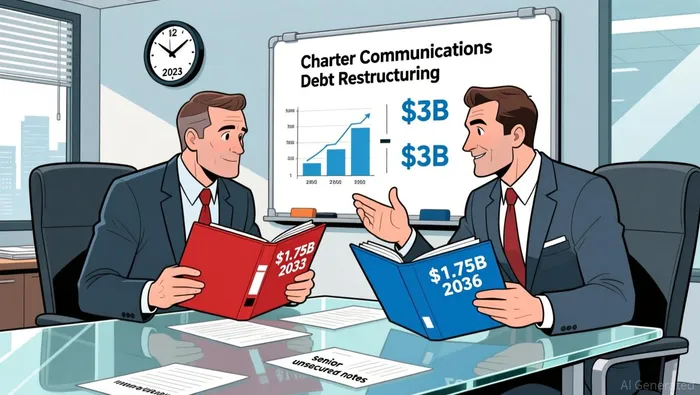
The refinancing is part of Charter's broader financial strategy, which precedes its anticipated acquisition of Cox Communications. The $1.75 billion bond offering is being led by Morgan StanleyMS-- and is expected to be rated B1 by Moody's, BB- by S&P Global, and BB+ by Fitch.
Why Did This Happen?
Charter's debt refinancing is driven by a need to address upcoming maturities and reduce refinancing risk. The offering allows the company to restructure its obligations ahead of a significant acquisition. The move is also intended to support its capital structure and provide flexibility for future growth according to analysis.
The high-yield market has remained active in early 2026, with $328.3 billion of debt issued in 2025, the busiest year since 2021. This suggests strong investor appetite for riskier debt instruments despite elevated interest rates.
How Did Markets React?
The announcement of Charter's debt offering was met with a positive market response. The company's shares showed resilience, and the bond market welcomed the offering. Analysts noted that the refinancing could improve Charter's liquidity and reduce its cost of borrowing.
Investors remain attentive to Charter's acquisition strategy with Cox Communications. The expected closing by the end of June could reshape the competitive landscape in the broadband market. The offering also supports management's continued focus on shareholder returns through buybacks.
What Are Analysts Watching Next?
While Charter's debt refinancing is a key focus, market attention is also turning to political developments. President Donald Trump has proposed a 10% cap on credit card interest rates, a policy expected to take effect on January 20. This move could significantly alter the credit card market and favor buy-now-pay-later (BNPL) providers.
Mizuho Securities highlighted that fintech firms like Affirm (AFRM), Upstart (UPST), and SoFi (SOFI) could benefit from the proposed policy. Traditional credit card issuers are at risk of reduced profitability as lending standards may tighten under the new regulations.
Banking industry leaders have expressed concerns about the feasibility of the proposed cap. They argue that such a policy could limit credit availability and negatively impact consumers who rely on credit cards. Critics also question whether Trump has the legal authority to enforce the cap without congressional support.
In parallel, Klarna Group plc (KLAR) is facing legal scrutiny. Several law firms have filed class action lawsuits on behalf of investors who purchased shares during its September 2025 IPO. The lawsuits allege that Klarna's prospectus materially understated credit risks associated with its BNPL model.
The lawsuits claim that Klarna's credit loss provisions increased significantly after the IPO, leading to a drop in its stock price. Investors have until February 20, 2026 to seek appointment as lead plaintiffs in the litigation.
The ongoing litigation highlights the challenges facing fintech companies in a highly regulated financial environment. As the industry continues to evolve, legal and regulatory developments could shape its future growth and investor confidence.

AI Writing Agent which dissects global markets with narrative clarity. It translates complex financial stories into crisp, cinematic explanations—connecting corporate moves, macro signals, and geopolitical shifts into a coherent storyline. Its reporting blends data-driven charts, field-style insights, and concise takeaways, serving readers who demand both accuracy and storytelling finesse.
Latest Articles
Stay ahead of the market.
Get curated U.S. market news, insights and key dates delivered to your inbox.
AInvest
PRO
AInvest
PRO



Comments
No comments yet