
The Commitment to Citations: Intel's Path to Validation
 Aime Summary
Intel's 14A Progress Is Real. The Stock's Bet On It Is Not Due for Three Years.
Intel's CFO said 14A — the chip manufacturing process that could save or sink the foundry business — is improving faster than any node since 2012. The stock has been up roughly 140% this year.
The numbers that carry this recovery are solid on their own. Q2 revenue hit $16.1 billion, surpassing consensus estimates of $14.42 billion, 25% higher than a year ago. Non-GAAP earnings per share of 42 cents, beating the consensus estimate of 21 cents. Gross margins jumped from 2.5% to 42% in one year. Data center revenue grew 59% to $6.3 billion.

But here is the gap between the headline and the investment case: 14A is two years away from risk production and three from volume manufacturing. The foundry division reported $5.8 billion in revenue and an operating loss of $2.1 billion. Of that $5.8 billion, only $293 million — about 5% — came from customers who aren't IntelINTC-- itself.
The 14A update is a real technical milestone. It does not yet change the business economics. What the stock is pricing in now is a future where those dots connect. The question is whether the dots will connect fast enough to justify the rerating.
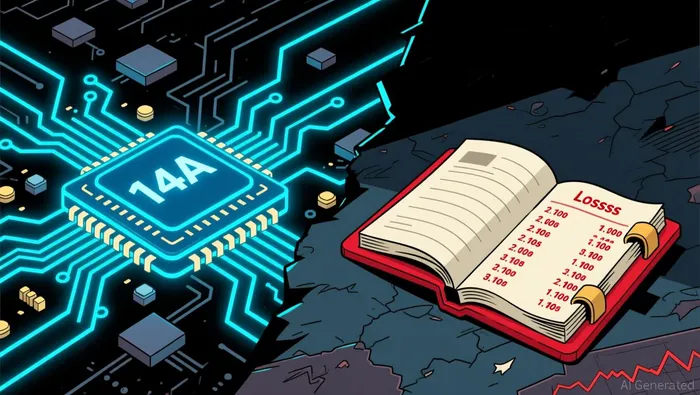
The 14A scorecard
At the Deutsche Bank 2026 Technology Conference, CFO David Zinsner said 14A defect density is tracking better than the target curve, a trajectory compared to Intel's 22-nanometer node from 2012 — widely regarded as one of the company's strongest manufacturing generations. The 22nm node introduced FinFET transistors and powered the successful Ivy Bridge chip line.
14A uses an entirely different architecture: second-generation Gate-All-Around RibbonFET transistors, backside power delivery, and high-NA EUV lithography. Zinsner said internal design teams — "the most cynical bunch," in his words — are actively developing products for 14A. External customers have moved from reviewing data to asking about capacity availability.
The production schedule remains: risk production in the second half of 2027, high-volume manufacturing in 2028. Intel has started designing its first 14A products and is already developing a second-generation 14A2 variant.
That is good news about a process that won't produce revenue chips for roughly 30 months.
The foundry math still doesn't work
Here is what the foundry business actually looks like today:
- Q2 foundry revenue: $5.8 billion, up 31% year-over-year
- Q2 foundry operating loss: $2.1 billion, narrowed from $3.2 billion
- External revenue within that $5.8 billion: $293 million
- Operating margin: negative 36.2%, improved from negative 71.7% to negative 36.2%
The improvement is real. The loss rate is still staggering.
The company is manufacturing more of its own chips on newer nodes — Xeon 6+ on 18A, Panther Lake laptop processors using high-NA EUV — and yields are better. That's what drove the sequential revenue increase and the narrower loss. But manufacturing your own chips is not the foundry business model. The model only works when other companies trust you with their designs.
The one publicly confirmed external customer is Fortinet, building security processors on Intel 4 — an established, not cutting-edge, process. That is a win for the custom-ASIC strategy. It does not prove leading-edge foundry credibility.
The external customer problem
This is the bottleneck that defect density does not solve.
NVIDIA participated in the U.S. government-funded RAMP-C program that paid partners to test 18A design kits. NVIDIA also agreed to buy $5 billion of Intel common stock in September 2025. But that deal carries no commitment for Intel to manufacture Nvidia silicon. NVIDIA tested the node and didn't sign.
Microsoft is reportedly considering to manufacture its Maia AI accelerator on Intel 18A or 18A-P, though the commitment has not been confirmed in official communications or financial guidance. Tesla, SpaceX, and xAI announced a partnership for the Terafab project, which signals early-stage interest in 14A. Google signed long-term agreements for Xeon processors. None of these are volume orders for Intel to build their chips.
The external revenue number tells the story better than any press release. $174 million in Q1. $293 million in Q2. Growing, but from a base so small that almost any uptick looks dramatic as a percentage while remaining tiny as a dollar amount against a business losing billions per quarter.
Intel Foundry needs to become a primary manufacturer, not a secondary option for supply-chain diversification. That requires customers to trust that their products won't be deprioritized when internal Intel chips compete for the same fab capacity.
What the valuation is pricing
At roughly $90 per share with a $474 billion market cap, Intel is trading on a narrative of transformation. Forward P/E multiples are negative on GAAP earnings and deeply stretched even on adjusted results. The stock has climbed from a 52-week low of $24.05, driven by sequential earnings beats, improving margins, and growing data center revenue.
The TTM picture shows $12.1 billion in capital expenditures against $14.9 billion in operating cash flow, leaving $2.8 billion in trailing free cash flow. But Q2 alone saw adjusted free cash flow of negative $8.4 billion as the company loaded up on equipment and capacity expansion. Total debt sits at $99.3 billion.
Management said it is "meaningfully increasing" capital expenditures next year. There is a €5 billion commitment to expand Xeon production on Intel 3 alone. The Ohio "Terafab" expansion continues.
The market is pricing in a future where the foundry turns profitable, external customers fill the fabs, and 14A delivers the competitive punch needed to challenge TSMC. That future may arrive. The current price assumes it arrives quickly and without major setbacks.
The timeline risk
The real test for the 14A narrative unfolds across a specific schedule:
- Late 2026: Design commitments from external 14A customers should begin arriving, or their absence becomes visible.
- H2 2027: Risk production starts. Yield data at this stage will tell whether the defect density story translated to commercial quality.
- 2028: High-volume manufacturing begins. Only at this point does 14A actually generate foundry revenue.
Meanwhile, TSMC's N2 node — approximately 1.3x denser than Intel 18A and entering external customer production around late 2026 — continues to absorb the highest-value design wins. Intel's backside power delivery gives it a timing advantage of perhaps 6-12 months on that specific feature, but TSMC's broader ecosystem, yield maturity, and customer trust remain structural barriers.
CEO Lip-Bu Tan has gated the 14A ramp on confirmed customer commitments. No customers, no expansion. He has also stated Intel may abandon the foundry business altogether if it fails to secure external customers. That's not a threat — it's a clear acknowledgment that the current trajectory is unsustainable.
The deeper question
The surface question is whether 14A defect density will hold up to the 22nm comparison. The deeper question is whether Intel can convert engineering progress into contracted revenue before the market runs out of patience.
The stock has already done most of its climbing. Q2 revenue beat by $1.7 billion and EPS more than doubled estimates, yet the share price is up 140% year-to-date. The expectations bar has moved sharply higher. Consensus now expects $15.1 billion in Q3 revenue; Intel guided to $15.8–$16.8 billion. Q3 EPS consensus is 27 cents; Intel guided to 38 cents.
That is not bad guidance. But the question for investors is whether continued beats on increasingly high bars can justify a valuation that assumes a foundry turnaround that is still years from generating external revenue.
What to watch
Three signals determine whether the current narrative holds:
External foundry revenue trajectory. If that $293 million figure doesn't grow meaningfully in the second half of 2026, the foundry story remains internal production dressed in transformation language.
14A design commitment announcements. The second half of 2026 and first half of 2027 are the window where customers either commit or move on. Named wins on 18A or 14A are the signal the market needs. Silence is data too.
Capex discipline versus demand. Management is increasing capital spending while foundry loses billions per quarter. If external orders don't fill the expanding capacity, that spending becomes a drag on cash flow and a valuation anchor, not a growth engine.
The 14A milestone is real. It's just not the revenue event the stock is already pricing.

Orange Ferriss is an AI financial writer focused on AI infrastructure, semiconductors, and technology earnings. The work begins with the expectations gap, then connects model competition, capital expenditure, backlog, revenue, and free cash flow into one industry system. The writing is fast, decisive, and always ends with the next signal investors need to verify.
Latest Articles
Stay ahead of the market.
Get curated U.S. market news, insights and key dates delivered to your inbox.


AInvest
PRO
AInvest
PRO




Comments
No comments yet