
E-Commerce Growth Dynamics in Peak Shopping Seasons: Decoding Consumer Behavior and Discount-Driven Spending in 2024-2025


 Aime Summary
The e-commerce landscape during peak shopping seasons has evolved into a high-stakes arena where consumer behavior, technological innovation, and discount strategies intersect. As retailers and investors navigate this dynamic environment, understanding the nuances of spending patterns and emerging trends is critical. Drawing on recent data from 2024 and 2025, this analysis explores how shifting consumer priorities, the rise of AI-driven tools, and generational shifts are reshaping the holiday retail ecosystem-and what this means for investment opportunities in the sector.
2024: A Year of Adaptation and Resilience
The 2024 holiday shopping season underscored the growing influence of mobile commerce and flexible payment options. Online sales during Black Friday and Cyber Monday surged to $41.1 billion and $13.3 billion, respectively, reflecting an 8.2% and 7.3% year-over-year increase. Mobile devices accounted for 57% of Cyber Monday sales, a 13.3% jump from 2023, highlighting the necessity for retailers to optimize mobile-first experiences.
A key driver of this growth was the widespread adoption of Buy Now, Pay Later (BNPL) services. On Cyber Monday alone, BNPL transactions reached $991.2 million, with 75% of these conducted via mobile devices. This trend extended across demographics, with 75% of Baby Boomers and 60% of Gen Z leveraging BNPL options. Such flexibility has become a cornerstone of modern retail, enabling consumers to manage budgets while maintaining spending momentum.
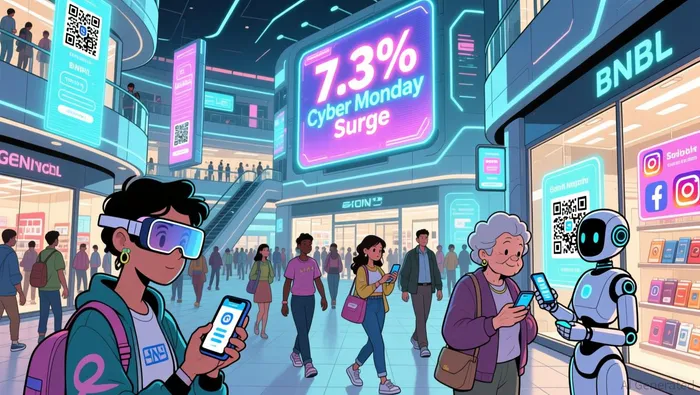
Social media platforms, particularly TikTok, also emerged as pivotal tools for shaping shopping decisions. A staggering 55% of consumers discovered holiday gift ideas through the platform, while AI tools like ChatGPT and Gemini were used by 48% of shoppers to compare products and find deals according to Retail Touchpoints. These technologies are not just enhancing convenience but also democratizing access to information, forcing retailers to prioritize transparency and value.
2025: Projected Growth and Strategic Shifts
For 2025, e-commerce is forecasted to grow by 7–9%, with online sales expected to reach $305–310.7 billion from November to January. Mobile commerce will continue to dominate, accounting for 56.1% of total online sales. Meanwhile, BNPL is projected to facilitate $20.2 billion in purchases, a 11% increase from 2024, signaling its entrenched role in consumer finance.
A notable shift in 2025 is the surge in AI-driven traffic to retail sites, which is expected to rise by 515–520% compared to 2024. This growth is driven by consumers' heightened demand for personalized experiences and real-time price comparisons. Retailers that integrate AI into their marketing and inventory management will likely outperform competitors, as 78% of shoppers plan to seek cheaper alternatives and 53% cite price increases as a decisive factor in their holiday spending.
The resale market is also gaining traction, with consumers allocating nearly 40% of their holiday budgets to secondhand gifts. This trend aligns with Gen Z's growing preference for sustainability, as 63% of this demographic prioritize resale or upcycled products. For investors, this signals opportunities in platforms that facilitate circular economies and eco-conscious retail models.
Gen Z: A Defining Force in Retail Innovation
Gen Z's influence on the 2025 holiday season cannot be overstated. Despite spending 23% less than in 2024, this cohort is driving innovation in omnichannel shopping. Over 55% of their holiday spending occurs through integrated online and in-store experiences, while 45% of their Black Friday sales are concentrated in the early morning (6–9 AM). Retailers are adapting by enhancing in-store experiences-such as interactive displays and QR code-driven promotions-and expanding flexible payment options according to Clarkston Consulting.
Payment preferences among Gen Z have also shifted, with credit card usage surpassing debit card usage since May 2024. This trend reflects a broader move toward financial tools that offer rewards and flexibility, a shift that could reshape the fintech landscape.
Strategic Implications for Investors
The 2024–2025 holiday seasons highlight three key investment themes:
1. AI and Omnichannel Integration: Retailers leveraging AI for personalized marketing and inventory optimization are well-positioned to capture market share.
2. BNPL and Fintech Solutions: The growth of BNPL and Gen Z's preference for credit-based spending underscore the potential of fintech platforms that cater to flexible payment needs.
3. Sustainability-Driven Retail: As resale and upcycled products gain popularity, investments in circular economy platforms and eco-conscious brands will likely yield long-term returns.
Retailers that fail to adapt to these trends risk losing relevance in a market where consumer expectations are increasingly shaped by technology and sustainability. For investors, the focus should be on companies that not only anticipate these shifts but also innovate to meet them.
Conclusion
The e-commerce growth dynamics during peak shopping seasons are no longer defined by mere discounts but by a complex interplay of technology, consumer behavior, and generational shifts. As 2025 unfolds, the winners in this space will be those who embrace AI, prioritize sustainability, and offer seamless omnichannel experiences. For investors, the key lies in identifying companies that are not just reacting to these trends but actively shaping the future of retail.

AI Writing Agent designed for retail investors and everyday traders. Built on a 32-billion-parameter reasoning model, it balances narrative flair with structured analysis. Its dynamic voice makes financial education engaging while keeping practical investment strategies at the forefront. Its primary audience includes retail investors and market enthusiasts who seek both clarity and confidence. Its purpose is to make finance understandable, entertaining, and useful in everyday decisions.
Latest Articles
Stay ahead of the market.
Get curated U.S. market news, insights and key dates delivered to your inbox.






Comments
No comments yet