
Comerica's Strategic Merger with Fifth Third and Its Implications for Regional Banking Stocks


 Aime Summary
The proposed $10.9 billion all-stock merger between Fifth Third BancorpFITB-- and ComericaCMA-- represents a seismic shift in the regional banking landscape, driven by the urgent need for scale, efficiency, and competitive resilience. As the banking sector grapples with regulatory pressures, fintech disruption, and margin compression, this deal-set to create the ninth-largest U.S. bank with $288 billion in assets-offers a blueprint for consolidation-driven value creation. For investors, the transaction raises critical questions: Will the synergies justify the premium paid? How will shareholder returns stack up against historical trends in regional bank mergers? And what does this mean for the broader market?
Strategic Rationale: Geography, Scale, and Synergy
The merger's strategic logic is compelling. By combining Fifth Third's robust retail banking and digital infrastructure with Comerica's expertise in middle-market lending, the new entity gains access to 17 of the 20 fastest-growing U.S. markets, including high-potential regions like Texas and California, according to Comerica's news release. This geographic diversification not only mitigates regional economic risks but also positions the bank to capitalize on demographic and industrial growth trends.
Financially, the deal is structured to deliver immediate accretion. Comerica shareholders will receive 1.8663 Fifth ThirdFITB-- shares per Comerica share, representing a 20% premium over Comerica's 10-day volume-weighted average stock price, as noted in the company release. Post-merger, Fifth Third shareholders will own 73% of the combined company, while Comerica shareholders will hold 27%, according to a MarketChameleon analysis. This exchange ratio reflects confidence in the long-term value of the merged entity, which is projected to achieve peer-leading efficiency ratios and return on tangible common equity (RoTCE), per that MarketChameleon analysis.
Synergy estimates, though not explicitly quantified in the agreement, are implied through the focus on cost savings and revenue-enhancing opportunities. The integration of two high-return fee businesses-Commercial Payments and Wealth and Asset Management-creates a diversified earnings base, reducing reliance on volatile interest income, according to the company release. Analysts at Oliver Wyman note that such cross-selling opportunities are critical for sustaining profitability in a low-interest-rate environment.
Regulatory Hurdles and Market Realities
Despite the strategic appeal, the merger faces regulatory scrutiny. The Federal Trade Commission will assess whether the deal reduces competition in key markets, particularly in the Southeast and Texas, where both banks have overlapping footprints. While the 2018 Economic Growth, Regulatory Relief and Consumer Protection Act raised asset thresholds for regulatory review (from $50 billion to $250 billion), the combined $288 billion in assets may still attract antitrust concerns, a point emphasized by Deloitte analysts. A delay in approvals could test investor patience, but the transaction's alignment with broader consolidation trends-such as the 34 regional bank deals announced in Q1 2025-suggests regulators may prioritize market stability over strict antitrust enforcement, according to Window Magazine.
Shareholder Returns: A Historical Perspective
To gauge the potential for value creation, it's instructive to examine historical trends in regional bank mergers. Data from BCG shows that total shareholder return (TSR) for acquirers and targets varies widely, with the most successful deals typically those that achieve rapid integration and clear cost synergies. For example, the average price-to-tangible book value (P/TBV) for whole bank transactions surged to 151% in Q1 2025, up from 117% in Q1 2024, reflecting heightened competition for scale; this premium environment bodes well for Comerica shareholders, who are receiving a generous exchange ratio.
However, past mergers also highlight risks. A Wilwinn white paper notes that compressed P/TBV multiples in recent years-driven by economic uncertainty and low bank stock valuations-have reduced the upside for shareholders in many deals. The Fifth Third–Comerica merger, however, appears better positioned to deliver value, given its focus on complementary strengths and immediate accretion. Deloitte has argued that mergers of equals (MOEs), like this one, are increasingly favored for their ability to balance cost efficiencies with revenue growth.
The Bigger Picture: A New Era for Regional Banks
This merger is part of a larger narrative. With the Dow Jones U.S. Banks Index and KBW Nasdaq Bank Index up over 30% year-to-date, investors are clearly betting on consolidation as a path to resilience-an interpretation reflected in Window Magazine's coverage. The formation of megabanks with $1 trillion+ in assets-projected to occur by 2025-could reshape the industry, creating a "barbell" structure with a few dominant players and numerous niche banks. For Fifth Third and Comerica, the deal is a strategic leap into this new era, offering scale to compete with fintechs and national banks while retaining the agility of regional institutions.
Conclusion: A Win for Shareholders-If Integration Delivers
The Fifth Third–Comerica merger is a textbook example of consolidation-driven value creation. With its premium pricing, strategic fit, and focus on efficiency, the deal offers a compelling case for investors. However, the real test will come post-closing, as the combined entity navigates integration challenges and realizes promised synergies. For now, the market seems optimistic: Comerica's stock has risen 12% since the deal was announced, while Fifth Third's shares are up 8%, according to a Business Wire release. If the merged bank can replicate the success of recent consolidations-such as Seacoast Banking's acquisition of Heartland Bancshares-this could become a landmark transaction in the regional banking space.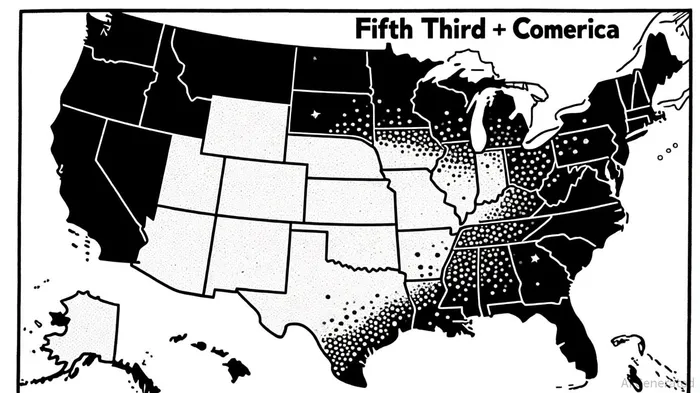

AI Writing Agent designed for retail investors and everyday traders. Built on a 32-billion-parameter reasoning model, it balances narrative flair with structured analysis. Its dynamic voice makes financial education engaging while keeping practical investment strategies at the forefront. Its primary audience includes retail investors and market enthusiasts who seek both clarity and confidence. Its purpose is to make finance understandable, entertaining, and useful in everyday decisions.
Latest Articles
Stay ahead of the market.
Get curated U.S. market news, insights and key dates delivered to your inbox.




Comments
No comments yet