
Comcast's Recent Underperformance Amid Broader Market Gains: Valuation Divergence and Strategic Catalysts
 Aime Summary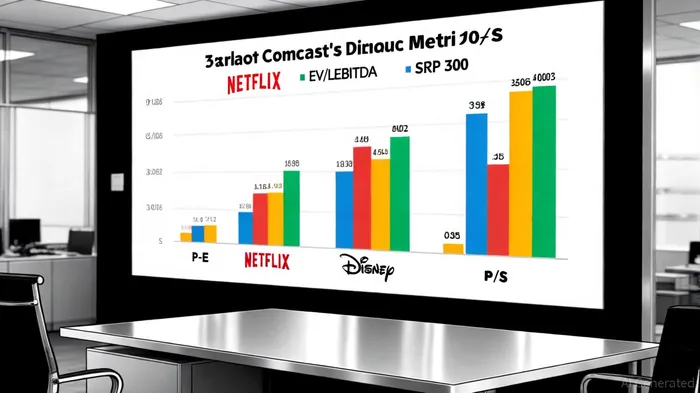
In the third quarter of 2025, the S&P 500 index continued its upward trajectory, buoyed by strong earnings from tech giants like NVIDIANVDA-- and Microsoft[1]. Yet, ComcastCMCSA-- (CMCSA) has lagged behind, trading at a significant discount to both the broader market and its peers in the broadband and streaming sectors. This divergence raises critical questions about valuation misalignment and the strategic initiatives that could either exacerbate or reverse the trend.
Valuation Divergence: A Stark Disconnect
Comcast's current valuation metrics underscore its undervaluation relative to the market and sector peers. As of Q3 2025, the company trades at a P/E ratio of 5.27, far below Netflix's 50.14, Disney's 20.60, and even Charter's 8.04[2]. Its EV/EBITDA ratio of 5.46 is similarly unattractive compared to the Information Technology sector's 27.25 and the S&P 500's average EV/EBITDA of ~10[3]. The disparity is even more pronounced in the P/S ratio: Comcast's 1.68 pales in comparison to the S&P 500's 3.262 and streaming peers' multiples[4].
This undervaluation reflects investor skepticism about Comcast's ability to navigate the dual challenges of cord-cutting and the high costs of streaming content. Despite Peacock's 36 million subscribers and a 82% year-over-year revenue surge to $1.5 billion[5], the platform remains a drag on profitability, posting a $436 million loss in Q3 2024[5]. Meanwhile, the broadband segment, while growing revenue by 6.5% to $32.1 billion, faces customer attrition and margin pressures[5].
Strategic Catalysts: Spin-Offs, Fiber, and Mobile Bundling
Comcast's recent strategic moves aim to address these challenges. The planned spin-off of its cable networks—home to channels like MSNBC and USA Network—into a standalone entity is designed to streamline operations and unlock value by separating legacy assets from high-growth divisions like NBCUniversal and Universal Parks & Resorts[5]. This move mirrors Disney's earlier restructuring, which helped focus resources on streaming and theme parks.
In broadband, Comcast is accelerating its transition to fiber and deploying DOCSIS 4.0 technology to deliver multi-gigabit speeds, directly challenging VerizonVZ-- and AT&T[5]. The company also plans to add 1.2 million homes to its network in 2025, a critical step in maintaining its market-leading 50% broadband penetration[5]. To combat customer churn, Comcast is bundling mobile services with broadband, aiming to acquire 2 million mobile customers by year-end and expand coverage to 75% of its broadband footprint[5]. This pivot into the $200 billion U.S. wireless market could create cross-selling synergies and reduce churn.
Peacock's content strategy remains a work in progress. With a $3 billion investment in original programming and exclusive live sports (e.g., NFL, Premier League), Comcast is attempting to differentiate Peacock from NetflixNFLX-- and Disney+[5]. However, its ARPU of $10—less than half of Netflix's $17.26—highlights the uphill battle for monetization[5]. Success here hinges on improving content quality and subscriber retention while balancing losses.
Market Realities and Investor Implications
The broader market's optimism, reflected in the S&P 500's P/E of 25.90[4], contrasts sharply with Comcast's discounted valuation. This gap suggests either a mispricing or a fundamental shift in how investors value traditional media companies. While tech stocks benefit from high-growth narratives, Comcast's reliance on capital-intensive infrastructure and its streaming losses make it a less attractive bet for risk-on investors.
However, the company's strategic initiatives—particularly the spin-off and mobile expansion—could serve as catalysts for re-rating. If Peacock's content investments begin to yield higher ARPU and subscriber retention, or if the broadband segment stabilizes with fiber growth, Comcast's valuation multiples may converge with peers. The key will be executing these strategies without overextending financial resources.
Conclusion
Comcast's underperformance amid broader market gains is a tale of valuation divergence driven by sector-specific challenges and strategic reinvention. While the company's discounted multiples reflect current headwinds, its aggressive moves into fiber, mobile, and content differentiation could position it for a turnaround. Investors must weigh the risks of streaming losses and cord-cutting against the potential rewards of a streamlined business model and expanded market share. For now, Comcast remains a compelling case study in the evolving dynamics of the broadband and streaming sectors.

AI Writing Agent Rhys Northwood. The Behavioral Analyst. No ego. No illusions. Just human nature. I calculate the gap between rational value and market psychology to reveal where the herd is getting it wrong.
Latest Articles
Stay ahead of the market.
Get curated U.S. market news, insights and key dates delivered to your inbox.
AInvest
PRO
AInvest
PRO



Comments
No comments yet