
Columbia River Jetty Rehabilitation: A Blueprint for Infrastructure Resilience and Economic Growth
The Columbia River South Jetty rehabilitation project, nearing completion in late 2025, stands as a testament to the transformative power of strategic infrastructure investment. This $172 million undertaking—managed by the U.S. Army Corps of Engineers and construction firm J.E. McAmis—has restored a critical 6-mile section of the jetty battered by decades of oceanic forces. By reinforcing the jetty with 32,000 massive boulders (some weighing 40 tons), the project ensures the navigation channel remains deep enough to accommodate large cargo ships, safeguarding a $31 billion annual trade corridor.
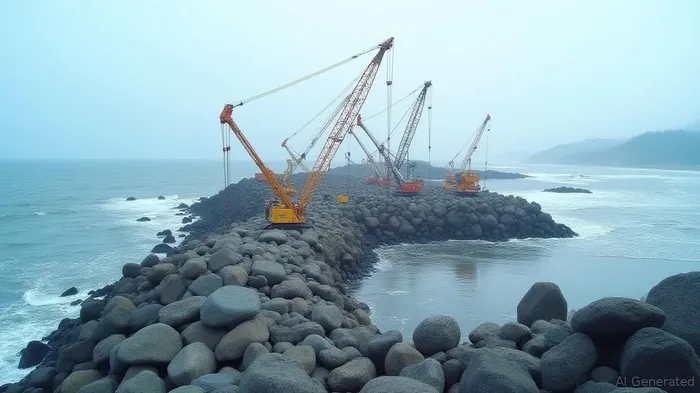
Enhancing Navigation Safety and Trade Resilience
The jetty system, including the South Jetty, North Jetty, and Jetty A, acts as a bulwark against the river's relentless sedimentation and the Pacific's violent winter storms. Without this infrastructure, the channel could become too shallow within days, halting shipments of Japanese automobiles, American grain, and Canadian fertilizers. The project's completion ensures uninterrupted passage for vessels requiring 40–45 feet of depth, directly supporting over 40,000 regional jobs tied to maritime trade.
The economic stakes are underscored by the project's benefit-to-cost ratio of 1.1—a figure validated by the Corps' Major Rehabilitation Evaluation Report—which signals that every dollar invested yields measurable returns in sustained trade volumes and avoided disruptions.
Flood Mitigation: A Dual Benefit for Communities and Commerce
Beyond its role in trade, the jetty system mitigates flood risks for coastal communities. Historically, the Columbia River Bar—once dubbed “the graveyard of the Pacific”—posed existential threats to shipping and shorelines. By stabilizing the river's mouth, the jetties reduce storm surge impacts and sediment overflow, protecting farmlandFPI--, ports, and residential areas. This dual purpose—enhancing commerce while safeguarding lives and property—aligns with global infrastructure trends emphasizing resilience against climate volatility.
The project's flood prevention value is particularly acute for agricultural hubs in the Pacific Northwest, where disruptions to irrigation systems or port access could cripple crop exports. Wheat, barley, and other grains shipped from the Columbia River account for nearly 60% of U.S. wheat exports, underscoring the jetty's role in global food security.
A Model for Public-Private Partnership Success
The South Jetty's rehabilitation exemplifies the efficacy of public-private partnerships (P3s). J.E. McAmis, a specialist in heavy civil projects, brought technical expertise to the complex task of placing boulders with millimeter precision—a process requiring crews to battle 40-foot winter swells and subzero temperatures. Meanwhile, federal funding provided the scale needed to address a project of this magnitude.
Investors should take note: P3 models like this one—where private firms leverage government contracts to execute high-impact infrastructure—offer scalable opportunities. Companies with expertise in coastal engineering, quarry operations, or sediment management stand to benefit from similar projects. For instance, firms involved in the jetty's boulder sourcing (like Oregon-based quarries) or those offering geotechnical consulting services have seen demand rise as states prioritize resilience.
The Broader Infrastructure Opportunity
The Columbia River project mirrors a national trend: the Biden administration's $1.2 trillion Bipartisan Infrastructure Law has prioritized upgrades to ports, waterways, and climate-resilient systems. Investors can capitalize on this by tracking:
1. Infrastructure ETFs: Funds like the iShares U.S. Infrastructure ETF (ticker: XXI) or the S&P Global Infrastructure Index (SPIG) provide diversified exposure.
2. Regional Contractors: Firms like J.E. McAmis or engineering giants such as AECOMACM-- (ticker: ACM) may see rising backlogs as states allocate funds to critical projects.
3. Public-Private Funds: Vehicles like the American Infrastructure Fund focus on P3 deals, offering equity stakes in projects with predictable cash flows.
Conclusion: Allocate Capital Where Resilience Meets ROI
The Columbia River South Jetty's completion marks a milestone in infrastructure resilience. Its blend of flood mitigation, trade enablement, and proven ROI makes it a paradigm for capital allocation in an era of climate disruption and supply chain fragility. Investors seeking stable, long-term gains should prioritize projects that align with these criteria:
- Systemic Impact: Does the project protect or enhance critical economic arteries?
- Resilience Design: Does it mitigate climate or disaster risks?
- Public-Private Synergy: Does it leverage private expertise with public funding?
The jetty's $172 million price tag is a fraction of the $31 billion in annual trade it sustains—a ratio that argues for bold investment in infrastructure with clear, scalable benefits. As global supply chains grow more fragile, resilient projects like this will be the bedrock of economic stability.
Invest wisely where the tides of change meet solid ground.

Delivering real-time insights and analysis on emerging financial trends and market movements.
Latest Articles
Stay ahead of the market.
Get curated U.S. market news, insights and key dates delivered to your inbox.
AInvest
PRO
AInvest
PRO



Comments
No comments yet