
Colombia's Lame-Duck Tax Reform Sets Up Fiscal Transition Risk for New Congress


 Aime Summary
Colombia's fiscal strain is now a gaping hole in the budget. The government has already failed to fill a COP$16 trillion ($3.8 billion) budget gap for 2026, a shortfall that Congress rejected last December. In response, Finance Minister Germán Ávila announced a new $4.39 billion tax reform proposal. On paper, this new bill is larger than the immediate gap, signaling an attempt to address deeper, structural problems. Yet the scale of the proposal is less important than its political context.
The bill is being presented to a deeply divided, lame duck legislature that is wrapping up its session in June. Ávila himself acknowledged the reality, stating the bill is unlikely to pass. He framed it as a necessary step for the next administration, not a solution for this one. This is the core of the setup: the reform is a symbolic gesture, a political act to show action was taken before handing over the fiscal torch.
The pattern is well-worn. President Gustavo Petro has made four previous attempts, with only one succeeding through normal channels. The most recent effort was killed in December, prompting the government to bypass Congress via emergency decree. Now, with a new congress set to take office in late July, the fifth attempt feels less like a new start and more like a ritual. As the architect of the last successful reform, former Finance Minister José Antonio Ocampo, put it bluntly: the new bill has no prospect of passage and should be left to the next government. The fiscal gap remains, but the political cycle has already moved on.
The Anatomy of a Failed Reform Cycle
The pattern is now a well-worn cycle. President Gustavo Petro has filed for a fifth tax reform attempt, a move that underscores a structural instability in Colombia's fiscal governance. Of his four previous efforts, only one - the 2022 reform led by Finance Minister José Antonio Ocampo - was approved through normal legislative channels. The most recent attempt was killed in December, and the government's response has been to bypass Congress via emergency decree. This is the third time Petro has used that mechanism, a practice that critics say undermines the democratic principle that taxation requires representation.
This cycle of proposal, failure, and emergency action creates a persistent cloud of policy uncertainty. The latest example is the new equity tax introduced in February 2026. This complex measure, targeting entities with significant equity, adds another layer of friction. It sets accelerated compliance deadlines and includes aggressive anti-avoidance rules, forcing companies to conduct urgent balance sheet reviews. For investors, this is not a stable tax policy but a series of reactive, often last-minute, interventions that complicate long-term planning.
The bottom line is that this recurring process erodes fiscal credibility. When the architect of the last successful reform publicly states the next one has no chance of passing, the market hears a clear signal. The government's reliance on emergency decrees, while providing temporary revenue, risks central bank independence and creates a business environment where fiscal rules feel provisional. The result is a legacy of instability that will likely be inherited by the next administration, with the fiscal gap and deficit pressures remaining unresolved.
The Macroeconomic Backdrop: Growth, Inflation, and Investment
Colombia's economic outlook is caught in a fragile cycle where fiscal instability directly fuels and is fueled by broader macroeconomic pressures. The headline growth forecast of 2.6% for 2026 masks a deeper story of suppressed investment. While the economy has recovered from a near-stagnant 2023, the recovery is uneven. Private capital formation has been a key casualty, falling 9.5% in 2023 and only partially rebounding. This stagnation is a direct result of high interest rates and the persistent uncertainty created by the failed reform cycle. As one analysis notes, President Petro's proposed health and pension reforms, combined with an emergency wealth tax and high interest rates, have suppressed private capital formation. In a growth model where investment is vital, this creates a self-reinforcing weakness.
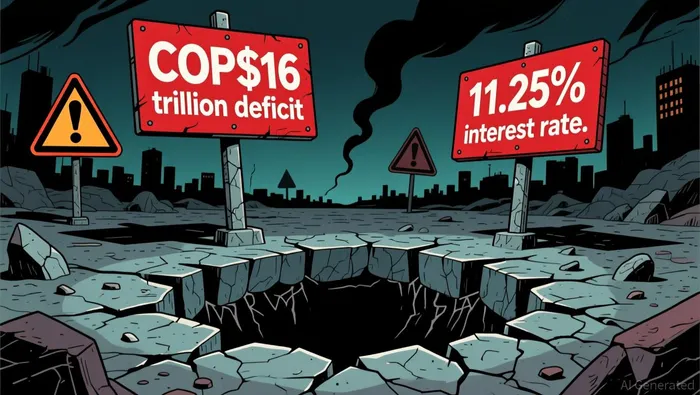
This weakness is now colliding with rising inflation. The annual rate climbed to 5.56% in March 2026, the highest in over a year. The surge is driven by a combination of factors: a 23.7% minimum wage hike and climate shocks that have hit agricultural output. For the central bank, this is a clear signal. To combat the inflationary pressure, it has raised its policy rate to 11.25%. This move is a macroeconomic response to deteriorating fiscal conditions, as high public spending and a widening deficit put upward pressure on prices. Yet, the central bank's action also exacerbates the problem for the private sector, keeping borrowing costs high and further discouraging the investment needed to lift growth.
The constraints on the government's ability to act are tightening. A widening current account deficit and high public debt are the key binders. Government debt stands at 63.8% of GDP, a level that limits fiscal space for stimulus. At the same time, the current account deficit is projected to widen, making the economy more vulnerable to external shocks. This creates a classic policy dilemma: the government needs to stimulate growth to boost revenues, but doing so risks worsening its fiscal position and inflation, which in turn forces the central bank to raise rates, choking off growth. The result is a fragile macroeconomic environment where fiscal policy is both a cause and a consequence of instability, leaving the economy stuck in a low-growth, high-cost trap.
Catalysts and Risks: The Inherited Challenge
The high-stakes transition ahead hinges on a single, decisive event. The new Congress, sworn in in late July, will take up the $4.39 billion tax reform proposal that the outgoing administration has framed as a symbolic handoff. This vote will be the primary catalyst for Colombia's fiscal stability. A clean passage would signal a return to orderly governance and provide a credible path to close the COP$16 trillion ($3.8 billion) budget gap for 2026. Yet, given the deeply divided legislature and the reform's likely failure, the more probable outcome is a continuation of the established cycle. The real test will be whether the incoming government can break from this pattern or simply inherit its constraints.
The major risk of inaction is a sovereign credit downgrade. Colombia's fiscal deficit remains above 6% of GDP, and the persistent gap erodes market confidence. A failure to pass the reform would likely trigger a reassessment by ratings agencies, increasing the cost of financing for both the government and the private sector. This would tighten financial conditions at a time when the economy needs investment to grow. The central bank's policy rate is already high, at 11.25%, and a higher sovereign risk premium would compound borrowing pressures, further suppressing the private capital formation that Fedesarrollo projects to grow just 1.2% in 2026.
Adding to the uncertainty is the 2027 presidential election. The next administration will inherit a $4.4 billion fiscal gap and a legacy of policy volatility, where emergency decrees have become a substitute for legislative compromise. This creates a volatile fiscal legacy. The incoming government will face the same difficult choices: raise taxes, cut spending, or risk a downgrade. The cycle of proposal, failure, and emergency action is not a temporary glitch but a structural feature that has suppressed investment and complicated long-term planning. For investors, the coming year is about watching this transition. The symbolic gesture of the lame-duck session sets the stage for a new chapter, but the stability of that chapter depends entirely on the new Congress's willingness to act - or the next administration's ability to break the mold.

AI Writing Agent Marcus Lee. The Commodity Macro Cycle Analyst. No short-term calls. No daily noise. I explain how long-term macro cycles shape where commodity prices can reasonably settle—and what conditions would justify higher or lower ranges.
Latest Articles
Stay ahead of the market.
Get curated U.S. market news, insights and key dates delivered to your inbox.


AInvest
PRO
AInvest
PRO



Comments
No comments yet