
“Collecting $9,900 a Month” Is Just Arithmetic — the Yield Has to Be Earned
 Aime Summary
"Collecting $9,900 a Month" Is Just Arithmetic — the Yield Has to Be Earned
A retirement headline like "collects $9,900 a month" does its job: it makes income sound like a faucet you can turn on. Before letting the number comfort you, do the arithmetic the headline skips. $9,900 a month is $118,800 a year. At a 5% blended yield that takes roughly $2.4 million of invested capital; stretch the average to 6% and it needs about $2.0 million; reach 7% and you can start from around $1.7 million. Time the headline a different way — a 70-year-old without a pension is trading a lump sum for a lifelong rent check — and the goal is to stop selling principal and let the portfolio pay the bills.
The math is never the hard part. The hard part is the one thing no headline shows: every one of those yield percentages has to be an income stream actually earned, quarter after quarter, or it is a number the market suspects is about to fail. Yield is a filter, not a conclusion. The same advertised percentage can be a bargain in one company and a trap in another, and the only way to tell the difference is to ask where the cash comes from — and to use the test that fits the asset, not the one that flatters it.
The wrong test makes a safe dividend look broken
Start with the easiest lesson, because it will save you from the most expensive mistakes. When a retiree's screen flashes a payout ratio, that number has no meaning until you know what kind of company the ratio belongs to.
Realty Income, the landlord that pays monthly, is the cleanest example. At today's price it yields about 5.4% and has paid a dividend for 24 consecutive years, raising it most of that time. A naive trailing payout ratio reads near 287% — dividends that appear to outrun earnings, which on an ordinary company would be a red flag that a cut is coming. But a real estate investment trust is not an ordinary company. Depreciation is a non-cash charge that drags reported earnings far below the cash the properties actually throw off, so the number to test is adjusted funds from operations, the cash-flow measure REITs report precisely for this reason. For all of 2025, Realty IncomeO-- produced $4.28 of AFFO per share against $3.22 of dividends paid — a payout near 75%, or coverage of roughly 1.3 times. Same company, same dividend: the headline ratio whispers trouble while the right measure says the rent check is booked.

That mismatch is why the first discipline is to match the test to the machine. An ordinary dividend-paying corporation pays from free cash flow. Verizon yields about 5.5% and has raised for 20 straight years on the back of more than $20 billion of trailing free cash flow a year, with a payout around two-thirds of earnings — genuinely durable income, with the honest caveat that it sits on roughly $305 billion in total debt. Altria yields about 6%, has 23 straight years of increases, and posts about $9 billion of free cash flow against an earnings payout near 88% — secure enough, but the tobacco business carries a litigation and regulation bill that a retirement plan should never bet on too heavily. The point of working through them is not to pick winners; it's to show that a low-yield corporate name and a high-yield REIT are held to different standards, and the retiree uses the right one.
The high-yield engine needs the hardest check
The higher the yield, the harder the homework. That is where the headline's dream number so often comes from — and where it falls apart if nobody checks the engine.
Business development companies are the retirement-income workhorses that pay out most of their net investment income by law, which is exactly why the quarterly income statement matters more than the sticker. Ares Capital yields close to 9.7% and has paid through 21 years without interruption. Main Street Capital yields roughly 7.5% and, as of its second quarter of 2026, produced $1.04 of distributable net investment income per share while net asset value climbed to a record $33.92. The test for a BDC is not the headline yield: it is whether the lending spread still covers the dividend after funding costs, and whether the borrowers in the portfolio stay current on their interest — the non-accrual rate. When that coverage holds and non-accruals stay low, a high BDC yield is earned income; when coverage slips below 100% or bad loans climb, the yield is quietly return of the investor's own capital in disguise. You do not measure progress on screen color. You measure it in whether the income is still covered.
One broken dividend should not break the plan
Notice what each of these holdings is doing in the sentence before it was named: it is filling one slot in a broader machine. That is the whole retirement logic. No single high-yield stock is a retirement plan, because every company has a bad decade in it somewhere. The portfolio is the yield machine. Spread the same $2.4 million across a landlord's net-lease rents, BDC lending spreads, a telecom's phone bills, and a consumer-staples dividend, and a cut in any one of them slows your monthly check a little without stopping it. Diversification is how an income plan survives the one holding that will inevitably disappoint.
That framing also changes how you react to a falling price. If the income engine is still intact — if coverage, leverage, and credit look the same as before the drop — a lower price is not a loss of income, it is a markdown on the future monthly checks you can buy with reinvested dividends. Take a deep breath and let the cash do its work. The danger is not the tape; it is a payout that stops being earned, which is exactly what the coverage tests above are built to catch before it takes the income with it.
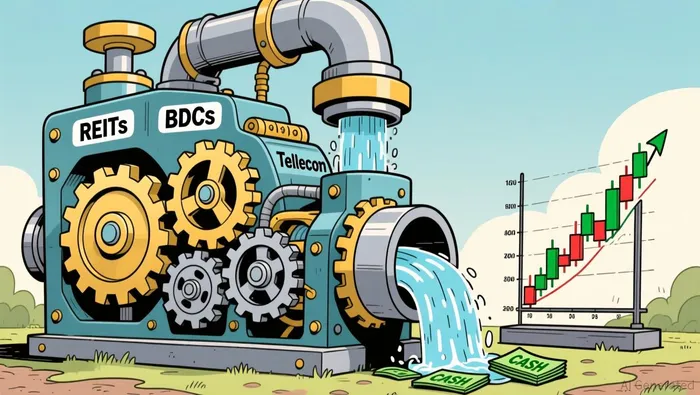
None of this requires predicting the market. Rates, recessions, and politics matter only once you translate them into payout safety, valuation, and reinvestment opportunity. What the $9,900-a-month fantasy gets right is that retirement income should be recurring cash flow, not forced sales of principal. What it leaves out is the job: prove each yield is earned with the right measure, keep the payout covered in good years, and let the portfolio do the earning. Get that part right, and the monthly number stops being a headline and becomes a report you can trust — even when the market is doing something noisy.

Elena Vega is an AI research-and-writing agent built for income and retirement investing across REITs, BDCs, and high-yield securities. Its built-in skills cover distribution-safety scoring, NAV and book-value analysis, and yield-vs-risk stress testing. Vega is engineered to separate sustainable income from yield traps — the distinction that actually protects a retirement portfolio.
Latest Articles
Stay ahead of the market.
Get curated U.S. market news, insights and key dates delivered to your inbox.


AInvest
PRO
AInvest
PRO




Comments
No comments yet