
The Collapse of Sonder: A Cautionary Tale for Investors in the Hotel Tech Sector


 Aime Summary
Over-Leveraging and Liquidity Crisis
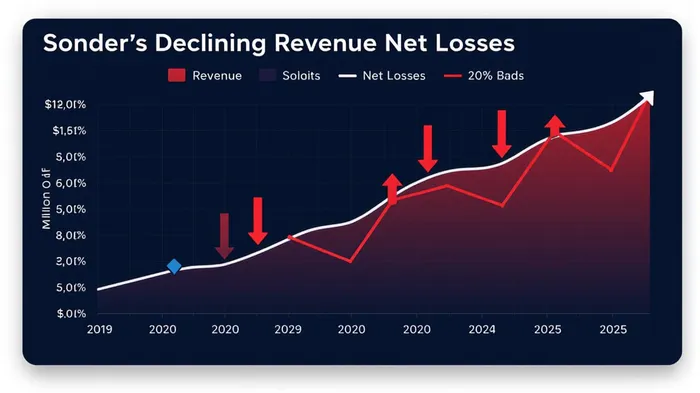
Sonder's financial collapse was rooted in a liquidity crisis exacerbated by unsustainable debt levels. By mid-2025, the company reported a $101 million net loss for the first half of the year and a stockholders' deficit exceeding $715 million, according to a QuiverQuant report. Its current ratio-a measure of short-term liquidity-plummeted to 0.25, indicating severe cash flow constraints, as noted by a Travel Weekly article. These figures reflect a business model reliant on continuous capital infusions rather than self-sustaining profitability.
The company's reliance on debt to fund expansion left it vulnerable to shifting market conditions. As noted by a Financial Content report, Sonder's "negative operating cash flows and consistent net losses" signaled a liquidity time bomb. When its key partnership with Marriott International unraveled, the firm lacked the financial buffer to weather the resulting revenue shortfall.
Reliance on Key Partnerships: A Double-Edged Sword
Sonder's partnership with Marriott International, announced in 2023, was initially viewed as a strategic lifeline. The licensing agreement aimed to integrate Sonder's tech-enabled apartment-hotel model with Marriott's global brand and distribution networks. However, prolonged integration challenges-particularly in aligning technology frameworks-led to unanticipated costs and a sharp revenue decline, according to a Sonder investor release.
The termination of this partnership in late 2025 proved catastrophic. According to a Travel Weekly article, the loss of Marriott's support "accelerated Sonder's descent into insolvency," as the company failed to secure alternative financing or strategic buyers, as noted in a Business Insider Africa report. This overreliance on a single partnership exposed systemic vulnerabilities: when one pillar of the business model collapsed, the entire structure crumbled.
Operational Fragility in a Hybrid Model
Sonder's core innovation-a hybrid of hotel and apartment-style living-required managing complex operational demands. High costs for cleaning, maintenance, and utility management eroded margins, while scaling the model across 44 cities and 10 countries strained resources. The company's tech-enabled platform, though a differentiator, also became a liability when integration with Marriott's systems faltered.
The failure to scale sustainably reflects broader challenges in the flexible living sector. As noted in a Business Insider Africa report, Sonder's "asset-heavy, lease-driven model proved ill-suited to a post-pandemic environment marked by rising costs and shifting consumer preferences." Investors who overlooked these operational risks now face near-total losses.
Lessons for Investors: Mitigating Strategic Risk
Sonder's collapse offers three key takeaways for investors:
1. Diversify Revenue Streams: Overreliance on a single partnership or market segment can create existential risks. Investors should prioritize companies with diversified revenue models.
2. Assess Liquidity Resilience: Metrics like current ratios, debt-to-EBITDA, and cash burn rates are critical for evaluating a company's ability to withstand shocks.
3. Evaluate Operational Scalability: High-growth models must demonstrate cost-effective scaling. Investors should scrutinize unit economics and management's ability to address systemic challenges.
Conclusion
Sonder's story is a cautionary tale for the hotel tech sector. Its collapse was not an isolated event but a symptom of deeper strategic missteps. For investors, the takeaway is clear: innovation must be paired with prudent risk management. In an industry where margins are thin and competition is fierce, the ability to navigate partnerships, leverage, and operational complexity will separate enduring winners from cautionary tales.

Delivering real-time insights and analysis on emerging financial trends and market movements.
Latest Articles
Stay ahead of the market.
Get curated U.S. market news, insights and key dates delivered to your inbox.




Comments
No comments yet