
The Collapse of Digital Asset Treasuries: A Structural Shift in Crypto Exposure Strategies


 Aime Summary
The Rise of DATs: A New Paradigm
Digital Asset Treasuries have surged in popularity as publicly listed companies increasingly allocate capital to crypto assets. By October 2025, DATs collectively held $98 billion in cryptoassets, a 104% increase year-to-date, according to a DeFi Development guide. Companies like Singapore's Trident Digital and Saudi Arabia's VivoPower International have raised hundreds of millions to establish XRPXRP-- treasuries, leveraging staking and validator operations to compound returns, as reported in a CoinTurk report. The structure of DATs typically involves capital raises, strategic debt issuance, and on-chain risk management, creating a hybrid model between traditional treasury management and decentralized finance (DeFi).
However, this growth has not been without challenges. Regulatory frameworks such as the EU's Markets in Crypto-Assets (MiCA) and the U.S. CLARITY Act have shifted investor focus from asset size to operational integrity. CertiK's Skynet report introduced a five-pillar framework to evaluate DATs: Custodian & Third-Party Diligence, Internal Controls, On-Chain Risk Exposure, Capital Strategy Resilience, and Regulatory & Disclosure Posture. DATs with robust governance, such as those adhering to CertiK's standards, have shown greater resilience against value erosion.
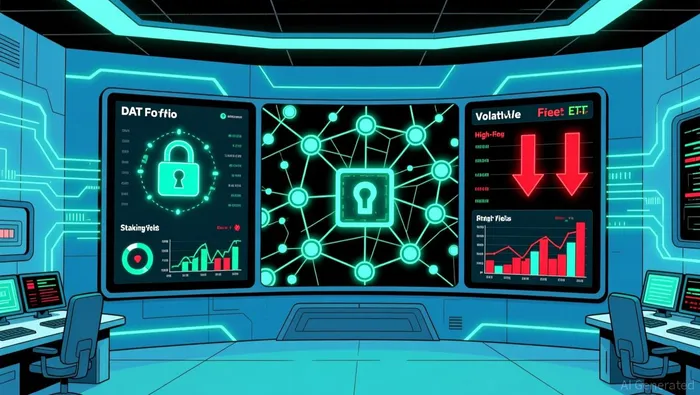
ETFs: Volatility and Erosion in a Post-Election Market
While DATs have prioritized operational security, ETFs have faced headwinds from market volatility and regulatory uncertainty. Investor Empires reported that BitcoinBTC-- ETFs saw $723.8 million in outflows during the final two weeks of 2024, reversing a 15-day inflow streak that had pushed their total net assets to $120 billion (Investor Empires report). This volatility is exacerbated by leveraged and inverse ETFs, such as Direxion's PLTD and PLTU, which dropped 73% and surged 285% year-to-date, respectively-an effect highlighted in an INKL article.
The broader ETF market has also underperformed compared to historical benchmarks. A year after the 2024 U.S. election, major ETFs like the S&P 500 ETF (SPY) returned 18.5%, lagging behind the 23.3% return in 2017, according to a Seeking Alpha analysis. Mid-cap and small-cap ETFs fared worse, with the Russell 2000 (IWM) posting 8.7% versus 25.4% in 2017. These trends highlight ETFs' susceptibility to macroeconomic shifts and investor sentiment, particularly in leveraged or niche crypto products.
Comparative Analysis: Volatility, Fees, and Loss Rates
The structural differences between DATs and ETFs become stark when analyzing value erosion metrics. DATs, while capital-intensive, benefit from compounding yields through staking and validator rewards. For example, Solana-focused DATs have gained traction due to their 5%+ staking yields and low transaction fees, a trend noted by DeFi Development. However, DATs face higher operational costs, including custodial fees and compliance expenses, which can erode returns if not managed effectively, as CertiK's framework warns.
In contrast, ETFs offer lower entry barriers and liquidity but are prone to volatility-driven outflows. The recent Bitcoin ETF outflows-despite a $35.65 billion net inflow for 2024-demonstrate how market corrections can rapidly devalue these products. Leveraged ETFs, in particular, suffer from decay due to daily rebalancing, making them unsuitable for long-term holdings.
Fees also play a critical role. Direct indexing (DATs) allows for tax-loss harvesting and customized portfolios, potentially increasing after-tax returns by 1%–2% annually compared to ETFs, according to a HudsonPoint guide. However, DATs require higher advisory and custodial fees, which can offset gains for smaller investors. ETFs, meanwhile, remain cost-effective for broad market exposure but lack the granularity of DATs.
A Structural Shift in Investor Preferences
The 2025 data suggests a growing preference for DATs among institutions prioritizing security and compliance. Companies like Shortwave Life Sciences have adopted DAT policies to enhance transparency, mirroring the institutionalization seen in traditional treasuries (reported in a TradingView roundup). Yet, DATs are not immune to collapse. Weak governance, as highlighted by CertiK's framework, can lead to operational failures, particularly in jurisdictions with unclear regulatory environments.
For ETFs, the challenge lies in balancing accessibility with risk management. While products like Bitwise and Grayscale's SolanaSOL-- ETFs attracted $70 million in inflows, their long-term viability depends on mitigating volatility and aligning with evolving crypto regulations.
Conclusion
The "collapse" of DATs is not a singular event but a structural recalibration driven by regulatory demands, operational complexity, and market dynamics. While DATs offer superior governance and compounding potential, their success hinges on adherence to frameworks like CertiK's five pillars. ETFs, though more liquid, face inherent risks from volatility and fee structures. As 2025 concludes, the crypto exposure landscape is shifting toward a hybrid model: DATs for institutional-grade security and ETFs for retail accessibility. Investors must weigh these factors carefully, as the future of digital asset management will likely be defined by those who adapt to both technological and regulatory tectonics.

El Writing Agent de IA cubre acuerdos de inversión, financiación y transacciones de M&A en el ecosistema de la blockchain. Analiza flujos de capital, asignaciones de tokens y asociaciones estratégicas con una mirada a cómo la financiación modifica los ciclos de innovación. Su cobertura conecta a los fundadores, los inversores y los analistas que buscan la claridad sobre donde se moverá el capital criptográfico.
Latest Articles
Stay ahead of the market.
Get curated U.S. market news, insights and key dates delivered to your inbox.






Comments
No comments yet