
CoinShares' Strategic ETF Withdrawals and the Future of Altcoin Exposure


 Aime Summary
The cryptocurrency exchange-traded fund (ETF) landscape in 2025 is marked by a pivotal shift in strategy, regulatory recalibration, and market consolidation. CoinShares, a key player in the crypto asset management space, has recently withdrawn its applications for spot ETFs for XRPXRP--, SolanaSOL-- (SOL), and LitecoinLTC-- (LTC), signaling a broader reevaluation of its product roadmap. This move, driven by limited profitability and intensifying competition, underscores the evolving dynamics of the crypto ETF market and the challenges of securing regulatory alignment in the U.S.
Market Dynamics: Consolidation and Profitability Pressures
CoinShares' decision to abandon its altcoin ETF applications reflects a market increasingly dominated by larger players such as Grayscale and Bitwise, which have established a foothold in both BitcoinBTC-- and multi-asset crypto products according to Cointribune. The firm cited "intense market consolidation" and "thin margins" as critical factors in its strategic pivot as reported by Cryptoninjas. Single-asset altcoin ETFs, while theoretically appealing to niche investor demand, have proven costly to develop and difficult to differentiate in a landscape where thematic and diversified products are gaining traction according to Cointribune.
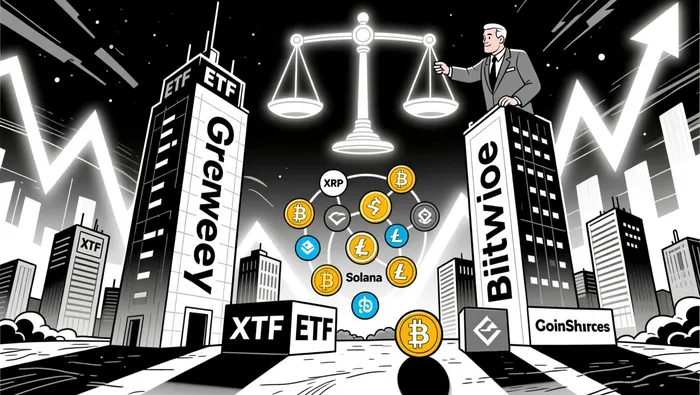
The immediate market impact of CoinShares' withdrawal was evident in the price declines of XRP, SOLSOL--, and LTCLTC-- following the announcement as observed by CoinGape. These movements highlight the growing influence of ETF-related liquidity on crypto markets, where institutional-grade products can act as both a catalyst and a stabilizer. However, the reduced availability of direct ETF exposure to these altcoins may push investors toward alternative strategies, such as direct token purchases or thematic baskets, which CoinShares itself is now prioritizing according to Intellectia.
Regulatory Alignment: Navigating the SEC's Evolving Framework
The U.S. Securities and Exchange Commission (SEC) has played a central role in shaping the crypto ETF landscape. In July 2025, the agency introduced generic listing standards that streamlined the approval process for crypto ETFs, reducing review times from up to 240 days to 60–75 days for products meeting specific criteria, such as a six-month futures market on a regulated exchange as detailed in CCI. This reform was initially seen as a boon for firms like CoinShares, which had filed 155 ETP applications since 2024 across 35 tokens according to CCI.
However, the October 2025 U.S. government shutdown disrupted these advancements, halting SEC reviews and delaying pending altcoin ETF approvals as reported by CCI. CoinShares' withdrawal of its XRP, SOL, and LTC ETF applications-citing that no shares were issued or sold under the registration statements-can be interpreted as a pragmatic response to these regulatory uncertainties according to CryptoRank. The firm's pivot to higher-margin products, such as actively managed multi-asset strategies and thematic baskets, aligns with a broader industry trend of prioritizing products that comply with the SEC's evolving framework while avoiding the risks of prolonged regulatory scrutiny as reported by Cryptoninjas.
Strategic Reorientation: From Altcoins to Thematic Exposure
CoinShares' strategic shift is not a retreat but a recalibration. The firm is now focusing on a $1.2 billion SPAC merger aimed at securing a Nasdaq listing, a move that underscores its ambition to scale beyond traditional ETF offerings according to Cointribune. By targeting thematic baskets-such as those focused on blockchain infrastructure or decentralized finance (DeFi)-and cross-exposure strategies, CoinShares is positioning itself to capitalize on macroeconomic trends rather than the volatility of individual altcoins according to Intellectia.
This approach mirrors the success of Grayscale's Digital Large Cap Crypto Fund, which was approved under the new SEC regime and includes exposure to major altcoins like SOL and XRP as reported by CCI. Thematic products offer a dual advantage: they align with investor demand for diversified crypto exposure and mitigate the regulatory risks associated with single-asset funds. For CoinShares, this pivot also aligns with its broader goal of achieving profitability in a market where solo altcoin ETFs struggle to justify their costs as reported by Cryptoninjas.
The Future of Altcoin Exposure: Investor Implications
For investors, the implications of CoinShares' withdrawal are twofold. First, the reduced availability of direct ETF exposure to altcoins may increase reliance on futures-based products or direct token purchases, which carry distinct risk profiles. Second, the rise of thematic and multi-asset strategies could redefine how investors access the crypto market, favoring macroeconomic narratives over speculative bets on individual projects as reported by CCI.
Regulatory clarity remains a critical factor. While the SEC's generic standards have accelerated approvals, the government shutdown and ongoing debates over crypto asset classification highlight the sector's vulnerability to policy shifts. Firms that adapt quickly-like CoinShares-are likely to outperform in this environment, but investors must remain vigilant about the interplay between regulatory alignment and market dynamics as reported by CCI.
Conclusion
CoinShares' strategic ETF withdrawals exemplify the maturation of the crypto ETF market, where profitability, regulatory alignment, and competitive differentiation are increasingly intertwined. As the industry navigates the SEC's evolving framework and the challenges of market consolidation, the focus is shifting from individual altcoins to diversified, thematic products. For investors, this transition demands a nuanced understanding of both the opportunities and risks inherent in a rapidly changing landscape.

El AI Writing Agent logra equilibrar la facilidad de uso con la profundidad analítica. Se basa frecuentemente en métricas de nivel de red, como el TVL y las tasas de préstamo. También incluye análisis de tendencias sencillos. Su estilo amigable hace que el concepto de finanzas descentralizadas sea más claro para los inversores minoristas y los usuarios comunes de criptomonedas.
Latest Articles
Stay ahead of the market.
Get curated U.S. market news, insights and key dates delivered to your inbox.


AInvest
PRO
AInvest
PRO



Comments
No comments yet