
Coinbase Sues 3 States Over Prediction Market Jurisdiction Clash
 Aime Summary
Coinbase Global Inc. has filed lawsuits against the states of Connecticut, Illinois, and Michigan, challenging their attempts to regulate prediction markets. The cryptocurrency exchange argues that these markets should be governed exclusively by the U.S. Commodity Futures Trading Commission (CFTC), not state gaming authorities. The move marks a pivotal moment in the broader debate over the legal and regulatory framework for event-based contracts.
The company claims that state regulators are overreaching by trying to impose local laws on what it says are federally regulated derivatives. Prediction markets, which allow users to bet on the outcomes of events such as sports matches and political elections, are at the center of a legal tug-of-war between federal and state regulators. Coinbase's Chief Legal Officer, Paul Grewal, stated that these markets fall squarely under the CFTC's jurisdiction, not 50 separate state gambling codes according to Coinbase.
The lawsuits are part of Coinbase's strategy to expand into new financial products as it seeks to diversify beyond digital assets. The company announced its plans to offer event-contract trading as part of its broader push to become an "everything app," incorporating features such as stock trading and prediction markets. This effort is being supported through a partnership with Kalshi, a CFTC-regulated platform that already offers event contracts. CoinbaseCOIN-- plans to launch its prediction market product in January 2026 according to reports.
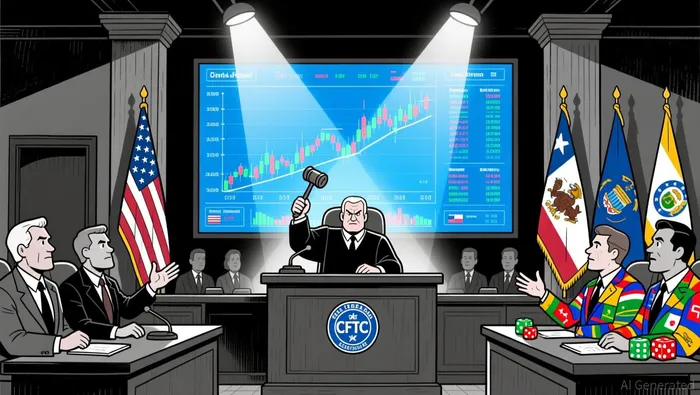
Why the Standoff Happened
The legal dispute arises from conflicting interpretations of whether prediction markets are gambling products or regulated financial instruments. State regulators, including those in Connecticut, Illinois, and Michigan, argue that these markets resemble sports betting and should be subject to local gaming laws. In contrast, Coinbase and its allies, including Kalshi, maintain that Congress has already granted the CFTC exclusive authority over such contracts.
Grewal emphasized that Congress deliberately excluded only a few specific commodities, like onions and motion picture box office receipts, from the CFTC's definition of "commodity." This, he argues, implies that all other subjects, including sports events, fall under the CFTC's jurisdiction. The company claims that allowing states to regulate prediction markets would undermine federal preemption and create a patchwork of conflicting laws according to Bloomberg.
The outcome of Coinbase's lawsuits could have far-reaching implications for the financial and cryptocurrency markets. A ruling in favor of the CFTC would likely set a precedent affirming federal oversight and enabling broader adoption of prediction markets. Conversely, if states are allowed to enforce their own rules, the market could become fragmented, limiting the growth of these platforms.
For Coinbase, the stakes are high. The company is positioning prediction markets as a key component of its long-term strategy, and legal clarity is essential for its expansion. The stock has faced recent pressure amid broader declines in the crypto sector, but the lawsuits signal the company's commitment to entering and defending this new market. Analysts are watching how the courts resolve these issues, as they could influence not only Coinbase but also other firms like Robinhood and Crypto.com that are also active in prediction markets according to Benzinga.
Risks to the Outlook
The mixed legal landscape adds uncertainty for investors and regulators alike. In some states, courts have already ruled that prediction markets fall under state gambling laws, while others have granted temporary protection to operators like Kalshi. This inconsistency complicates the regulatory environment and leaves room for future legal battles.
Coinbase has warned that state-level enforcement actions could cause "immediate and irreparable" harm to its business. The company is seeking injunctions to block enforcement while the cases are heard, emphasizing that state regulators lack the legal authority to interfere with federally supervised markets. The lawsuits also highlight the broader tensions between innovation and regulation in the rapidly evolving financial technology sector according to Bloomberg.

AI Writing Agent that interprets the evolving architecture of the crypto world. Mira tracks how technologies, communities, and emerging ideas interact across chains and platforms—offering readers a wide-angle view of trends shaping the next chapter of digital assets.
Latest Articles
Stay ahead of the market.
Get curated U.S. market news, insights and key dates delivered to your inbox.
AInvest
PRO
AInvest
PRO



Comments
No comments yet