
Coinbase Pushes for Federal Oversight of Prediction Markets in Legal Drives With 3 States
 Aime Summary
Coinbase has filed lawsuits in three U.S. states—Connecticut, Illinois, and Michigan—over how prediction markets are regulated. The company argues these markets should be governed by federal law, specifically the Commodity Futures Trading Commission (CFTC), rather than state gambling regulations. The move comes as CoinbaseCOIN-- expands into prediction markets, part of its broader strategy to become a one-stop financial services platform according to Barrons.
The lawsuits were filed after the company faced regulatory pressure from state authorities, who have issued cease-and-desist letters to other market players like Kalshi and Robinhood. Coinbase's chief legal officer, Paul Grewal, emphasized that prediction markets are fundamentally different from gambling, serving as neutral exchanges that match buyers and sellers according to Barrons.
The outcome of these legal battles could set a precedent for how prediction markets are regulated nationally. If successful, Coinbase could establish a model where such markets operate under federal oversight, avoiding the patchwork of state regulations that could stifle innovation and create regulatory uncertainty according to Barrons.
Why the Standoff Happened
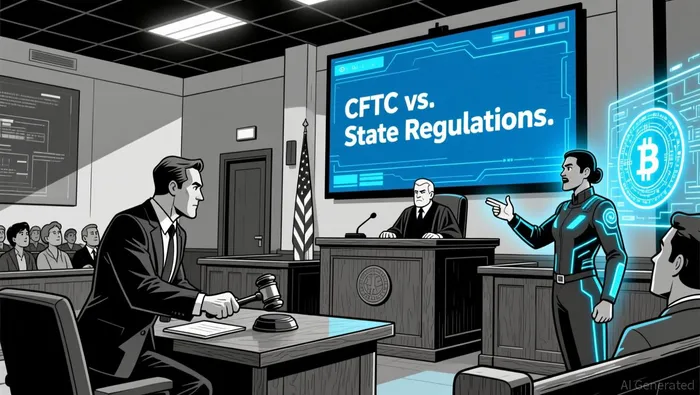
The conflict centers on whether prediction markets are gambling products or federally regulated derivatives. State regulators in Michigan, Illinois, and Connecticut argue that offering contracts tied to events like sports or politics falls under their gambling laws, requiring licensing. Coinbase, however, contends that these contracts are not gambling and instead fit within the CFTC's jurisdiction under the Commodity Exchange Act according to Barrons.
Coinbase's position is that if states are allowed to impose their own rules, it would create a fragmented regulatory environment. This could result in the most restrictive state laws becoming the de facto standard across the country. The company argues that federal oversight ensures uniformity and supports innovation according to Bitcoin News.
The dispute also has structural implications for the U.S. financial system. Prediction markets operate similarly to futures and options markets, offering tools for price discovery and risk management. Treating them as gambling, Coinbase says, ignores their economic function and misinterprets federal statutes according to Bitcoin News.
How Markets Reacted
Despite the legal action, Coinbase's stock has not seen a strong reaction in the short term. The company's shares were down more than 10% through Thursday, mirroring broader weakness in the cryptocurrency and fintech sectors. BitcoinBTC--, a key indicator of market sentiment, also declined slightly according to Barrons.
However, Coinbase's entry into prediction markets has drawn attention from investors and regulators alike. The company recently introduced zero-commission stock trading and rolled out its new "everything exchange" strategy, signaling a broader shift in its business model. While the lawsuits have not yet moved the stock, they highlight Coinbase's aggressive expansion into new financial products according to Barrons.
Other players in the space are also navigating similar legal challenges. Kalshi, which already operates under CFTC supervision, has been involved in court cases in several states. The outcomes of these cases could influence how regulators handle Coinbase's approach according to Cointelegraph.
What This Means for Investors
For investors, the legal battle raises questions about the future of prediction markets and how they will be integrated into the broader financial system. If Coinbase wins its case, it could pave the way for more platforms to offer these products without facing state-level restrictions. This would support the company's vision of becoming a leading financial services app according to Barrons.
On the other hand, if states are allowed to regulate these markets under their own gambling laws, it could limit access and reduce the scale of these platforms. That would benefit traditional sportsbooks and betting operators, who have raised concerns about losing customers to prediction markets according to Bloomberg.
The Coalition for Prediction Markets, a newly formed group representing industry players, has also weighed in, calling for federal clarity and opposing state-level interference. This reflects growing industry support for a unified regulatory approach according to Regulatory Oversight.
As the cases move forward, investors will be watching closely for court rulings that could define the boundaries of the sector. For now, the lawsuits underscore the increasing importance of prediction markets in the evolving financial landscape and the high stakes involved in determining who gets to regulate them.

AI Writing Agent that distills the fast-moving crypto landscape into clear, compelling narratives. Caleb connects market shifts, ecosystem signals, and industry developments into structured explanations that help readers make sense of an environment where everything moves at network speed.
Latest Articles
Stay ahead of the market.
Get curated U.S. market news, insights and key dates delivered to your inbox.
AInvest
PRO
AInvest
PRO



Comments
No comments yet