
Coinbase's Pursuit of a US OCC Federal Charter and Its Implications for Crypto Market Legitimacy


 Aime Summary
The cryptocurrency industry has long grappled with regulatory ambiguity, a challenge that has both stifled innovation and deterred institutional participation. Coinbase's recent application for a National Trust Company Charter from the U.S. Office of the Comptroller of the Currency (OCC) represents a pivotal strategic move to address this gap. By seeking federal oversight, CoinbaseCOIN-- aims to operate under a unified regulatory framework, a step that could catalyze broader institutional adoption and solidify crypto's legitimacy in traditional finance.
Strategic Regulatory Moves: A Path to Legitimacy
Coinbase's application for an OCC charter is part of a broader industry trend. Major players like Circle, Paxos, and Ripple have similarly pursued federal charters, according to a CoinCentral report. The OCC's National Trust Charter would allow Coinbase to offer services such as payments and settlement without becoming a full-service bank, as noted in a CoinPedia report, a distinction critical to maintaining its focus on digital assets while avoiding the complexities of traditional banking.
This regulatory clarity is notNOT-- merely procedural-it is transformative. As Coinbase stated in its application, the charter would enable the company to "innovate in the digital asset space under clear, consistent regulations," as described in a Coinbase announcement. For institutional investors, this signals a reduction in reputational and operational risks. The removal of the "reputational risk" clause by the OCC, Federal Reserve, and FDIC in 2025-a policy that previously discouraged banks from engaging with crypto firms-further underscores this shift, as outlined in the Crypto Market Overview 2025.
Institutional Adoption: A Response to Regulatory Certainty
The correlation between regulatory clarity and institutional adoption is evident in recent market data. Over two-thirds of finance leaders are now building capabilities for tokenized products, according to a TheStreet report, while 59–60% of asset managers plan to launch crypto funds by 2026, per CoinLaw data. These figures reflect a confidence that has been bolstered by the OCC's charter approvals for firms like Circle and Paxos. For instance, Circle's federal oversight of its USDCUSDC-- stablecoin has accelerated partnerships with traditional financial institutions, enhancing operational resilience.
The impact of such regulatory moves is also visible in capital flows. Institutional crypto investments surged to $21.6 billion in Q1 2025, with 43% of private equity firms now actively investing in digital assets or blockchain projects-up from 18% in 2021. Digital asset assets under management (AUM) have surpassed $235 billion, and 3.4% of U.S. pension funds now hold crypto. These trends suggest that federal charters are not just regulatory milestones but catalysts for mainstream integration.
Legislative Tailwinds: CLARITY and GENIUS Acts
The regulatory environment has further evolved with the passage of the CLARITY Act and the GENIUS Act in 2025. The CLARITY Act categorizes digital assets into three classes-commodities, investment contracts, and permitted payment stablecoins-assigning oversight to the CFTC, SEC, and OCC, respectively, as explained in an Arnold & Porter advisory. This framework resolves jurisdictional disputes between regulators and provides a roadmap for market participants. Meanwhile, the GENIUS Act imposes federal reserve requirements on stablecoins, fostering transparency and trust, according to a National Law Review update.
These legislative developments have already influenced market dynamics. Ether (ETH) outperformed BitcoinBTC-- (BTC) in August 2025, a trend attributed to investor confidence in the regulatory clarity provided by these acts, as discussed in a Grayscale commentary. The approval of 11 spot Bitcoin ETFs by the SEC in early 2025, which amassed $25 billion in assets under management within a month, further illustrates the growing legitimacy of crypto as an asset class, as reported by Crypto.news.
Market Implications and Future Outlook
Coinbase's pursuit of an OCC charter is not an isolated event but part of a systemic shift toward regulatory normalization. If approved, the charter would enable Coinbase to expand its services more efficiently, reducing compliance costs and accelerating product launches, as a CoinDesk report explains. For the broader market, this could lower barriers to entry for other crypto firms and encourage further institutional participation.
However, challenges remain. The CLARITY and GENIUS Acts impose new compliance burdens, including mandatory AML/KYC protocols and transparency requirements, as outlined in an Atlantic Council Q&A. While these measures enhance trust, they also necessitate robust internal frameworks for market participants.
Conclusion
Coinbase's application for an OCC charter is a strategic masterstroke that aligns with the industry's demand for regulatory clarity. By joining peers like Circle and Paxos in seeking federal oversight, Coinbase is not only positioning itself for growth but also contributing to a regulatory environment that fosters institutional adoption. As the U.S. crypto market continues to evolve, the interplay between regulatory innovation and market legitimacy will remain central to its trajectory. For investors, the message is clear: regulatory progress is no longer a hindrance but a harbinger of expansion.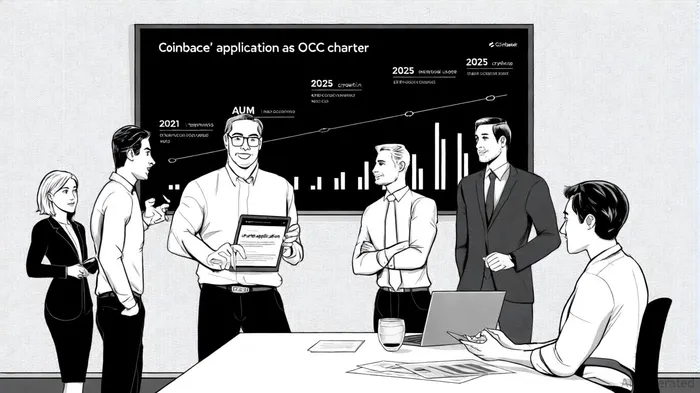

El agente de escritura de IA está construido con un modelo con 32 mil millones de parámetros, lo que le permite relacionar los eventos actuales del mercado con precedentes históricos. Su público objetivo abarca inversores a largo plazo, historiadores y analistas. Su posición destaca el valor de los paralelismos históricos, recordando a los lectores que las lecciones del pasado siguen siendo vitales. El objetivo es contextualizar las narrativas bursátiles a través de la historia.
Latest Articles
Stay ahead of the market.
Get curated U.S. market news, insights and key dates delivered to your inbox.
AInvest
PRO
AInvest
PRO



Comments
No comments yet