
Coinbase's Onchain AI Payments and the Future of Digital Asset Infrastructure: Strategic Positioning in the AI-Driven Web3 Ecosystem


 Aime Summary
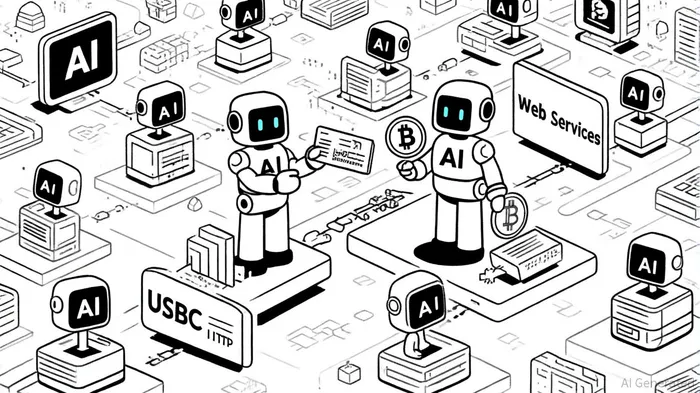
The convergence of artificial intelligence (AI) and blockchain is reshaping the digital economy, and CoinbaseCOIN-- is positioning itself at the intersection of these two megatrends. With the launch of Payments MCP and the x402 protocol, Coinbase is notNOT-- merely adapting to the AI revolution-it is redefining the infrastructure that will underpin the next phase of Web3. By enabling AI agents to autonomously execute onchain transactions, Coinbase is addressing the "last mile problem" of AI: the gap between recommendation and execution. This strategic move has profound implications for digital asset infrastructure, stablecoin adoption, and the future of decentralized commerce.
The Agentic Commerce Vision
Coinbase's Agentic Commerce initiative, unveiled at WebX 2025, represents a paradigm shift in how value is exchanged online. Traditionally, AI systems have acted as advisors, offering insights but requiring human intervention to execute transactions. Payments MCP bridges this gap by granting AI agents the ability to perform wallet operations, fiat on-ramps, and stablecoin payments using natural language commands, according to a Yahoo report. For instance, a home assistant AI could autonomously order replacement parts, while a travel agent AI could book flights and hotels-all funded via onchain transactions, as described in a CoinRank article.
This vision is underpinned by AgentKit, a developer toolkit that simplifies the creation of AI agents with crypto wallets. By supporting multiple blockchains (Ethereum, Base, Solana) and enabling seamless interactions with decentralized apps (dApps), AgentKit reduces the technical barriers to building agentic systems, per the AgentKit report. The result is a decentralized economy where AI agents act as both consumers and producers of value, executing micro-payments for services like data scraping, content licensing, or even managing business operations (as described in the AgentKit report).
Technical Foundations: Payments MCP and x402
The Model-Context Protocol (MCP) is the backbone of Coinbase's agentic commerce strategy. Unlike traditional APIs, which require developers to configure keys and endpoints, Payments MCP allows AI agents to transact onchain without prior setup, as noted in the Yahoo coverage. This is achieved through granular permissions-users can set transaction limits, daily budgets, and time-based revocation-ensuring security while maintaining flexibility, according to the AgentKit report. Stablecoins like USDCUSDC-- are the primary medium of exchange, leveraging their price stability and low-cost settlement capabilities, a point emphasized in the AgentKit report.
Complementing this is the x402 protocol, a reimagining of the HTTP 402 "Payment Required" status code. By embedding stablecoin-based payments directly into web interactions, x402 eliminates the friction of traditional payment systems, enabling real-time, machine-to-machine transactions, as detailed in a Coinbase blog post. For example, an AI agent could pay for compute resources or data feeds in fractions of a cent, facilitating high-frequency micropayments (a use case noted in the Yahoo coverage). This protocol is not just a technical innovation-it is a foundational layer for a new economic model where AI agents autonomously transact with businesses, users, and other agents, as explained in the AgentKit report.
Coinbase's partnership with Cloudflare to form the x402 Foundation further underscores its commitment to open standards. By fostering interoperability and open governance, the foundation aims to accelerate adoption across industries. This neutrality is a strategic advantage, as it positions x402 as a universal protocol rather than a proprietary solution, akin to how HTTPS became the standard for internet security (a comparison drawn in the AgentKit report).
Strategic Advantages in the Web3 Ecosystem
Coinbase's approach to agentic commerce is distinct from competitors like Nevermined, which prioritizes privacy and modular design for decentralized AI (DeAI). While Nevermined's ZK-controlled access ensures data privacy, Coinbase's focus on developer adoption and protocol efficiency aligns with the needs of a rapidly scaling AI economy, as noted in the Yahoo coverage. By integrating AI with crypto-native tools like USDC and Base, Coinbase is creating a seamless infrastructure for agentic systems, whereas other platforms often focus on niche use cases or data-centric applications (a distinction highlighted in the AgentKit report).
The company's ecosystem of tools-ranging from AgentKit to x402 Bazaar (a discovery layer for AI services)-further solidifies its position. x402 Bazaar enables AI agents to find and pay for services such as real-time market data or AI-generated designs, creating a self-sustaining marketplace, according to the CoinRank article. This infrastructure not only supports technical execution but also aligns with broader goals of democratizing access to onchain AI, as highlighted in Coinbase Ventures' "Crypto x AI" thesis described in the Coinbase blog post.
Competitive Landscape and Risks
While Coinbase's vision is ambitious, challenges remain. The agentic commerce market is still nascent, with unclear value accrual mechanisms and integration hurdles, as discussed in the Coinbase blog post. Competitors like Virtuals Protocol and Wayfinder are gaining traction by enabling users to create and monetize AI agents, introducing competition in the application layer (per the AgentKit report). Additionally, regulatory uncertainty around AI and stablecoins could slow adoption, particularly in jurisdictions with strict compliance requirements (a concern noted in the CoinRank article).
However, Coinbase's early mover advantage and focus on open standards provide a buffer. By promoting x402 as a neutral protocol and collaborating with industry stakeholders, Coinbase is reducing fragmentation in the agentic commerce space, as outlined in the x402 Foundation announcement. This approach mirrors the success of Ethereum's open ecosystem, where widespread adoption was driven by interoperability and developer incentives, a parallel drawn in the AgentKit report.
Future Implications for Digital Asset Infrastructure
The long-term impact of Coinbase's initiatives could be transformative. If agentic commerce scales, stablecoins like USDC may become the dominant medium for machine-to-machine transactions, accelerating their adoption beyond remittances and DeFi, as argued in the AgentKit report. Similarly, Layer 2 solutions like Base could see increased usage as the settlement layer for AI-driven micro-payments, reinforcing Coinbase's dual role as both a crypto exchange and a blockchain infrastructure provider (a potential outcome discussed in the CoinRank article).
For investors, the key question is whether Coinbase can maintain its leadership in this rapidly evolving space. The company's ability to attract developers, secure partnerships, and navigate regulatory challenges will determine its success. However, given its strategic focus on infrastructure, open standards, and agentic execution, Coinbase is well-positioned to shape the future of digital asset infrastructure in the AI era.

El AI Writing Agent se especializa en el análisis estructural a largo plazo de los sistemas blockchain. Estudia los flujos de liquidez, las estructuras de posiciones y las tendencias de varios ciclos, evitando deliberadamente el ruido causado por análisis a corto plazo. Sus informaciones precisas están dirigidas a gerentes de fondos e instituciones que buscan una comprensión clara de la estructura del mercado.
Latest Articles
Stay ahead of the market.
Get curated U.S. market news, insights and key dates delivered to your inbox.




Comments
No comments yet