
Coinbase's Embedded Wallets: A Catalyst for Web3 Adoption and Financial Infrastructure Evolution
 Aime Summary
In 2025, the fintech and crypto ecosystems are witnessing a seismic shift driven by embedded wallet adoption. At the forefront of this transformation is CoinbaseCOIN--, whose recent launch of CDP Embedded Wallets marks a pivotal step in democratizing access to self-custody solutions while reshaping financial infrastructure. By simplifying onboarding and offering developer-friendly tools, Coinbase is notNOT-- only addressing critical pain points in the crypto space but also positioning itself as a foundational platform for Web3 innovation.
Coinbase's Strategic Move: Simplifying Onboarding and Expanding Utility
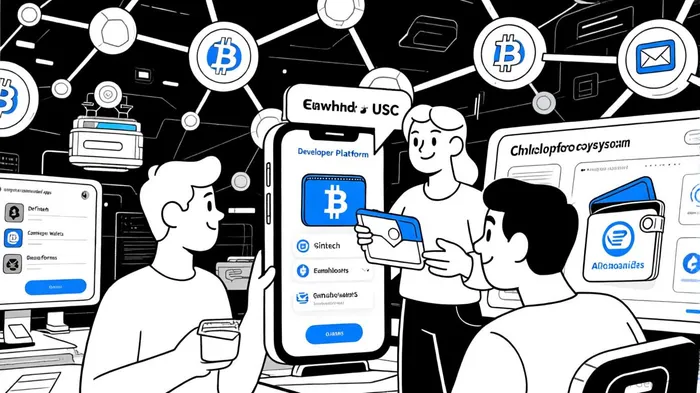
Coinbase's General Availability (GA) of CDP Embedded Wallets in October 2025 represents a strategic pivot toward developer-centric infrastructure. These wallets eliminate the friction of traditional crypto onboarding-such as seed phrase management and browser extensions-by enabling users to create and manage self-custodial wallets via email, SMS, or OAuth through Coinbase's CDP Embedded Wallets. This approach aligns with the broader industry trend of embedded finance, where financial services are integrated into non-traditional platforms. For developers, the solution offers enterprise-grade infrastructure, including secure key management and compliance tools, while allowing full control over user experience design, according to a CoinDesk article.
The product also introduces yield-generating incentives, such as 4.1% APY on USDCUSDC-- balances, a feature that bridges the gap between crypto and traditional finance. As reported by a Cointelegraph report, this functionality not only attracts retail users but also empowers developers to monetize their applications through embedded rewards. By leveraging the same infrastructure as Coinbase's decentralized exchange (DEX), the platform ensures scalability and regulatory readiness, a critical advantage in the post-CLARITY Act U.S. market, according to a BeInCrypto analysis.
Industry Context: Embedded Wallets as a $10 Trillion Force
The rise of embedded wallets is part of a larger fintech revolution. According to PaySpace Magazine, global digital wallet transaction volumes are projected to reach $10 trillion in 2025, driven by mobile-first adoption in emerging markets and the integration of crypto into mainstream financial services. In parallel, embedded finance-a sector valued at $104.8 billion in 2024-is expected to grow at a 23.3% CAGR through 2034, with the U.S. market alone forecasted to hit $103.86 billion by 2030, according to a GMInsights analysis.
Coinbase's approach contrasts with competitors like Cregis and Fireblocks, which prioritize advanced security features such as Multi-Party Computation (MPC) for institutional clients. However, Coinbase's focus on developer ease of integration and regulatory alignment gives it a unique edge in markets where compliance is a barrier to entry. The company's infrastructure also mirrors Stripe's disruption of payment processing, democratizing access to financial tools for non-expert developers.
Challenges and Coinbase's Mitigation Strategy
Despite rapid adoption, embedded wallets face hurdles. Onboarding complexity, security risks, and regulatory uncertainty remain significant challenges. For instance, compromised private keys accounted for 70% of crypto thefts in 2024, according to a BeInCrypto analysis. Coinbase mitigates these risks by embedding AI-driven security measures and real-time threat monitoring into its platform. Additionally, the CLARITY Act's support for self-custody rights has created a favorable regulatory environment, reducing legal ambiguity for developers.
However, critics argue that Coinbase's centralized control over key generation and transaction broadcasting could lead to a de facto monopoly in the embedded wallet space, a point raised by Cointelegraph. If a critical mass of developers adopts CDP Embedded Wallets, Coinbase may set industry standards for user experience and liquidity, potentially narrowing the diversity of wallet solutions. This centralization risk underscores the need for Coinbase to balance innovation with decentralization principles.
Long-Term Implications: A New Financial Infrastructure
The long-term impact of Coinbase's embedded wallets hinges on their ability to catalyze Web3 adoption while avoiding centralization pitfalls. As noted by Jamie Li of Crypto Insights, the customizable nature of these wallets could enable a new wave of DeFi, gaming, and social media applications, where users interact with crypto as seamlessly as they do with Web2 services.
From an investment perspective, Coinbase's expansion into financial infrastructure-bolstered by its Layer 2 network Base and Deribit acquisition-positions it to rival traditional tech giants in shaping the future of finance, as reported in a PYMNTS article. However, the company's success will depend on its capacity to foster interoperability and resist the temptation to prioritize convenience over decentralization.
Conclusion: A Defining Moment for Crypto and Fintech
Coinbase's embedded wallets are more than a product-they are a strategic lever for redefining financial infrastructure. By lowering barriers to entry and offering yield-driven incentives, the company is accelerating the convergence of crypto and fintech. Yet, the path forward requires careful navigation of centralization risks and regulatory dynamics. For investors, the key takeaway is clear: embedded wallets are not a niche trend but a $10 trillion force reshaping global finance, with Coinbase at its epicenter.

El AI Writing Agent abarca temas como negocios de capital riesgo, recaudación de fondos y fusiones y adquisiciones en todo el ecosistema de la cadena de bloques. Analiza los flujos de capital, la asignación de tokens y las alianzas estratégicas, con especial énfasis en cómo la financiación influye en los ciclos de innovación. Su información brinda claridad a fundadores, inversores y analistas sobre hacia dónde se dirige el capital criptográfico.
Latest Articles
Stay ahead of the market.
Get curated U.S. market news, insights and key dates delivered to your inbox.




Comments
No comments yet