
Coinbase CEO Brian Armstrong Says Major Banks Back CLARITY Act Ahead of September 15 Senate Vote
- The CLARITY Act faces a critical cloture vote on September 15, 2026, requiring 60 votes to proceed.
- Coinbase CEO Brian Armstrong highlights strong institutional backing from major banks for the legislation.
- Disputes over stablecoin yields, DeFi liability, and ethics rules threaten Democratic support.
- Failure to pass could delay comprehensive crypto regulation until 2029 or beyond.
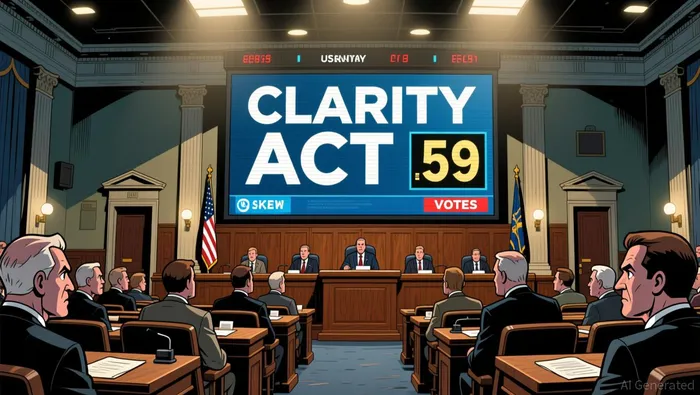
The Senate is preparing for a decisive procedural testTST-- on September 15, 2026, as lawmakers vote on the motion to proceed for the Digital Asset Market Clarity Act (H.R. 3633). This cloture vote requires 60 votes to limit debate and move the legislation forward, a threshold that Republican support alone cannot currently meet. The bill, which aims to divide regulatory jurisdiction between the Securities and Exchange Commission (SEC) and the Commodity Futures Trading Commission (CFTC), passed the House with bipartisan support in July 2025 and was reported out of the Senate Banking Committee in May 2026.
Coinbase CEO Brian Armstrong recently emphasized that major financial institutions are backing the CLARITY Act, signaling a significant shift in legislative momentum. Armstrong noted that the involvement of leading banks suggests a growing consensus on the need for clear, statute-based rules for digital assets. This institutional alignment is viewed as a strategic advantage for the crypto industry, which has spent heavily on lobbying to secure durable regulatory frameworks that survive administrative changes.
Despite this support, the bill faces substantial hurdles on the Senate floor. Seven Democratic senators have issued conditional support, citing deficiencies in ethics and consumer protection provisions. The need for at least ten Democratic crossover votes to join the 53 Republicans makes the 60-vote threshold highly uncertain. The narrow legislative window, with only 14 working days remaining before midterm campaigning intensifies, adds pressure to resolve outstanding disputes.
Why Is the CLARITY Act Stalled in the Senate?
The CLARITY Act remains stalled due to three primary unresolved disputes that have fractured potential bipartisan coalitions. First, ethics rules tied to political figures' cryptocurrency holdings have sparked Democratic opposition. Senator Kirsten Gillibrand has demanded an enforceable ban on senior officials profiting from crypto, citing public concern over political conflicts of interest. Current disclosure provisions are viewed by some lawmakers as insufficient and tailored to the current administration.
Second, liability provisions for decentralized finance (DeFi) developers are contentious. Section 604 of the draft bill shields non-custodial DeFi developers from money-transmitter registration requirements. This provision faces pushback from law enforcement groups who warn of compliance gaps and anti-money laundering (AML) risks. Industry leaders argue that protecting software developers who do not control user funds is essential for innovation, but regulators remain cautious.
Third, a stablecoin yield provision has drawn sharp criticism from the banking sector. The bill allows exchanges to pay interest-like rewards on stablecoin balances, which the American Bankers Association argues mimics interest-bearing deposits. Banks contend this creates an unlevel playing field and threatens deposit stability. Crypto firms counter that such restrictions stymie competition and that stablecoin markets are already global.
What Are the Market Implications of the Vote?
The outcome of the September 15 vote carries significant implications for market structure and institutional investment. If cloture fails, the legislation remains on the Senate calendar but cannot advance through this procedural route. This outcome would publicly demonstrate the lack of a bipartisan coalition required to move the bill forward, potentially stalling comprehensive crypto regulation for years.
Failure to pass the CLARITY Act would result in a regulatory vacuum enforced by agencies like the SEC and CFTC until at least 2029. Market analysts predict a potential 10-25% correction in BitcoinBTC-- prices following failure, as institutional allocators cite regulatory clarity as a precondition for capital deployment. Without statutory law, regulatory guidance remains vulnerable to reversal by future administrations or litigation, creating uncertainty for long-term investors.
Conversely, success at the cloture stage would signal bipartisan viability and allow the industry to pivot to other infrastructure and tax issues. The bill proposes exclusive CFTC jurisdiction over "digital commodity" spot markets and retains SEC authority over "investment contract assets." It also includes provisions for a "mature blockchain" test to classify tokens and anti-fraud authority.
Industry lobbying has been intense, with Fairshake PAC raising $193 million for the 2026 midterms and direct lobbying on the CLARITY Act totaling at least $14.6 million in 2025. CoinbaseCOIN-- emerged as the largest single spender on lobbying, investing over $2 million. The combined political spending reflects the industry's strategic shift from seeking basic rule definitions to establishing durable statutory frameworks.
Prediction markets currently price the passage of the CLARITY Act at only 12-15%, reflecting the significant hurdles ahead. Polymarket, a leading prediction market platform, has strengthened its surveillance systems to detect insider trading amid the high-stakes vote. Traders have wagered nearly $12 million on the outcome, with odds plummeting from 82% in February to approximately 16% by late August.
The SEC and CFTC are actively developing regulatory interpretations and rules using existing statutory authority, but legal experts note that agency action cannot fully replace statutory clarity. CFTC Chair Michael Selig directed staff to explore regulatory fallbacks if Congress fails to pass the bill, though he acknowledged the limitations of agency-only action. The CLARITY Act's comprehensive framework, including definitions of digital assets and registration rules for exchanges, offers greater permanence and certainty than current interim measures.
As the September 15 vote approaches, the industry remains divided on the bill's final form but united on the need for action. Crypto executives argue that an imperfect but durable law is preferable to the current scenario of favorable-but-reversible agency guidance. Further delay could slow institutional investment and shift infrastructure to foreign markets with established rules. The outcome will likely determine the trajectory of crypto regulation in the United States for the foreseeable future.

Blending traditional trading wisdom with cutting-edge cryptocurrency insights.
Latest Articles
Stay ahead of the market.
Get curated U.S. market news, insights and key dates delivered to your inbox.


AInvest
PRO
AInvest
PRO




Comments
No comments yet