
Coinbase and AI Agents: Why Crypto Payments Could Outpace Traditional Banking
 Aime Summary
Crypto is no longer just about humans sending money to each other. A new era of payments is emerging, where AI agents are conducting transactions at scale—often bypassing traditional banking systems entirely. This is why CoinbaseCOIN-- CEO Brian Armstrong and Binance founder Changpeng Zhao are doubling down on crypto wallets for AI-driven commerce. The structural mismatch between identity-heavy banking and keyless crypto has opened the door for software agents to become financial actors in their own right.
Why Is Coinbase Focusing on AI Agents for Crypto Payments?
Traditional banks require identity verification to open accounts—something that AI agents, by nature, cannot satisfy. This is a fundamental problem for autonomous systems that need to execute transactions without human oversight. Coinbase has responded by launching Agentic Wallets on its x402 protocol, allowing AI agents to pay for data, APIs, and computing resources without requiring human approval. This infrastructure enables machine-to-machine commerce at a fraction of the cost of credit card networks, especially for high-frequency, low-value transactions.
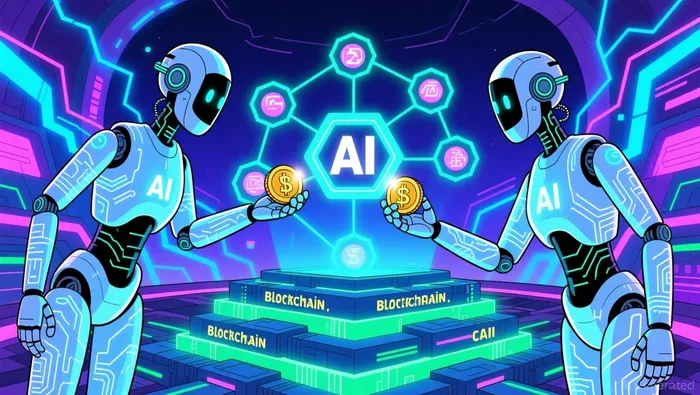
Stablecoins like USDC are proving particularly well-suited for this new paradigm. Their programmability and composability make them ideal for automated financial workflows. Coinbase's x402 protocol, for instance, integrates stablecoin payments directly into HTTP requests, allowing agents to pay for things like API calls in fractions of a cent. CircleCRCL--, the company behind USDC, has seen significant stock gains recently as its stablecoin gains traction in the AI agent space.
How Could AI Agents Impact the Future of BitcoinBTC-- and Stablecoins?
The long-term potential of this trend is staggering. Bitwise CIO Matt Hougan estimates that if Bitcoin captures 25% of the global gold market—currently valued at over $10 trillion—it could reach a price of $1.3 million. This scenario would be accelerated by the expansion of tokenized assets, which could grow from $20 billion to $200 trillion if equities and bonds move onto blockchains.
At the same time, stablecoins are already becoming a foundational layer for AI agent payments. Experts argue that these tokens could modernize B2B transactions and cross-border payments, especially in high-volume environments where traditional card networks are inefficient. This is why companies like Stripe, Circle, and Coinbase are investing heavily in agentic commerce—anticipating a future where bots handle many of the financial transactions humans currently manage.
What Are the Risks and Challenges for Coinbase and the Industry?
Despite the promise, there are significant challenges ahead. One is the decline in blockchain developer activity since early 2025. Weekly code commits have dropped 75%, with many developers shifting their focus toward AI projects. This raises questions about the long-term innovation pipeline for crypto infrastructure and whether the industry can keep pace with AI-driven demands.
Regulatory uncertainty also looms large. While companies like Mastercard are embedding security and governance into agentic commerce models, the legal framework for AI agent transactions is still being defined. Questions around liability, fraud, and compliance remain unresolved, particularly when no human is involved in the transaction.
For Coinbase, the stakes are high. If AI agents become a dominant force in global commerce, the company's Agentic Wallets and x402 protocol could become foundational infrastructure for the next generation of financial systems. But if adoption stalls or regulation slows the pace of innovation, the opportunity may not materialize as quickly as some are predicting.
For now, the future of payments is being written by software. Investors should be watching how AI agent adoption evolves, what role stablecoins play in enabling this growth, and how traditional financial players like Mastercard, Visa, and even Microsoft adapt to this new paradigm. The next few years could redefine not just how we pay for things—but who is doing the paying.

Stay ahead of the market.
Get curated U.S. market news, insights and key dates delivered to your inbox.


AInvest
PRO
AInvest
PRO



Comments
No comments yet