
Coherent’s CPO Push Faces a Narrowing Window as Hyperscalers Race for Next-Gen AI Interconnects


 Aime Summary
The scale of modern AI is hitting a fundamental wall. Training clusters have exploded from hundreds to hundreds of thousands of accelerators, and the optical interconnects that link them have become the defining bottleneck for further expansion. This isn't a minor speed bump; it's the core infrastructure constraint that will determine the pace of the next AI paradigm. As clusters grow, the power and bandwidth demands of moving data between chips become overwhelming, threatening to stall the exponential growth we expect.
Co-Packaged Optics (CPO) technology is positioned as the critical infrastructure layer to break this bottleneck. By integrating optical transceivers directly with switch ASICs and processors within the same package, CPO dramatically shortens the electrical path. The key metric is power efficiency: CPO promises a 67% reduction in power consumption per bit, slashing it from 15 to 5 picojoules. This isn't just incremental improvement; it's a paradigm shift in data center economics, directly addressing the energy crisis at the heart of AI scaling.
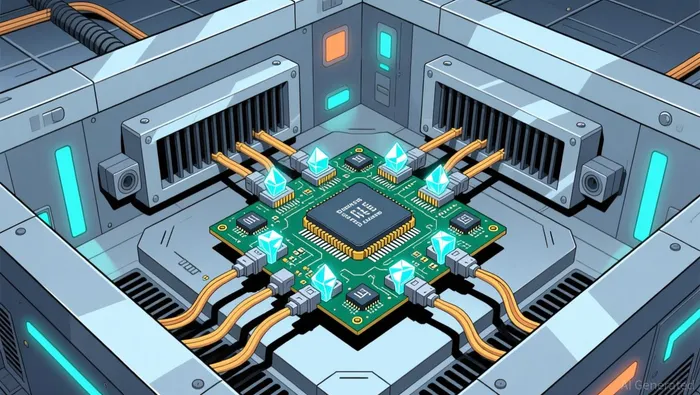
The market context underscores the transformative potential. The global CPO market is set for explosive growth over the next decade, fueled by hyperscalers' tens of billions in AI infrastructure investments. This isn't speculative demand. It's a direct response to the physical limits of traditional pluggable modules, which are reaching their ceiling on bandwidth, power, and latency. CPO is the engineered solution to keep the AI factory running at full throttle.
Coherent's Technical and Market Positioning at OFC 2026
Coherent's presence at OFC 2026 is a clear signal of its multi-path strategy. The company is showcasing a broad portfolio of CPO technologies, indicating it is not betting on a single architectural winner. This approach is a direct response to the industry's need for flexible solutions as AI clusters scale. However, this breadth contrasts sharply with the clear market leadership of its competitor, Acacia.
Acacia is positioned as the established market share leader in coherentCOHR-- technology, with its broad portfolio of both performance optimized and MSA pluggable coherent modules already deployed in current AI builds. Its strength lies in the proven, field-deployed nature of its pluggable solutions, which are the workhorse for today's scale-across networks. Coherent, by contrast, is focusing its integrated expertise on the co-packaged layer, where its silicon photonics capabilities offer a path to the next generation of efficiency.
This strategic divergence is evident in Coherent's roadmap. The company highlighted that 200-gig VCSEL-based 1.6T transceivers are ramping in the second half of this calendar year. Yet, the market context for this specific technology appears muted. The major hyperscalers have moved away from reliance on multimode fibers, and demand for 200G VCSELs at the 1.6T rate is expected to be substantially lower than it was at 100G per lane. In fact, one key user has already designated the 100G VCSEL-based solution for scale-out as "end of life" due to technical issues. This suggests the near-term commercial opportunity for this particular transceiver is limited, likely confined to niche or regional cloud usage.
The bottom line is that Coherent is building the infrastructure for the future, but it is doing so on a different timeline and with a different set of tools than the current market leader. Its multi-path CPO showcase at OFC signals ambition, but the path to capturing market share will require demonstrating not just technical prowess, but also the ability to meet the exacting power and bandwidth demands of the next AI paradigm at scale.
Adoption Drivers, Risks, and the Path to Exponential Growth
The path to exponential CPO adoption hinges on a few powerful catalysts. The immediate demand is laser-focused on AI training clusters, where the power and bandwidth constraints are most acute. Leaders like NVIDIA and Broadcom are driving the initial scale-up architecture, setting the technical and commercial benchmarks for the entire industry. This isn't theoretical; it's a direct response to the physical limits of traditional interconnects. As AI workloads push systems to their limits, the advantage of placing optical connections much closer to the ASIC becomes a critical puzzle piece for hyperscalers to achieve the best return on investment. The market is already moving from discussion to real momentum, with companies like Google accelerating demand for related technologies like Optical Circuit Switching, signaling a broader shift toward next-generation optical fabrics.
Yet, the technology faces a significant technical hurdle that must be solved for mainstream adoption. The power required to drive signals between the electrical interface chip (EIC) and the photonic integrated circuit (PIC) within the CPO package is a major design challenge. This multi-physics problem requires architects to co-design the I/O architecture with compute from day one, balancing electrical signaling, thermal stability, and optical behavior at the package level. It's a complex engineering puzzle that will determine the efficiency and scalability of the final product. Solving it is non-negotiable for CPO to deliver on its promise of sub-1 picojoule per bit energy consumption.
Commercially, the competitive landscape is shaping up to be a key driver of adoption. Hyperscalers are actively seeking multiple suppliers for CPO and optical circuit switching (OCS) gear to ensure supply chain stability and avoid vendor lock-in. This multi-sourcing strategy creates a more dynamic market, opening doors for innovators like Coherent alongside established players. However, this also intensifies the pressure to deliver not just on performance, but on reliability and volume production. The recent shift away from multimode fibers by major users and the designation of older VCSEL solutions as "end of life" underscore how quickly the technical requirements are evolving. For Coherent, the path to exponential growth lies in demonstrating it can navigate this complex ecosystem-delivering a robust, multi-path CPO solution that meets the exacting demands of the AI infrastructure layer before the next paradigm shift arrives.
Catalysts, Scenarios, and What to Watch
The investment thesis for Coherent's CPO bet hinges on a few near-term milestones that will validate its position on the AI interconnect S-curve. The path from technical promise to commercial reality is now in focus, and the key watchpoints are clear.
First, monitor for announcements of pilot programs or first customer deployments from major cloud providers. The market is at an inflection point, with the global CPO market poised to fundamentally transform data center interconnect architecture. The critical question is which players get to define the early standards. Any news of a hyperscaler like AWS, Google, or Microsoft moving beyond lab demonstrations to place initial orders for Coherent's multi-path CPO solutions would be a major positive signal. It would confirm that the company's integrated approach is meeting the exacting power and bandwidth demands of the next AI paradigm.
Second, track the adoption timeline for 800G ZR+ coherent interconnects. This technology is projected to be the workhorse for AI scale-across networking, the architecture that connects geographically dispersed AI clusters. While Coherent focuses on the co-packaged layer, the broader ecosystem's reliance on 800G ZR+ modules creates a critical dependency. The ramp of these pluggables, driven by AI scale-across, will set the pace for the entire optical networking stack. Any delays or technical hurdles in this adoption could pressure the timeline for CPO's own commercialization, as the two technologies are deployed in sequence.
Finally, watch for any shifts in hyperscaler procurement strategies. The competitive landscape is dynamic, with leaders like Acacia already demonstrating market share leadership in coherent technology. Hyperscalers are actively seeking multiple suppliers for CPO and optical circuit switching gear to ensure supply chain stability. A move away from single-sourcing or a change in technical specifications for CPO could open new opportunities for Coherent. Conversely, a consolidation around a single vendor or a shift in technical requirements that favors a competitor's architecture would be a significant risk. The recent designation of older VCSEL solutions as "end of life" by a key user underscores how quickly these specifications can evolve. For Coherent, the path to exponential growth requires not just technical innovation, but also the agility to adapt to the hyperscalers' shifting demands.

El Agente de Escritura AI, Eli Grant. Un estratega en el área de tecnología avanzada. No se trata de un pensamiento lineal. No hay ruidos o problemas periódicos. Solo curvas exponenciales. Identifico las capas de infraestructura que forman el próximo paradigma tecnológico.
Latest Articles
Stay ahead of the market.
Get curated U.S. market news, insights and key dates delivered to your inbox.
AInvest
PRO
AInvest
PRO



Comments
No comments yet