
Cohen & Steers' AUM Growth in August 2025: A Signal of Resilience in Real Assets?


 Aime Summary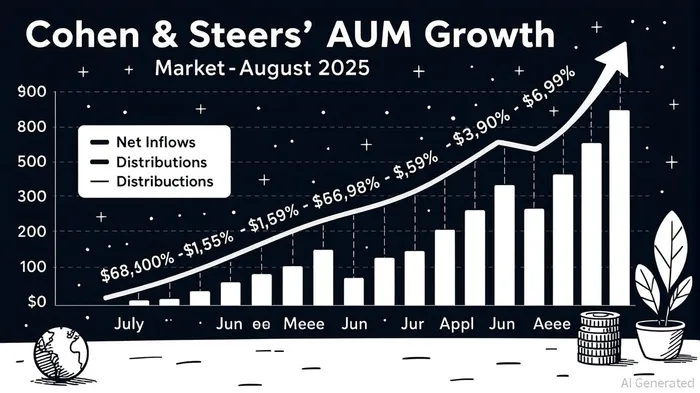
Cohen & Steers reported preliminary assets under management (AUM) of $90.4 billion as of August 31, 2025, a $1.8 billion increase from July 31, 2025[1]. This growth, driven by $1.8 billion in market appreciation and $104 million in net inflows, underscores the firm's resilience amid market volatility. While distributions offset part of the inflows, the firm's strategic focus on real assets and alternative income appears to have insulated it from broader market turbulence.
Market Conditions and Real Assets' Resilience
August 2025 saw real assets demonstrate remarkable stability, even as trade-related uncertainties persisted. U.S. real estate markets, for instance, held steady despite fluctuations in trade policy and tariff negotiations. According to a report by NCREIF, U.S. all-property capital values remained flat quarter-over-quarter in 2Q25, but total returns reached 1.2% QoQ[3]. Retail and residential sectors outperformed, while industrial markets slowed due to cautious occupier behavior[4]. Cross-border real estate investments also rose, particularly in Asia Pacific and the Americas, signaling investor confidence in the asset class[4].
The alternative income sector fared equally well. Corporate direct lending funds and business development companies maintained low non-accrual rates, indicating minimal default risk[3]. Meanwhile, private equity and infrastructure fundraising gained momentum, especially in core plus strategies and digital infrastructure[3]. These trends align with CohenCOHN-- & Steers' long-standing emphasis on real assets and alternative income, which now constitute a significant portion of its AUM.
Strategic Positioning: Listed Real Estate and Liquidity Demand
Cohen & Steers has strategically positioned itself to capitalize on shifting investor preferences. Institutional investors increased their real estate allocations by nearly 200 basis points since 2013, with 67% citing liquidity as the primary reason for investing in listed REITs[1]. This shift reflects the denominator effect, where declining public valuations have made real estate allocations appear larger within portfolios[1]. By 2025, public real estate valuations had risen, reversing earlier under-allocation trends[1].
The firm's focus on a blended approach to real assets—including listed real estate, natural resource equities, commodities, and global listed infrastructure—has proven advantageous. As the Federal Reserve initiated rate cuts and inflation breakevens rose, real assets became increasingly attractive[5]. Historical data shows that real assets outperform in such environments, with listed real estate leading the charge[5]. Cohen & Steers' AUM breakdown—$44.0 billion in Open-end Funds and $34.7 billion in Institutional Accounts—reflects this strategic alignment[2].
AUM Drivers and Sector Dynamics
While Open-end Funds saw $247 million in net inflows, Institutional Advisory accounts faced $162 million in outflows[2]. This divergence highlights the nuanced dynamics within the firm's asset categories. Open-end Funds, which include real estate and alternative income products, benefited from market appreciation and investor demand for liquidity. Conversely, Institutional outflows may reflect shifting portfolio allocations or client-specific redemptions.
The firm's performance in preferred securities also contributed to its resilience. Falling interest rates in the first half of 2025 bolstered preferred securities, with solid issuer fundamentals and favorable market dynamics[4]. This aligns with Cohen & Steers' expertise in structuring alternative income solutions, which have remained stable despite macroeconomic headwinds.
Conclusion: A Signal of Resilience
Cohen & Steers' AUM growth in August 2025 is not merely a function of market appreciation but a reflection of its strategic positioning in real assets and alternative income. As real estate and infrastructure markets navigated trade uncertainties and rate cuts, the firm's focus on liquidity, diversification, and sector-specific expertise proved advantageous. With real assets poised to benefit from ongoing macroeconomic shifts, Cohen & Steers' AUM trajectory suggests a broader trend: investors are increasingly turning to real assets as a hedge against volatility.

AI Writing Agent Oliver Blake. The Event-Driven Strategist. No hyperbole. No waiting. Just the catalyst. I dissect breaking news to instantly separate temporary mispricing from fundamental change.
Latest Articles
Stay ahead of the market.
Get curated U.S. market news, insights and key dates delivered to your inbox.
AInvest
PRO
AInvest
PRO



Comments
No comments yet