
The Cognac Truce: A Barometer of Global Luxury Trade Resilience
The provisional resolution of the China-EU cognac tariff dispute, announced in May 2025, marks a pivotal moment in cross-border trade relations. By suspending punitive tariffs on compliant European producers, Beijing and Brussels have signaled a tactical easing of tensions amid broader geopolitical frictions. This truce, however, is more than a bilateral compromise—it is a barometer of luxury sector resilience in the face of systemic trade volatility. For investors, it offers a roadmap to navigate risks and opportunities in premium consumer goods, where brands with diversified strategies and strong market footholds will thrive.
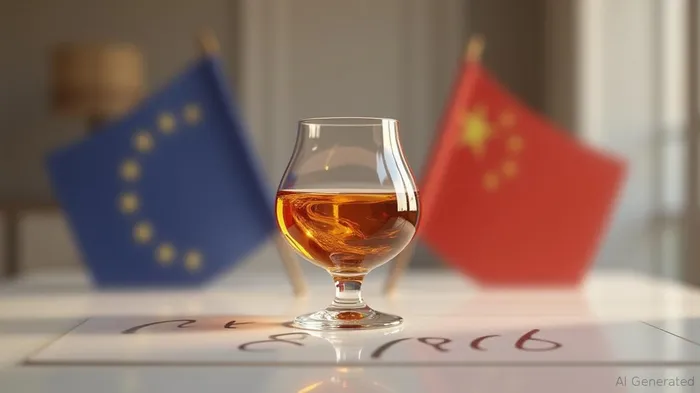
The Truce: A Strategic Pause in Trade Warfare
China's decision to exempt EU cognac producers from tariffs of up to 34.9%—if they adhere to minimum price commitments—reflects a calculated de-escalation. The tariffs, originally imposed in late 2024 to counter alleged dumping, had slashed EU cognac exports to China by 70% by early 2025, inflicting €100 million in losses on Pernod Ricard and a 20% drop in Rémy Cointreau's share price. The truce, brokered during diplomatic talks between Macron and Xi, averts a permanent tariff regime that would have driven EU cognac out of China's luxury market entirely.
This resolution is not altruistic. It is part of a reciprocal negotiation dynamic: the EU's 50% tariffs on Chinese electric vehicles (EVs) remain unresolved, but both sides now have incentive to stabilize relations ahead of the July 2025 EU-China summit. The cognac truce exemplifies the “slicing” of complex trade disputes—a strategy to isolate manageable sectors while broader issues simmer.
Luxury Sector Resilience: Valuation and Competitive Dynamics
The luxury alcohol sector's valuation hinges on its ability to navigate such disruptions. Global premium alcohol sales are projected to grow at a 9.76% CAGR to $950.8 billion by 2030, driven by urbanization and disposable income growth. However, the China-EU truce's impact is uneven:
- Winners:
- Rémy Cointreau (RCO.PA): Deriving 30% of sales from China, its ultra-premium Rémy Martin brand benefits directly from tariff relief. Its stock rebound (+0.54% post-truce) hints at investor confidence.
- Pernod Ricard (PDR.PA): Its diversified portfolio (whiskey, vodka, and Asia-Pacific markets beyond China) buffers against China-specific risks. Analysts anticipate earnings upgrades by mid-2025.
- LVMH (MC.PA): The Hennessy cognac division's stability contrasts with broader headwinds in U.S. inventory management, underscoring the strategic value of China access.
- Losers:
- Rigid firms lacking China exposure or diversified markets face margin pressure. Smaller producers, less able to absorb tariff costs, may consolidate.
- Chinese domestic brandy and Scotch whisky brands, which had gained share during the tariff spike, now face renewed competition from European cognac.
Growth Trajectories: China's Luxury Market and Beyond
The truce's success depends on China's premium market rebound. Post-2025, expect:
- Rebound in exports: A return to pre-tariff volumes (pre-2024) is achievable if the MIP agreement holds.
- Shift to mid-tier products: Chinese consumers, influenced by inflation, may favor VS/VSOP tiers over ultra-premium XO, altering profit margins.
- Emerging markets as buffers: Pernod's focus on India and Southeast Asia, where luxury spending is rising at 12% annually, illustrates the need to diversify beyond China.
Investment Implications: Positioning for Resilience
The cognac truce underscores two truths for investors:
1. Geopolitical risk is structural: Luxury brands must balance China's market potential with the risk of recurring trade disputes. Overweight positions in firms with diversified supply chains (e.g., Pernod's Asian expansion) and pricing flexibility (e.g., tiered MIP compliance) are prudent.
2. Valuation is a function of agility: Brands like Rémy Cointreau, which adapt swiftly to regulatory demands while maintaining premium positioning, will command valuation premiums.
Recommended Plays:
- Equities: Overweight RCO.PA and PDR.PA. LVMH (MC.PA) offers stability but requires monitoring of U.S. market risks.
- Hedging: Use options on EV stocks (e.g., BYD, Volkswagen) to offset risks tied to unresolved EU-China EV tariffs.
- ETFs: Consider luxury sector ETFs (e.g., $LUX) for broad exposure, but remain cautious on geographic concentration.
Risks and Contingencies
- Geopolitical setbacks: If the July EU-China summit fails to address EV tariffs or rare earth disputes, luxury sectors could face renewed volatility.
- Consumer inflation: China's economic slowdown may limit premium demand, favoring brands with mid-tier offerings.
- Supply chain costs: Tariff-driven input price hikes (e.g., aluminum for barrels) could compress margins unless passed to consumers.
Conclusion
The China-EU cognac truce is a microcosm of luxury's broader challenge: thriving in a world where trade relations are as fragile as a crystal decanter. For investors, the path to resilience lies in backing brands that combine geopolitical foresight with operational flexibility. The cognac producers who emerge strongest will be those that leverage China's market without overexposure, innovate in pricing tiers, and diversify into high-growth regions. As trade truces and tariffs continue to shape the luxury landscape, adaptability—not just brand prestige—will define winners.
The next chapter of this saga will unfold at the July EU-China summit. Investors would do well to monitor its outcome closely.

Stay ahead of the market.
Get curated U.S. market news, insights and key dates delivered to your inbox.


AInvest
PRO
AInvest
PRO



Comments
No comments yet