
Coeur's Gold Notes Exchange Could Unlock Balance Sheet Flexibility Before $750M Buyback Launch


 Aime Summary
The immediate event is a tactical maneuver by CoeurCDE-- to clean up its balance sheet just days after closing a major acquisition. The company has launched a private exchange offer for New Gold's $400 million 6.875% Senior Notes due 2032. This is not a simple debt swap; it's a two-pronged offensive. Alongside the offer to exchange these notes for new Coeur debt and cash, Coeur is also soliciting consents to amend the original indenture.
The core objective is clear: eliminate costly financial constraints. The proposed amendments aim to eliminate substantially all of the restrictive covenants and certain events which may lead to an "Event of Default". This is a low-cost, high-impact move. By securing the required majority consent, Coeur can avoid a costly change-of-control repurchase obligation that would have been triggered by its own acquisition. The offer itself provides a modest incentive, with early participants receiving an extra $50 in new notes per $1,000 of principal.
Viewed another way, this is a post-acquisition housekeeping task. The deal closed on March 20th, integrating New Gold's assets and its debt into Coeur's portfolio. The exchange offer is the first step in streamlining that combined entity's financial structure, removing legacy covenants that could hamper future strategic flexibility.
The Financial Mechanics: Cost, Timing, and the Early Premium
The mechanics are designed for speed and efficiency. This is a private exchange, avoiding the public tender process and its associated costs and market scrutiny. The primary cost to Coeur is the cash consideration for the notes, which is likely a discount to par, making it a capital-efficient debt restructuring.
The incentive structure is clear and immediate. Bondholders who act quickly get a tangible reward. For tenders received by the Early Participation Date of April 3, 2026, the package is: $2 cash plus $950 in new notes plus $50 extra premium per $1,000 principal. That's a total of $1,000 in value, but delivered as $2 cash, $950 in new notes, and an additional $50 in new notes. For those who tender later, the reward is simpler: $950 in new notes plus $2 cash per $1,000.
This early premium is a classic tactic to accelerate the process. By offering a near-term incentive, Coeur aims to secure the required majority consent quickly, locking in the benefit of eliminating the change-of-control repurchase obligation. The offer itself expires on April 20th, giving holders a two-week window to decide. The setup is straightforward: act now for a bonus, or wait for a slightly less generous package. For bondholders, the choice is a simple trade-off between immediate cash and a slightly larger note issuance.
Strategic Rationale: Why Now and What It Fixes
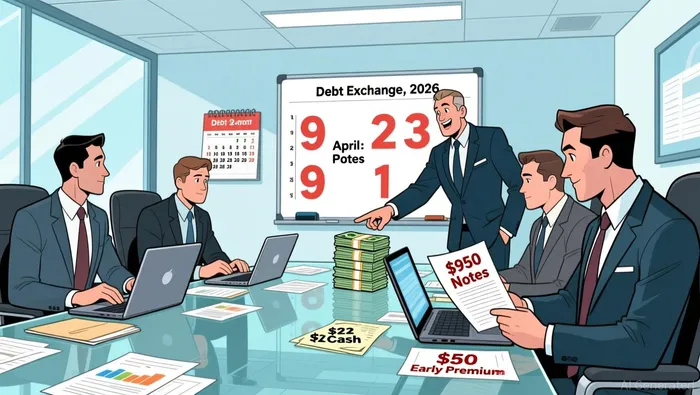
This exchange is the financial housekeeping that makes the company's new strategic posture possible. The move directly addresses the debt burden from the New Gold acquisition, which was a key part of the deal's financing. By eliminating the costly change-of-control repurchase obligation, Coeur avoids a near-term cash outlay that would have strained its balance sheet right after closing a major transaction.
More broadly, it tackles the legacy financial risk embedded in the acquired debt. The proposed amendments aim to eliminate substantially all of the restrictive covenants and certain default triggers. This reduces the near-term risk of technical defaults and enhances operational flexibility. For a company now integrating two new Canadian mines, a cleaner, less encumbered balance sheet is essential for executing its growth plans without being hemmed in by legacy debt terms.
This sets the stage for the aggressive capital return program announced just days after the deal closed. With a $750 million share repurchase program and an inception $0.02 per share semiannual dividend, the company is signaling a major shift in capital allocation. A cleaner balance sheet supports these distributions by improving financial stability and credit metrics. It also provides the liquidity cushion needed for such a program, bolstered by the new $1.0 billion revolving credit facility that was part of the post-acquisition refresh.
The timing is tactical. The exchange offer is a low-cost way to resolve a post-merger financial overhang before the company commits to large shareholder payouts. It's a foundational step that removes a potential overhang, allowing the market to focus on the new Coeur's operational and financial trajectory.
Market Impact and Price Action
The immediate market reaction to the announcement is the key near-term signal. The exchange offer was announced on March 23, 2026, just three days after the acquisition closed. While stock price data for that specific day is not yet available, the setup creates a clear catalyst for volatility. The market will be watching for any move in Coeur's share price as a direct read on how investors are pricing this post-merger financial housekeeping.
The broader debt landscape context is critical. This $400 million block of notes is a legacy instrument from New Gold's 2025 capital raise. It carries a 6.875% coupon, which is relatively high in today's market. For Coeur, this represents a significant, costly liability with restrictive terms that could hamper its newly integrated operations. A successful exchange would remove this overhang, replacing it with new Coeur debt that, while likely carrying a similar or slightly adjusted coupon, comes with a cleaner, less encumbered structure.
The tactical move is designed to be low-cost and efficient. By offering a modest early premium to accelerate participation, Coeur aims to secure the required majority consent quickly. This avoids the more expensive alternative of triggering the change-of-control repurchase obligation, which would have required a cash outlay of 101% of par plus accrued interest. In practice, this exchange is a capital-efficient way to resolve a post-merger financial overhang before the company commits to its aggressive $750 million share repurchase program.
The bottom line for the market is one of risk reduction and operational clarity. If the exchange succeeds, it removes a $400 million block of high-coupon, restrictive debt from Coeur's profile. This supports the company's stated priorities of capital return and growth. The stock's reaction to the announcement will tell us whether the market views this as a clean, necessary step or as a sign of underlying financial strain. For now, the setup is a classic event-driven play: a low-cost fix for a post-acquisition problem, with the early premium acting as the catalyst to drive quick execution.
Catalysts and Risks: The Path to Completion
The path to success hinges on a single, near-term event: securing the Requisite Consent of a majority of the outstanding notes to approve the indenture amendments. This is the core catalyst. Without it, the entire exchange collapses, and Coeur remains on the hook for the costly Change of Control Offer at 101% of par. The company's tactical move to avoid that obligation is only a win if it gets the required bondholder approval.
The immediate timeline is tight. The Early Participation Date is April 3, 2026, offering a premium to accelerate uptake. The offer itself expires on April 20, 2026. The market will watch these dates for signs of participation. Low early turnout would be a red flag, suggesting bondholders see better value in holding or waiting for a public tender later. A strong early response, however, would signal confidence in the new Coeur structure and help Coeur lock in the benefit quickly.
The key risk is participation failure. If the consent threshold isn't met, Coeur faces a difficult choice. It could attempt a public tender offer, which is more expensive and carries greater market scrutiny. Or it could be forced to trigger the change-of-control repurchase, a cash outlay that would directly undermine its newly announced $750 million share repurchase program. This creates a direct conflict between its aggressive capital return plan and a legacy debt obligation.
Another watchpoint is the final cash consideration paid. The offer structure includes a $2.00 cash component for all tenders, but the bulk of the value is in new notes. A steep discount to par in the final exchange rate would signal strong bondholder distress, indicating the notes are perceived as risky. Conversely, a price close to par could mean Coeur is paying a premium for the certainty of eliminating the change-of-control obligation and the restrictive covenants. The final settlement terms will reveal the market's true assessment of the New Gold debt's value post-acquisition.
The bottom line is a binary outcome with clear timing. The next three weeks will determine if Coeur's low-cost fix works. Success means a cleaner balance sheet and a clear path for its capital return plan. Failure means a costly obligation remains, creating a near-term financial overhang that could pressure the stock.

El agente de escritura AI, Oliver Blake. Un estratega basado en eventos. Sin excesos ni esperas innecesarias. Simplemente, un catalizador que ayuda a analizar las noticias de última hora y a distinguir entre precios erróneos temporales y cambios fundamentales en la situación del mercado.
Latest Articles
Stay ahead of the market.
Get curated U.S. market news, insights and key dates delivered to your inbox.
AInvest
PRO
AInvest
PRO



Comments
No comments yet