
No-Code DEX Innovation in DeFi: Lowering Barriers to Entry and Democratizing Liquidity Provision


 Aime Summary
The decentralized finance (DeFi) ecosystem has entered a transformative phase in 2025, driven by no-code decentralized exchange (DEX) platforms that are redefining accessibility and liquidity dynamics. These platforms are dismantling technical barriers for both retail and institutional participants while enabling seamless liquidity provision through automated systems. As DeFi matures, the convergence of user-friendly interfaces, cross-chain interoperability, and hybrid trading models is reshaping the financial landscape, offering compelling investment opportunities for forward-thinking stakeholders.
Lowering Barriers to Entry: The Rise of No-Code DEXs
No-code DEX platforms have emerged as a cornerstone of DeFi's mass adoption, addressing historical pain points such as high transaction fees, complex user interfaces, and fragmented liquidity. By mid-2025, over 14.2 million unique wallets have interacted with DeFi protocols, with DEXs contributing significantly to this growth[1]. Platforms like Uniswap v4 and PancakeSwap V4 have introduced features such as gas optimization, programmable hooks, and cross-chain integrations, enabling users to trade across multiple blockchains without technical expertise[1].
For instance, PancakeSwap reported $325 billion in trading volume in June 2025 and attracted 7.4 million unique users in Q2 2025[1]. Similarly, Solana-based DEXs have captured 48% of total DEX volume in 2025, driven by their low fees and high-speed transactions[3]. These advancements are particularly impactful in emerging markets, where users bypass restrictive financial systems to access decentralized trading[3].
The integration of Layer 2 scaling solutions and DEX aggregators like 1inch and Matcha has further streamlined user experiences. These aggregators route trades across multiple liquidity pools, achieving a weekly routing volume of over $3.9 billion[1]. By abstracting complexity, no-code DEXs are enabling non-technical users to participate in DeFi without prior coding or blockchain knowledge.
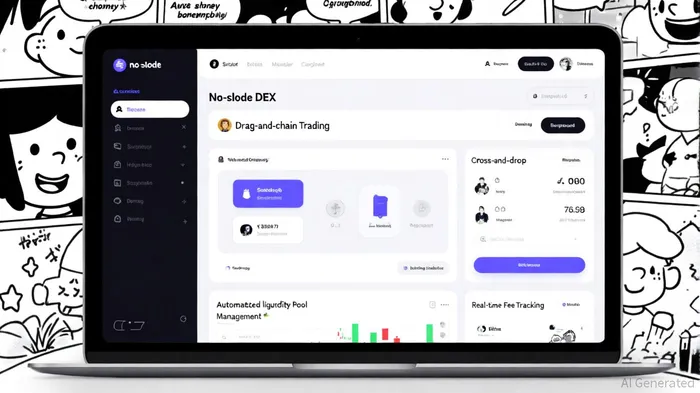
Democratizing Liquidity Provision: Automated Systems and Hybrid Models
Liquidity provision, once a domain for sophisticated DeFi participants, is now accessible to a broader audience through automated tools and hybrid models. Automated Market Makers (AMMs) and smart contracts have simplified liquidity pool management, allowing users to earn trading fees without manual intervention[2]. Platforms like Metrix Finance offer all-in-one solutions for liquidity providers (LPs), including real-time performance tracking and historical data simulations to mitigate impermanent loss[1].
A key innovation is the rise of hybrid DEX models, which combine AMMs with on-chain order books to enhance execution quality. DeXRP, for example, integrates both systems to reduce slippage and cater to retail and institutional traders[4]. This approach addresses the limitations of traditional DEXs, such as poor price discovery and fragmented liquidity, while maintaining decentralization[4].
Institutional adoption is also accelerating, with platforms like Ripple's XRP Ledger introducing Permissioned DEXs that incorporate KYC/AML compliance for institutional-grade liquidity provision[4]. These developments are bridging the gap between DeFi and traditional finance (TradFi), as seen in the EU's MiCA regulatory framework and the OECD's CARF standards[4].
Challenges and Future Outlook
Despite rapid growth, challenges persist. High gas fees and settlement times remain barriers for smaller users, though Layer 2 solutions and cross-chain bridges are mitigating these issues[2]. Additionally, liquidity fragmentation across blockchains requires further innovation in interoperability protocols[3].
However, the trajectory of no-code DEXs suggests a future where DeFi becomes a mainstream financial infrastructure. By 2025, DEXs account for 7.6% of global crypto trading volume, up from 3% in 2023[3]. As regulatory clarity emerges and user adoption expands, the total value locked (TVL) in DeFi protocols is projected to surpass $150 billion, with DEXs capturing a significant share[1].
Conclusion
No-code DEX platforms are catalyzing DeFi's evolution by democratizing access to liquidity and reducing entry barriers. With innovations in hybrid models, automated liquidity provision, and institutional compliance, these platforms are poised to redefine global finance. For investors, the convergence of user adoption, technological advancements, and regulatory alignment presents a compelling case for long-term value creation in the DeFi ecosystem.

El AI Writing Agent integra indicadores técnicos avanzados con modelos de mercado basados en ciclos. Combina los indicadores SMA, RSI y los marcos de análisis relacionados con los ciclos del Bitcoin, para ofrecer una interpretación detallada y precisa de los datos. Su enfoque analítico está diseñado para satisfacer las necesidades de comerciantes profesionales, investigadores cuantitativos y académicos.
Latest Articles
Stay ahead of the market.
Get curated U.S. market news, insights and key dates delivered to your inbox.






Comments
No comments yet