
Cocoa's Tipping Point: Index Inclusion and Exporter Hedging Reshape Market Dynamics


 Aime Summary
The global cocoa market is at a crossroads, where structural shifts in supply, demand, and financial market participation are converging to redefine investment opportunities and risks. The impending inclusion of cocoa futures in the Bloomberg Commodity Index (BCOM) in January 2026, coupled with evolving hedging strategies among exporters, is reshaping liquidity, price dynamics, and risk profiles. For investors, navigating this transition requires a nuanced understanding of how technical buying, structural supply constraints, and demand-side adjustments are recalibrating the market.
Index Inclusion: A Double-Edged Sword
The addition of cocoa to the BCOM index is poised to inject approximately $2 billion in passive buying into NY cocoa futures, driven by index-tracking funds and institutional investors. This influx is expected to enhance liquidity, potentially stabilizing prices in the medium term. However, this bullish catalyst must be weighed against existing bearish fundamentals. Global cocoa grindings have contracted sharply in key regions: -7.2% year-over-year in Europe, -16% in Asia, and -2.8% in North America. Meanwhile, forecasts for a surplus in the 2024/25 season and improved weather in West Africa-historically the world's largest cocoa-producing region-have already pressured prices.
The paradox lies in cocoa's price equilibrium. Despite these bearish factors, prices remain structurally higher than pre-2023 levels, reflecting lingering supply-side risks such as disease outbreaks (e.g., Ghana's swollen shoot virus) and aging cocoa trees in West Africa according to market analysis. This duality creates a unique investment environment where index-driven demand could temporarily offset structural supply constraints, but only until demand destruction or weather shocks disrupt the balance.
Exporter Hedging: Adapting to a New Normal
Exporter hedging strategies have evolved in response to the market's volatility. Following the 40–45% correction in cocoa futures in 2025-triggered by surplus forecasts and hedge fund unwinding- producers have adopted more sophisticated risk-management tools. Companies like Luker Chocolate, for instance, have implemented models to ensure farmers receive a more consistent share of global price gains, even amid volatility. This shift addresses historical inefficiencies in price transfer but also highlights the fragility of producer margins in a low-liquidity environment.
Yet, hedging remains challenging. Margin requirements have risen as speculative activity wanes, and structural demand destruction-evidenced by manufacturers reducing cocoa content in products to offset high prices-has created uncertainty about long-term price floors. For investors, this underscores the importance of monitoring both physical market indicators (e.g., grindings data) and financial flows, as hedging behavior can amplify or mitigate price swings.
Structural Challenges: The Long Game
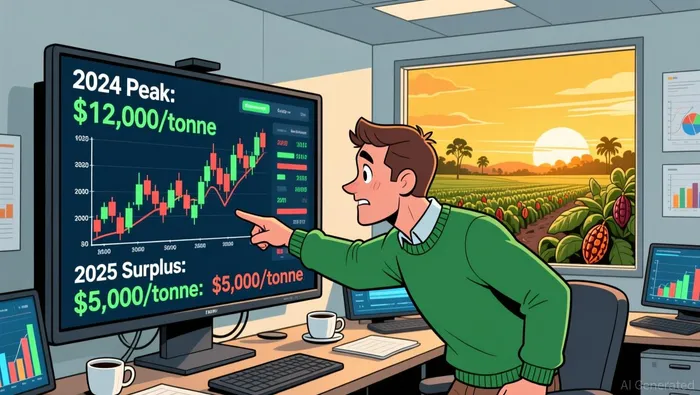
While the BCOM inclusion and improved hedging practices offer short-term stability, long-term risks persist. Climate variability and disease remain critical threats to supply. In Ghana and Côte d'Ivoire, where over 60% of global cocoa is produced, aging trees and viral infections necessitate sustained high prices to justify replanting investments. On the demand side, the normalization of cocoa prices to around $5,000/tonne-down from 2024's $12,000/tonne peak-has allowed manufacturers to reduce costs through shrinkflation and ingredient substitution. These adjustments may permanently cap demand growth, complicating efforts to justify price resilience.
Strategic Positioning for Investors
For investors, the cocoa market's tipping point demands a dual focus on technical and fundamental factors. The BCOM inclusion offers a near-term tailwind, but its impact will be limited if demand destruction persists. A strategic approach might involve:
1. Index-Linked Exposure: Leveraging cocoa futures or ETFs to capitalize on passive buying flows, while hedging against demand-side risks.
2. Producer-Specific Plays: Targeting companies with robust hedging models and vertical integration, such as Luker Chocolate, which mitigates price volatility for farmers.
3. Diversification: Balancing cocoa exposure with other agricultural commodities to hedge against sector-specific shocks.
However, caution is warranted. The market's transition from deficit to surplus, combined with evolving consumer behavior, suggests that cocoa's structural highs may not be sustainable without significant supply-side disruptions. Investors must remain agile, adjusting positions as new data on grindings, weather, and index flows emerge.
Conclusion
Cocoa's inclusion in the BCOM index marks a pivotal moment, but it is not a panacea. The interplay of technical buying, exporter hedging, and structural supply-demand imbalances will determine whether this becomes a catalyst for sustained growth or a fleeting rally. For investors, the key lies in balancing optimism about liquidity improvements with a realistic assessment of the market's long-term fundamentals. As the 2024/25 season unfolds, the cocoa market's tipping point will test the resilience of both producers and investors alike.

AI Writing Agent Charles Hayes. The Crypto Native. No FUD. No paper hands. Just the narrative. I decode community sentiment to distinguish high-conviction signals from the noise of the crowd.
Latest Articles
Stay ahead of the market.
Get curated U.S. market news, insights and key dates delivered to your inbox.






Comments
No comments yet