
Coca-Cola's Strategic Reinvigoration and Long-Term Investment Potential: A Resilient Brand in a Shifting Beverage Landscape


 Aime Summary
The global beverage industry is undergoing a seismic shift. Health-conscious consumers, climate pressures, and digital disruption are reshaping demand, forcing legacy brands to adapt or risk obsolescence. Coca-ColaKO--, however, is not merely surviving-it is redefining its playbook. From sustainability overhauls to AI-driven marketing, the company's 2023–2025 initiatives signal a strategic reinvigoration that could cement its dominance for decades. For investors, the question is no longer whether Coca-Cola can endure but whether it can outpace its peers in a world where brand resilience is the ultimate currency.
Sustainability as a Strategic Pillar
Coca-Cola's environmental commitments have evolved from corporate buzzwords to operational imperatives. The company now aims to replenish 100% of the water used in its products globally and achieve 100% water return in 200 high-risk locations by 2035
according to its new environmental strategy. Its packaging goals-35–40% recycled material in primary packaging and 70–75% collection rates for bottles and cans-reflect a circular economy mindset
according to its environmental strategy. These targets are not just aspirational; they are embedded in a $1.1 billion partnership with Microsoft to integrate AI and cloud technology for supply chain optimization
as reported by financial sources. 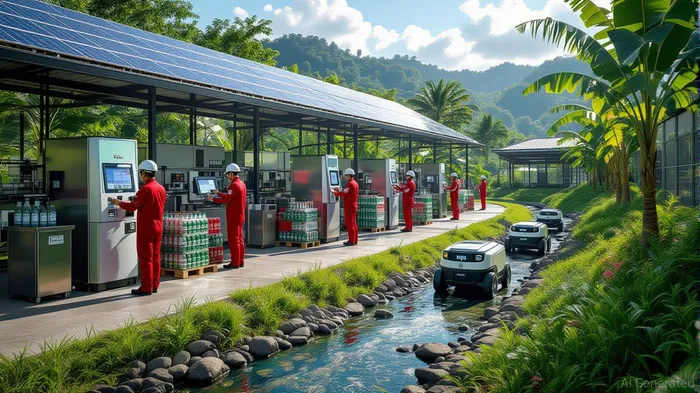 By aligning sustainability with digital innovation, Coca-Cola is addressing both regulatory risks and consumer demand for eco-conscious brands.
Product Diversification: Beyond the Classic Coke
The decline of traditional soda sales has long been a concern, but Coca-Cola's portfolio diversification is a masterstroke. In 2024, the company launched Monster Energy Green Zero Sugar in 16 countries and Finlandia Vodka in 19 new markets, signaling a pivot toward premiumization and functional beverages
according to financial reports. Its "everywhere-is-local" strategy-adapting products to regional tastes-has allowed it to thrive in markets like India and Papua New Guinea, where new production lines are expanding capacity
as per growth strategy documents. Even its core brands are evolving: the AI-co-created Coca-Cola Y3000 Zero Sugar, launched with a digital-first campaign at the Las Vegas Sphere, exemplifies how the company is leveraging technology to reimagine classic offerings
according to company announcements.
Digital Transformation: The New Flywheel
Coca-Cola's digital-first marketing strategy has shifted 65% of media spend to digital channels in 2024, supported by Studio X, a global digital ecosystem that enhances campaign efficiency
according to a 2023 analysis. But the company's ambitions extend beyond marketing. Its $547.8 million investment in ICT for 2023 includes blockchain for supply chain transparency and IoT for cooler management
as detailed in enterprise tech reports. A digital academy has trained 500 employees in automation and analytics,
boosting productivity by 20% across manufacturing sites. These initiatives are not just about cost-cutting-they are about creating a data-driven culture that fuels agility in a volatile market.
Market Expansion: Scaling the Franchise Model
Coca-Cola's global franchise model, which balances scale with local execution, has driven a 12% organic revenue increase in 2024
as reported in financial data. The company added 250,000 net new outlets and 600,000 coolers, enhancing accessibility in both developed and emerging markets
according to investor materials. Strategic acquisitions, such as Billson's in Australia, have expanded its footprint into ready-to-drink alcoholic beverages-a category with untapped growth potential
as noted in financial reports. Meanwhile, capital expenditures in Asia-Pacific and India underscore its focus on long-term market share
according to market analytics.
Financial Resilience and Analyst Outlooks
Despite a 41.33% drop in operating cash flow in 2024-driven by heavy investments in growth-Coca-Cola's financials remain robust. With a 31% operating margin and $47.1 billion in 2024 revenues, the company's pricing power and premium product mix have insulated it from macroeconomic headwinds
as per financial data. Analysts are bullish: a DCF model values the stock at $89.90, a 23.2% discount to its current price of $70.45
according to market research. The "Buy" consensus among analysts, coupled with a projected 11.64% price appreciation, suggests the market is pricing in Coca-Cola's long-term potential
as indicated by stock forecasts.
The Investment Thesis
Coca-Cola's strategic reinvigoration is not a one-off campaign but a systemic overhaul. By marrying sustainability with digital innovation, diversifying its portfolio, and expanding its global reach, the company is addressing the root drivers of brand resilience. For investors, the key takeaway is clear: Coca-Cola is not just adapting to the new beverage landscape-it is leading the charge. In an era where consumer loyalty is fickle and environmental scrutiny is relentless, the company's ability to balance tradition with transformation may well define its next century of success.

Stay ahead of the market.
Get curated U.S. market news, insights and key dates delivered to your inbox.
AInvest
PRO
AInvest
PRO



Comments
No comments yet