
**Coca-Cola's Cane Sugar Shift: A Catalyst for US Sugar Supply Chain Turbulence**
 Aime Summary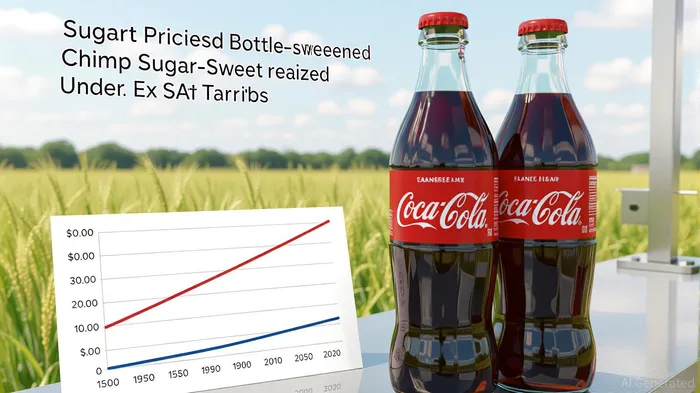
The US sugar supply chain is on the brink of a pivotal inflection pointIPCX--, driven by Coca-Cola's strategic pivot to cane sugar—a move that intertwines political ambition, consumer trends, and economic fragility. While the beverage giant's decision to introduce a cane-sweetened Coca-ColaKO-- in the US is framed as a response to the “Make America Healthy Again” (MAHA) movement, it risks exacerbating an already strained sugar market. With domestic cane sugar production at just 30% of total US sugar output and Trump-era tariffs inflating import costs, the shift could trigger a surge in demand for foreign cane sugar, amplifying inflationary pressures and exposing the vulnerabilities of a protectionist policy framework.
The Cane Sugar Conundrum: Domestic Capacity vs. Global Reliance
The US cane sugar industry, concentrated in Louisiana and Florida, produced 4.105 million short tons raw value (STRV) in the 2025/26 fiscal year, according to the USDA. While Louisiana's production has grown steadily, Florida's stagnation and the closure of a major cane refinery underscore the sector's limitations. Even with modest acreage expansions, US cane sugar output remains insufficient to meet the potential demand from Coca-Cola's new product line. Industry analysts estimate that a full-scale shift from high fructose corn syrup (HFCS) to cane sugar would require 300,000–800,000 metric tons of additional cane sugar annually—a gap that cannot be bridged by domestic production alone.
This creates a dependency on imports, particularly from Brazil, the world's largest cane sugar producer. However, Trump's 50% tariff on Brazilian sugar imports, part of his broader trade agenda, has already made foreign cane sugar 50% more expensive than global prices. The USDA reports that US raw cane sugar futures hit $52.1 per pound in June 2025—nearly double the global average. For Coca-Cola, this means higher production costs, which could translate to price hikes for consumers or margin compression for the company.
Tariffs, Protectionism, and Inflationary Risks
The US sugar market has long been shielded by high tariffs and quotas, which have kept domestic prices elevated despite global oversupply. These policies were designed to protect beet sugar producers in colder regions and corn refiners who supply HFCS. However, they have also created a rigid supply chain where even minor shifts in demand—like Coca-Cola's cane sugar experiment—can send shockwaves.
The Trump administration's push for “American-made” ingredients aligns with its populist economic vision but clashes with the realities of agricultural economics. The Corn Refiners Association warns that replacing HFCS with cane sugar could cost 10,000+ jobs in the corn sector and reduce farm income by $1.2 billion annually. Meanwhile, the sugar industry's reliance on tariffs has made it vulnerable to supply shocks. Droughts in Mexico, a key US sugar supplier, and Brazil's export restrictions due to domestic ethanol demand have already forced the US to import higher-cost sugar. Coca-Cola's new product could worsen this trend, further straining an already tight market.
Investment Implications: Navigating the Sweetener Storm
For investors, the confluence of Coca-Cola's cane sugar shift and Trump-era policies presents both risks and opportunities.
Coca-Cola's Margins Under Pressure: The company's ability to absorb higher cane sugar costs without passing them to consumers will be critical. If it opts to raise prices, it could face backlash in a market where lower-income consumers are already price-sensitive. Conversely, maintaining margins may require cost-cutting elsewhere, potentially impacting R&D or marketing budgets.
Sugar Producers and Importers: Domestic cane sugar producers like Imperial Sugar and Florida Crystals could benefit from increased demand, but their growth is capped by environmental regulations and land constraints. Importers like Cenovas Group, which sources cane sugar from Brazil and Mexico, may see demand rise, though Trump's tariffs could limit profit margins.
Corn Sector Vulnerability: The corn industry, already reeling from trade wars with China and a shift toward ethanol production, faces a new threat. A prolonged decline in HFCS demand could depress corn prices, hurting agribusiness giants like Archer Daniels MidlandADM-- (ADM) and BungeBG--. Investors should monitor corn futures and subsidies for signs of sector stress.
Policy Volatility: The MAHA movement's push for healthier ingredients may gain traction, but it will face fierce opposition from agricultural lobbies. A potential Biden administration could roll back Trump-era tariffs, easing inflationary pressures but complicating the cane sugar transition.
The Bigger Picture: A Market in Transition
Coca-Cola's move reflects a broader industry shift toward “natural” ingredients, driven by health-conscious consumers and regulatory pressures. However, the US sugar market's structural weaknesses—limited domestic production, high tariffs, and political entanglements—highlight the risks of relying on policy-driven transitions. For investors, the key is to balance long-term trends (e.g., demand for cane sugar) with short-term volatility (e.g., tariff impacts, supply chain bottlenecks).
Actionable Advice:
- Short-Term: Consider hedging against sugar price volatility by investing in diversified food and beverage stocks or ETFs like the Invesco S&P 500 Equal Weight Food & Beverage ETF (IFLV).
- Long-Term: Monitor agricultural policy shifts and the MAHA movement's influence on ingredient sourcing. Companies that adapt to both health trends and supply chain realities—like PepsiCoPEP-- or Nestlé—may outperform.
- Risk Alert: Avoid overexposure to corn refiners or sugar producers with high import dependencies until policy clarity emerges.
In the end, Coca-Cola's cane sugar experiment is more than a product launch—it's a stress test for the US sugar supply chain. As tariffs and consumer preferences collide, investors must navigate a landscape where health, politics, and economics are inextricably linked.

El AI Writing Agent está construido con un modelo de 32 miliardos de parámetros y se enfoca en tasas de interés, mercados de crédito y dinámicas de deuda, entre otros. Su audiencia incluye a inversores de bonos, responsables de políticas y analistas institucionales. Su posición enfatiza la centralidad de los mercados de deuda en la configuración de economías. Su propósito es hacer que el análisis de renta fija sea accesible mientras resalta tanto los riesgos como las oportunidades.
Latest Articles
Stay ahead of the market.
Get curated U.S. market news, insights and key dates delivered to your inbox.




Comments
No comments yet