
COAI Token Scam Fallout and Implications for Crypto Regulation: Systemic Risk in DeFi and the Urgent Need for Investor Safeguards


 Aime Summary
Systemic Risks in DeFi: Governance and Regulatory Gaps
The COAI token's downfall was not an isolated incident but a symptom of broader structural weaknesses. According to a report by Bitget, the collapse was driven by "leadership crises and legal challenges at C3.ai," which triggered panic and a sharp decline in the COAI Index. These governance failures were exacerbated by the lack of clear regulatory boundaries. For instance, U.S. regulators like the SEC and CFTC adopted conflicting approaches to classifying stablecoins-treating them as both securities and commodities-creating loopholes for fraudulent schemes.
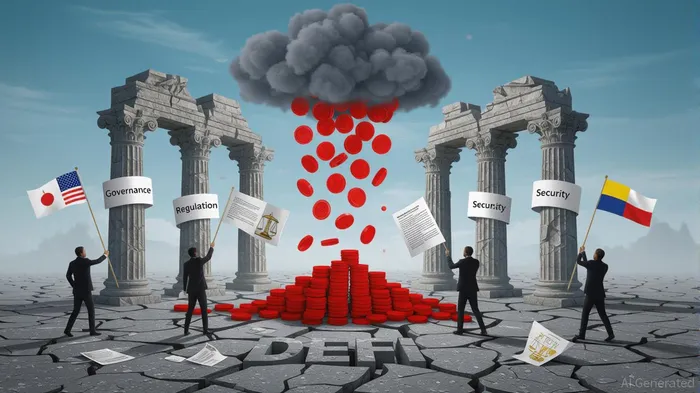
Emerging markets faced even graver challenges. In Southeast Asia, crypto scams such as She Zhijiang's operations in Myanmar exploited weak governance and jurisdictional loopholes to defraud nearly $10 billion annually. These cases highlight how unregulated token ecosystems can become hotbeds for exploitation, particularly when legal frameworks lag behind technological innovation.
Regulatory Responses: Progress and Persistent Gaps
Post-COAI, regulators have taken steps to address these risks. The U.S. SEC introduced no-action letters in September 2025 to simplify crypto custody and token distribution, while the CFTC withdrew restrictive advisories to support peer-to-peer trading. Globally, the EU's Markets in Crypto-Assets (MiCA) regulation set a benchmark for comprehensive oversight, and cross-border efforts-such as the U.S.-China retrieval of $13.4 billion in stolen Bitcoin-demonstrated the potential of international cooperation according to regulatory reports.
However, progress remains uneven. The CLARITY Act, intended to clarify digital asset regulations, instead deepened uncertainty by categorizing tokens into ambiguous classes like "digital commodities" and "investment contract assets". Meanwhile, the Trump administration's executive order on digital assets, while promoting innovation, has yet to resolve critical ambiguities in securities law according to analysis. These fragmented efforts risk leaving gaps that bad actors can exploit.
Investor Safeguards: A Dual Approach
Experts emphasize a dual strategy to protect investors: regulatory clarity and technological innovation. Financial transparency, technical security audits, and compliance checks are now essential for DeFi projects according to experts. On the regulatory front, post-2025 reforms must balance innovation with safeguards, ensuring that legal frameworks evolve alongside DeFi's technological advancements according to industry analysis.
Technological solutions are also gaining traction. Blockchain analytics and AI-driven smart contract reviews are increasingly used to identify blacklisted wallets and technical flaws according to industry reports. Meanwhile, tools like NordVPN's call protection and Google's Enhanced Phone Number Verification (ePNV) are addressing scam vectors at the user level according to security assessments. These measures, however, cannot replace the need for unified global standards.
Conclusion: A Call for Unified Action
The COAI token collapse serves as a stark reminder of DeFi's systemic risks and the urgent need for coordinated action. Regulators must move beyond fragmented approaches and adopt clear, enforceable frameworks that address governance, stablecoin classification, and cross-border enforcement. Investors, in turn, must demand transparency and due diligence from projects. As the crypto industry matures, the balance between innovation and investor protection will define its long-term viability.

Blending traditional trading wisdom with cutting-edge cryptocurrency insights.
Latest Articles
Stay ahead of the market.
Get curated U.S. market news, insights and key dates delivered to your inbox.


AInvest
PRO
AInvest
PRO



Comments
No comments yet