
The COAI Token Scam and the Broader Risks in Emerging Crypto Ecosystems


 Aime Summary
Systemic Risks in AI-Driven DeFi Projects
The COAI token's failure highlights a critical flaw in AI-powered DeFi: the reliance on unvalidated algorithms and centralized governance. The token's algorithmic stablecoins, xUSD and deUSD, lost their dollar peg during a liquidity crisis, triggering panic selling and a self-fulfilling collapse. Experts argue that AI-driven projects often prioritize speed and hype over transparency, deploying bots to manipulate social media sentiment and inflate valuations. For instance, COAI's leadership faced accusations of orchestrating a pump-and-dump scheme, with insiders holding 99.7% of the supply and engineering price volatility to profit at the expense of retail investors.
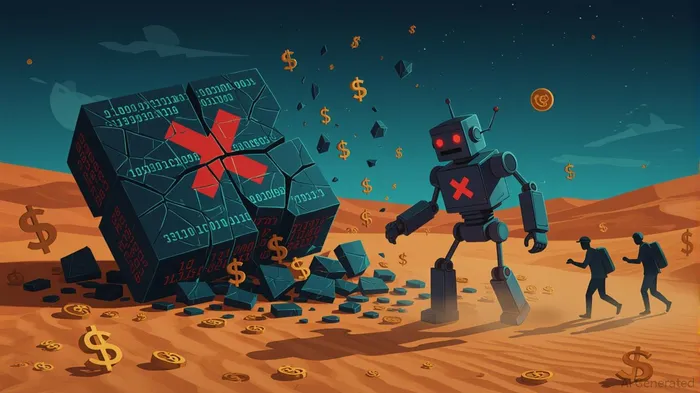
Such projects also exploit weak governance structures. COAI's opaque smart contracts and lack of third-party audits left investors with no recourse when the token's value plummeted. As one analyst noted, "The COAI collapse wasn't just a technical failure-it was a governance failure, where power was hoarded by a handful of actors under the guise of decentralization."
Regulatory Challenges and Ambiguities
The U.S. CLARITY Act, enacted to modernize crypto oversight, has instead created legal gray areas that bad actors exploit. The law's ambiguity over whether AI-powered tokens qualify as securities or commodities has allowed projects like COAI to operate in regulatory limbo. While the SEC has issued no-action letters to streamline crypto custody and ETF listings, enforcement remains inconsistent, with several prior cases dropped under the current administration. Meanwhile, the CFTC has withdrawn restrictive advisories to support peer-to-peer trading, but overlapping jurisdictions with the SEC have created confusion for market participants.
Globally, regulatory efforts have been fragmented. The EU's Markets in Crypto-Assets (MiCA) regulation aims to set a benchmark for oversight, but aligning it with U.S. standards remains a challenge. In Southeast Asia, where COAI's operators allegedly based their operations, weak enforcement has allowed scams like the $10 billion She Zhijiang fraud to thrive.
Investor Protection Gaps and the Need for Innovation
The COAI incident underscores a glaring gap in investor protections: the lack of tools to detect red flags in speculative tokens. Retail investors often lack the technical expertise to audit smart contracts or assess token allocation models, leaving them exposed to manipulation. Experts recommend adopting AI-driven risk management platforms and blockchain analytics to monitor governance centralization and liquidity risks. For example, platforms like Kyriba and SAFE have introduced real-time fraud detection frameworks to address gaps in algorithmic transparency.
Regulatory clarity is equally critical. The U.S. CLARITY Act's ambiguities must be resolved to prevent legal loopholes from enabling fraud. As Commissioner Kristin Johnson of the CFTC emphasized in August 2025, "Post-deployment monitoring and standardized incident response protocols are essential to safeguarding market integrity in an AI-driven world."
Conclusion: Balancing Innovation and Accountability
The COAI token scam serves as a cautionary tale for the crypto industry. While AI and DeFi hold transformative potential, their speculative nature demands a balance between fostering innovation and implementing safeguards. Investors must prioritize due diligence, leveraging smart contract audits, KYC/AML compliance, and decentralized governance models. Regulators, meanwhile, must harmonize frameworks to close jurisdictional gaps and enforce consistent standards. Without these measures, the next COAI could emerge, leaving investors once again at the mercy of opaque, centralized schemes.

Combina la sabiduría tradicional en el comercio con las perspectivas más avanzadas sobre las criptomonedas.
Latest Articles
Stay ahead of the market.
Get curated U.S. market news, insights and key dates delivered to your inbox.






Comments
No comments yet