
COAI's Sudden Price Drop: A Wake-Up Call for Tech Investors?
 Aime Summary
Valuations Under Pressure: A Perfect Storm of Corporate and Regulatory Risks
At the heart of COAI's collapse lies the deteriorating fundamentals of C3.ai, the index's anchor constituent. The company's leadership crisis-marked by CEO Thomas Siebel's abrupt resignation due to health reasons-triggered a cascade of investor concerns. Compounding this, a class-action lawsuit alleging misleading statements about its AI capabilities further eroded trust. Financially, C3.ai's Q1 2025 net loss of $116.8 million highlighted the chasm between its ambitious AI vision and operational reality.
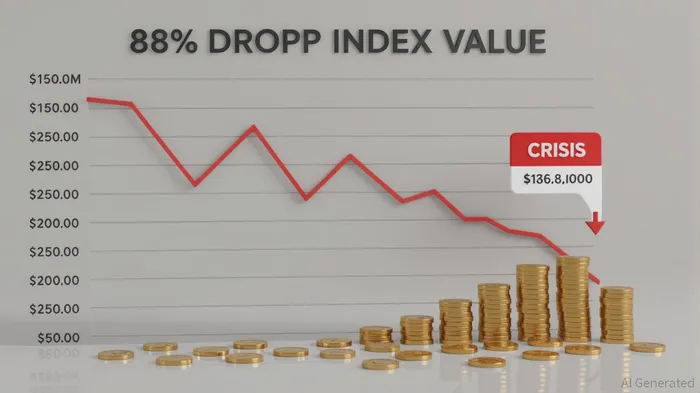
Regulatory uncertainty has amplified these pressures. The CLARITY Act, intended to clarify the legal status of AI tokens, has instead created a "gray zone" by failing to define whether these assets qualify as securities or commodities. This ambiguity has left institutional investors hesitant to commit capital, accelerating the sell-off in COAI and similar indices. As one analyst noted, "The lack of regulatory guardrails has turned what was once a speculative bet into a high-risk liability."
Sector Rotation: From Crypto AIAI-- to "Safer" Infrastructure Plays
The COAI selloff has coincided with a strategic shift in capital toward AI infrastructure stocks, reflecting investor preference for tangible assets over speculative crypto-linked ventures. Celestica (CLS), a provider of AI hardware and data-center solutions, saw its shares surge 5.78% in a single week in November 2025, outperforming both the Nasdaq and S&P 500. This rotation highlights a broader trend: investors are prioritizing companies with proven revenue streams and physical infrastructure over crypto projects reliant on unproven token economics.
Meanwhile, the agentic AI market-focused on AI systems capable of autonomous decision-making-has shown resilience. SoundHound AI, for instance, reported 68% year-over-year revenue growth, suggesting that not all AI-related investments are equally vulnerable. However, the divergence between crypto AI and traditional AI infrastructure underscores a critical risk for investors: the potential mispricing of innovation in speculative markets.
Technical Indicators and Market Sentiment: A Fragile Rebound?
Despite the bleak fundamentals, technical analysis hints at a possible short-term rebound. The Relative Strength Index (RSI) for COAI displayed a hidden bullish divergence between October 11 and October 28-a pattern historically associated with price recoveries. Whale activity also suggests positioning for a turnaround: whale balances grew by 26.19%, while smart money holdings increased by 31.17% during the recent decline according to CoinMarketCap analysis.
Yet these signals must be weighed against COAI's extreme volatility and liquidity risks. The token has lost 92.6% of its value over 30 days, with 88% of its supply concentrated in the top 10 wallets. A retest of the $0.46 Fibonacci support level or a break below $0.50 could trigger a deeper bearish phase, according to ChainOpera's price analysis. For now, the market remains in a precarious balancing act between hope and despair.
Conclusion: A Wake-Up Call for Tech Investors
COAI's collapse serves as a stark reminder of the perils of overvaluing unproven technologies in a regulatory vacuum. While the AI sector as a whole continues to evolve, the crypto AI subset has exposed vulnerabilities that demand caution. Investors must now grapple with two critical questions: Can regulatory clarity restore confidence in AI tokens, and is the sector rotation toward infrastructure stocks a temporary flight to safety or a structural shift?
For now, the answer lies in the hands of policymakers and market participants. Until then, COAI's freefall stands as a cautionary tale for a tech-investing world still grappling with the intersection of innovation and risk.

Blending traditional trading wisdom with cutting-edge cryptocurrency insights.
Latest Articles
Stay ahead of the market.
Get curated U.S. market news, insights and key dates delivered to your inbox.






Comments
No comments yet